
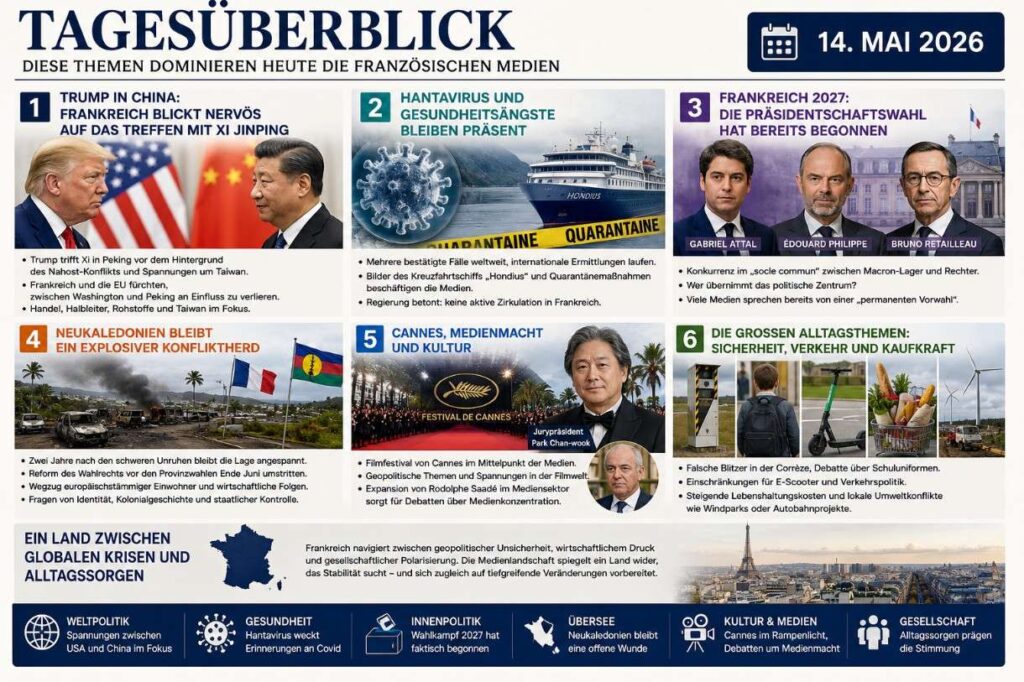
France begins this May 14 with an exceptionally busy news day, spanning international politics, domestic reshuffling, and social unrest. While international attention focuses on relations between the United States and China, debates on security, health, and political stability within the country are intensifying simultaneously. The French media landscape thus portrays a Republic in transition – externally under pressure, internally already in election campaign mode.
Trump and Xi: Paris fears a new world order without Europe
The main international theme remains the meeting between Donald Trump and Xi Jinping in Beijing. French media mainly analyze the strategic significance of the talks in light of tensions in the Middle East, the Taiwan issue, and global trade conflicts.
In Paris, the fear is growing that Europe will increasingly become a spectator of a geopolitical reorganization negotiated between Washington and Beijing. Commentators emphasize that France’s influence on key issues such as semiconductor production, securing raw materials, or the security architecture will remain limited as long as the European Union does not act in a more externally coherent manner.
French media are closely monitoring any signs of economic easing between the United States and China. Because a stabilization of relations could indeed calm the markets in the short term, but at the same time would weaken the strategic importance of Europe.
Hantavirus: the memory of Covid remains politically effective
The topic of hantavirus continues to attract great attention. Although French authorities emphasize that there is currently no acute danger for France, media presence remains strong. International quarantine measures and reports of possible chains of transmission once again fuel this uncertainty deeply ingrained in social consciousness since the Covid pandemic.
The government is clearly trying to calm fears. President Emmanuel Macron and several health officials avoid alarmist tones and highlight the responsiveness of French health authorities. Nevertheless, the coverage shows how sensitive European societies now react to potential health risks.
Moreover, it is not only about medicine. The issue touches on fundamental questions of state credibility, crisis preparedness, and international mobility. French commentators emphasize that the mere media dynamics related to a health alert can already trigger significant economic and political consequences.
France 2027: the campaign is practically already underway
Domestically, attention is increasingly shifting towards the 2027 presidential election. Although the vote is still formally distant, the main players are already in a permanent phase of positioning.
Currently at the center of discussions are Gabriel Attal, Édouard Philippe, and the Interior Minister Bruno Retailleau. The three represent different variations of a political center which, after the Macron era, is still searching for itself.
Gabriel Attal tries to present himself as a modernized continuation of Macronism. Édouard Philippe relies more on the distance of a head of state and credibility in economic policy. Retailleau, for his part, is rising in profile especially within the conservative camp by aggressively addressing issues of security and migration.
The major French media increasingly debate the structural weakness of the “common ground” – this political bloc between the liberal center and the moderate right. Many analysts now doubt that this coalition is sufficiently solid in the long term to sustainably stand up to the National Rally.
New Caledonia remains an open wound of the Republic
The situation in New Caledonia remains tense. Two years after the violent riots, the French media are once again taking an in-depth look at the political and social consequences of the conflict.
The debate on voting rights reform ahead of the upcoming provincial elections is particularly sensitive. Critics see it as an attack on the fragile balance between the different communities in the Pacific territory. At the same time, several media report on the increasing departure of residents of European origin as well as on economic disorders since the riots.
The discussion raises fundamental questions about the integration capacity of the French Republic: how far does it extend? What role does France’s colonial heritage play in the 21st century? And what stability is there for the French presence in the Indo-Pacific region?
Paris is still trying to keep the situation under control through political negotiations and security measures. But many observers see the conflict as a symptom of a deeper crisis in French overseas policy.
Cannes between glamour and political reality
The Cannes Festival also remains a central media theme. As every year, the festival serves not only as a cultural event but also as a platform for societal and geopolitical debates.
Special attention is given to jury president Park Chan-wook, whose public statements on the role of cinema in times of geopolitical crisis are widely discussed. At the same time, many comments focus on the economic transformations of the international film industry, notably the influence of major streaming platforms and the growing concentration in the media sector.
In this context, businessman Rodolphe Saadé also draws increased attention. His growing presence in the French media market sparks debates about journalistic independence and the concentration of media power. France is thus experiencing a phenomenon that concerns many European democracies: the increasing link between economic power, political influence, and media control.
Everyday concerns still dominate the regions
Besides major geopolitical and political issues, classic daily concerns remain strongly present. Regional media report in detail on the rising cost of living, transportation policies, environmental conflicts, and security issues.
More specifically discussed are stricter regulations for electric scooters, local conflicts around wind turbine projects, as well as debates on school uniforms and juvenile violence. It is precisely these regional issues that show that many French people perceive political uncertainty less through international crises and more through concrete changes in their daily lives.
The combination of geopolitical nervousness, economic pressure, and social polarization is currently shaping public mood in France. The country appears to be a society seeking stability while preparing for profound political transformations.