
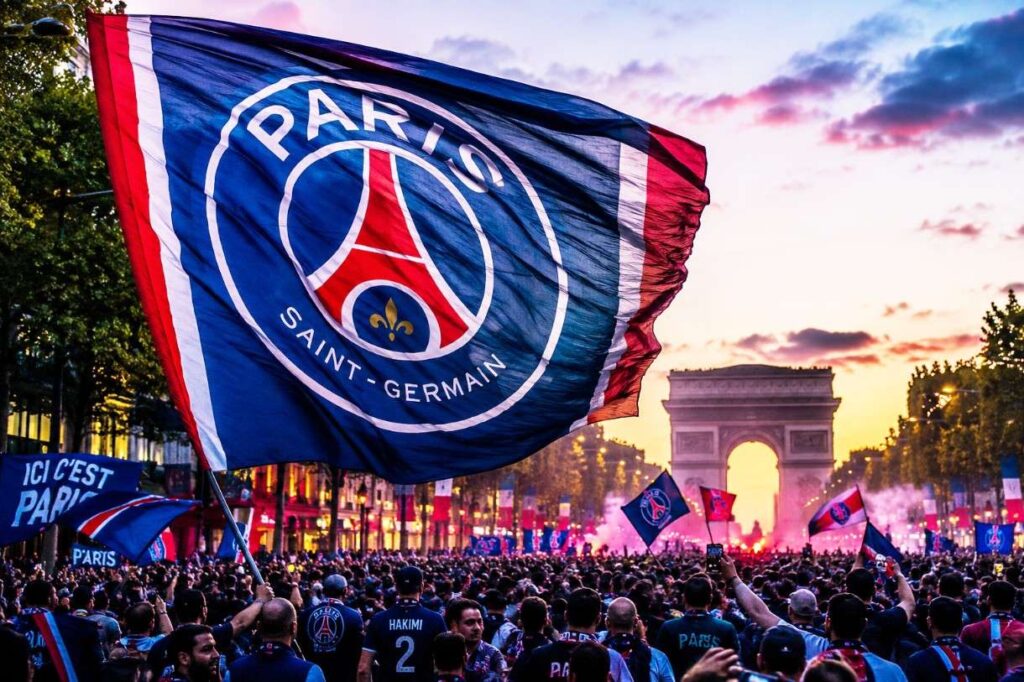
Three days before the Champions League final between Paris Saint-Germain and Arsenal F.C., a nervousness that is almost tangible hangs over Paris. At first glance, the capital seems as usual – tourists stroll past cafés, taxis honk their way through the evening rush hour, an accordion tinkles somewhere. But behind the scenes, a state of emergency is already underway.
Especially around the Champs-Élysées, police and authorities are preparing for a weekend that could spiral out of control.
The memories of last year’s riots run deep. Back then, after PSG’s European triumph, parts of the city transformed into a battlefield within hours. Burning cars, looted shops, and street battles with police marked the night. Many Parisians still recount it with a weary shrug – as if it had by now almost become a fixed ritual of major football nights. This is exactly what worries the authorities.
The mayor of the 8th arrondissement is now calling for a massive security presence. Several thousand police officers and gendarmes are on standby, access roads are to be closed off, and metro stations may be shut down temporarily. Above all, the famous avenue should not become a symbol of loss of control again this time.
A victory parade on the Champs-Élysées? Out of the question.
The decision was apparently made early, together with the police prefecture. Behind closed doors, security circles admit that such a crowd is now hardly manageable anymore. Not only because of fanatical ultras. The real problem has long been groups that have nothing to do with football. They show up as soon as chaos breaks out – young looters, aggressive small groups, people looking for trouble. “Some are now just about rioting,” one hears quite often in Paris these days.
Interior Minister Laurent Nuñez openly speaks of an “extraordinary” security concept. French politicians usually do not use such wording lightly. But for years, France has had a strained relationship with large events in public spaces. Football matches, demonstrations, spontaneous celebrations – the atmosphere repeatedly turns more volatile faster than law enforcement can react.
Particularly tricky: parallel to the final, hundreds of thousands of visitors flock to the capital anyway. The French Open is underway, concerts attract crowds, and there is the usual spring tourism. On such weekends, Paris resembles an overcrowded pressure cooker, with no one exactly knowing when the lid will blow off.
Therefore, authorities are apparently now considering alternatives. Discussions include a possible celebration near the Eiffel Tower to relieve pressure on the Champs-Élysées. Nothing has been officially confirmed so far. But the very consideration shows how great the concern about new escalations is.
And it is no longer just about football.
France has been grappling for years with the question of how to organize public celebrations safely without sealing off entire neighborhoods. Sport often only serves as a trigger for deeper tensions – social frustration, readiness for violence, and growing mistrust of state authority. Some police officers now openly say they have to prepare for urban guerrilla tactics on such nights. A harsh term. But one that shows how seriously the situation is assessed.
And so Paris now looks at this final like a weather front full of dark clouds. Should PSG indeed win Europe’s crown, the euphoria will likely be enormous. But the real test will only begin after the final whistle.