
Paris has that rare talent of extracting emotions even from stone.
Now it happens again — right at the Pont Neuf.
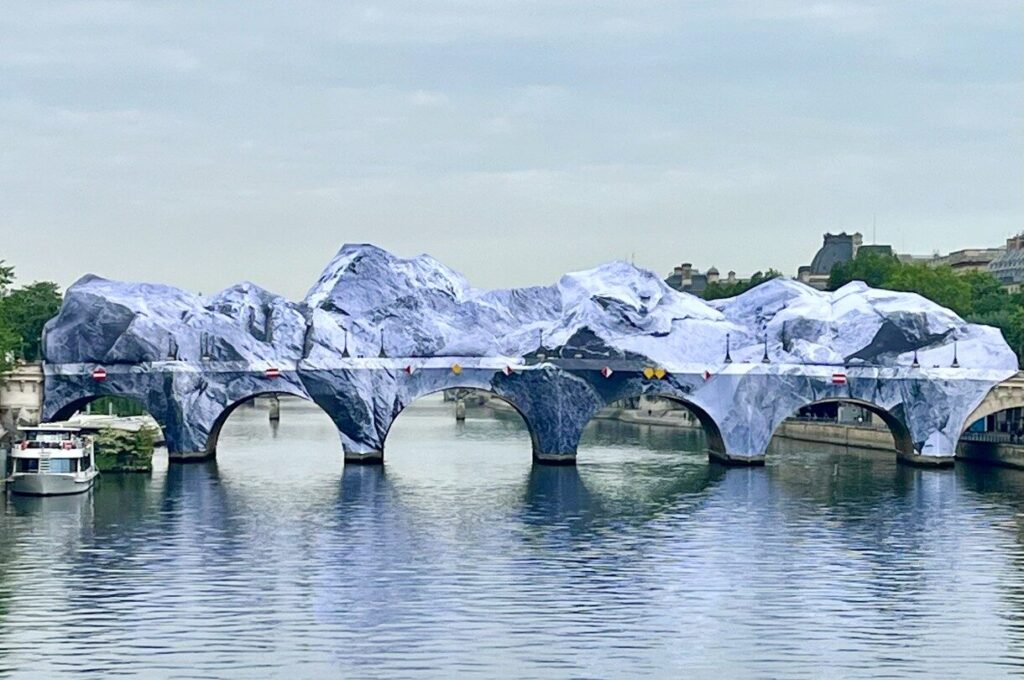
The oldest bridge still preserved in the French capital suddenly seems open, displaced, almost alive. The urban artist JR has covered this historic work with monumental illusions. The printed surfaces mimic cracked stone, simulate cracks, abysses, and open structures. Anyone standing in front of it doubts their own eyes for a moment. That is where the charm of this installation lies.
The name “Pont Neuf” carries with it an almost comical historic irony. The “New Bridge” is now for many the oldest bridge in Paris. It stretches across the Seine for centuries and now serves again as a symbol of renewal. A bit crazy — but typical of Paris.
The images of the transformation have been circulating in French media and social networks for days. Tourists stop, take out their smartphones, record videos, marvel. Some discuss artistic theory, others simply say: “It looks amazing.” And, to be honest, sometimes that is enough.
JR consciously connects with an event deeply anchored in French cultural memory: the spectacular wrapping of the Pont Neuf by Christo and Jeanne-Claude in 1985. Back then the bridge disappeared under large fabrics, becoming for a few days a giant artistic object. Today JR takes a different path. He does not cover it — he visually decomposes it. His art works with illusions, fragments, and photographic power.
The result has a surprising effect.
Because this installation does not appear at a carefree moment. France has been experiencing for months a mixture of political irritation, economic uncertainty, and social exhaustion. After an Olympic Games surrounded by debates about security and an atmosphere of constant crisis, Paris is visibly seeking images that convey optimism.
It is precisely here that the project unfolds its true power.
The bridge suddenly recalls what has defined Paris for centuries: the ability to transform public space into a cultural stage. In many cities, infrastructure simply serves traffic. In Paris, it becomes a national event. A bridge is not just crossed — it tells a story.
Perhaps that also explains the enormous impact.
The installation simultaneously works as a magnet for tourists, an Instagram phenomenon, a historic appointment, and a patriotic cultural staging. It reaches people who otherwise would never enter a museum. JR masters exactly this form of monumental democratic art. His works seem monumental but remain accessible. No one needs art history knowledge to understand the effect.
And suddenly all of Paris is talking about art again instead of only about crisis.
That alone almost has a political dimension.
For a brief moment, the French capital once again seems like that cultural laboratory of Europe that sets trends, provokes debates, and places beauty in the middle of daily life. Not polished, not sterile — rather playful, bold, and a bit megalomaniac.
So, typical Paris.
By C. Hatty