
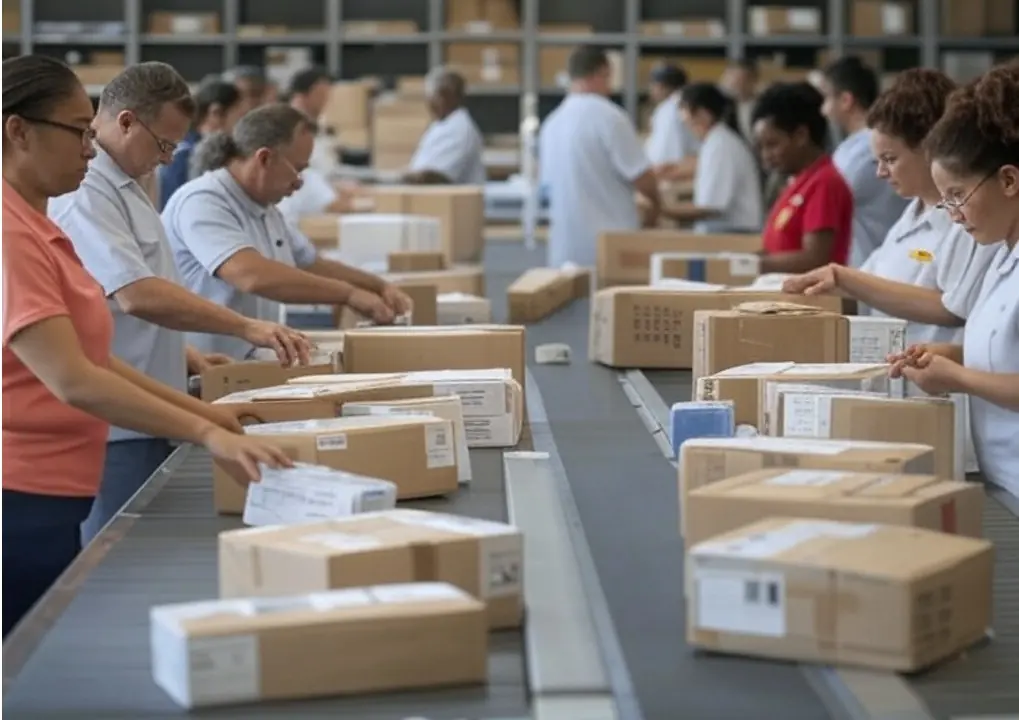
The French government intended to send a warning to ultra-cheap imports from Asia with a new tax on small consignments arriving from non-EU countries. But just weeks after the measure took effect, unexpected side effects emerged. It is not the large e-commerce platforms that are under pressure but a French freight hub itself. Paris–Vatry airport in the Marne department has seen business volumes fall sharply and is now demanding a policy reversal from Paris.
From 1 March 2026, France is imposing a €2 tax per item category on certain small consignments arriving from non-European Union countries. The main targets are low-priced goods entering Europe in large volumes via platforms such as Shein or Temu. The measure was part of a political strategy to address the environmental and social impacts of ultra-fast fashion and distortions of competition in European trade.
However, this type of unilateral national measure has now revealed the limits of acting alone on economic policy within the European single market.
Sharp drop in Vatry’s freight business
According to the airport, air cargo volumes fell by about 65% in less than 10 weeks. At the same time, 17 redundancies have already been announced. For Paris–Vatry, a regional freight hub that relies heavily on international logistics flows, this is a major blow.
The cause lies less in a drop in demand and more in the global supply chain’s ability to adapt. International traders and logistics companies quickly changed routes. Instead of air-shipping goods directly to France, imports via other European hubs such as Belgium and the Netherlands followed by truck transport to the French market are becoming more common.
Economically, this mechanism is understandable. Within the European single market, goods can circulate almost freely once they have been imported into the EU. If France’s special tax applies only to direct imports into France, there is a strong incentive to circumvent it through neighboring countries.
As a result, France loses not only the expected tax revenue but also logistics value added, jobs, and customs activity.
The Political Symbolism of the Tax
This small parcel tax was originally designed to respond to the explosive growth of low-cost Asian platforms. In particular Shein and Temu have been the subject of criticism for months. The reasons include extremely short production cycles, high return rates, questionable environmental standards, and distortion of competition for European merchants.
The French government argued that the existing tariff system effectively facilitated mass imports of low-value small parcels. While millions of low-unit-price packages are processed daily through almost automated procedures, suppliers within Europe face stricter regulations.
The new tax aimed to achieve several objectives at once:
- in particular to curb cheap imports,
- enhanced control over cross-border e-commerce,
- to finance additional customs and enforcement capacity,
- a political demonstration of environmental regulatory clout.
France has for years taken a stance of wanting to lead strict regulation of the digital platform economy. President Emmanuel Macron has often tried to use national initiatives as a stimulus for later EU rules.
However, the parcel tax case shows the structural weaknesses of this approach. As long as there is no integrated Europe-wide system, trade flows can be relatively easily circumvented.
The Single Market as a Space for Avoidance
The Paris-Vatry case illustrates a typical problem of European economic policy. When companies can use alternative bases within the EU, national regulations quickly reach their limits.
In particular, the Benelux countries have traditionally benefited from their role as European logistics hubs. Airports such as Liège, Amsterdam-Schiphol, and Brussels have highly developed cargo infrastructure and flexible customs systems. Even small cost differences can already cause significant relocation.
This creates a double problem for France:
On the other hand, most imported goods are still likely to remain in the French market and be consumed there. On the other hand, France itself will lose import tax revenue and employment effects across the supply chain.
The environmental benefits of the measure also appear limited. If goods do not arrive directly and instead take additional transport routes within Europe, CO₂ emissions may actually increase.
Preparing a European-level solution
The French government therefore points to a European-level system scheduled to take effect on 1 July 2026. At EU level, an integrated mechanism is currently being developed to more strongly charge and control small consignments coming from third countries.
The background is the reality that low-priced direct imports from China are surging. According to estimates by the European Commission, millions of low-priced parcels currently enter the EU every day. Existing customs and value-added tax systems are considered saturated in many places.
Brussels is discussing measures including the following:
- introduction of a uniform European import levy,
- strict product liability rules,
- digital pre-registration system,
- expanded customs checks,
- new transparency obligations for platforms.
An EU-level approach has the advantage of reducing distortions of competition between member states. This is precisely the point Vatry’s critics are making now.
As long as France acts alone, the economic adjustment costs remain domestic while trade flows respond flexibly at the European level.
The debate reaches parliament
This issue has now reached the political stage. A written question has already been submitted to the Assemblée nationale asking whether France can additionally tax in the future alongside a Europe-wide uniform tariff.
This gives rise to a sensitive problem: the risk of double taxation.
If France maintains its national tax while EU-level regulation comes into force, importers could face cumulative taxation. This could increase pressure on French hubs and trigger further avoidance movements.
There are also growing concerns within French industry that a national symbolic policy pursued without European-level coordination could ultimately inflict greater harm on domestic companies.
Therefore the government faces a political dilemma. Withdrawing the measure could be interpreted as a defeat in the fight against ultra-fast fashion. Conversely, insisting on the regulation could jeopardize jobs and the competitiveness of France’s logistics hubs.
The Paris-Vatry case symbolically shows how difficult economic governance in the European Single Market has become. As capital, goods, and logistics flows can flexibly bypass borders within Europe, national regulations have only limited effect. This is especially true in the field of digital trade, where companies respond to new cost structures almost in real time.
France tried to send a signal with a package tax. Instead, within just a few weeks a practical test case was created at the boundary of national industrial and trade policy. The coming months will determine whether Paris sticks to its policy course or whether the reality of integrated European supply chains overwhelms national regulatory will.
Author: P. Tiko