
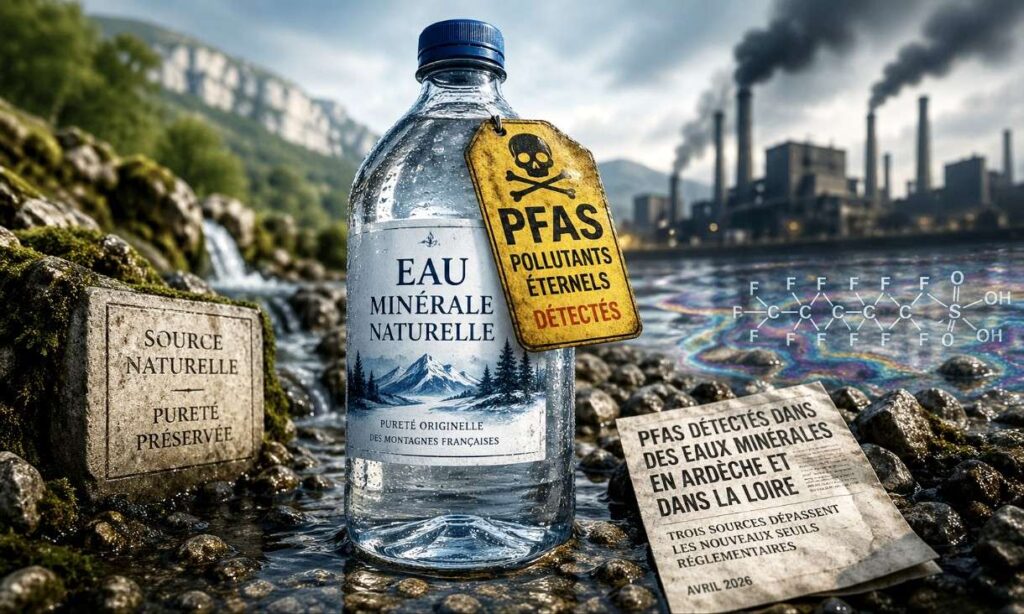
You want to laugh if it did not taste so bitter. There they stand now, the bottles with the promise of purity, authenticity, untouched nature — and containing the opposite: the chemical chronicle of decades of irresponsibility. PFAS in the mineral water. Of all places, where one thought one could still escape the world.
This is one of those pieces of news that are so logical they almost become surprising again. Of course the “forever chemicals” are also in the water we call “natural.” Where else should they be, if not everywhere? Anyone who produces substances for decades that are practically indestructible should not be surprised if one day they appear even in the last refuge — in the glass you set in front of your children.
And now? Now the big ritual begins. Authorities express “concern.” Companies express “surprise.” Politicians express “determination.” One knows this choreography. It belongs to the standard repertoire of modern crisis management like handwashing belongs to hygiene — except here nothing gets clean anymore.
The corporation Sources Alma will assure that it of course complies with all regulations. That is probably true. The problem is only: the regulations have about as much to do with reality as an umbrella has to do with a forest fire. They come too late, they are too small, and they pretend this is all an operational accident — and not the logical result of a system.
Because this system has done for decades exactly what it does best: externalize. Profits here, risks there. Production here, pollution everywhere. And when the pollution finally becomes visible, it is called a “challenge” – a word that sounds as if it could be solved with a workshop.
The World Health Organization has been warning for years about the potential health effects of PFAS. The European Chemicals Agency has been debating stricter rules for years. And politics? It does regulate, yes – but like sealing a leaking boat with patches: carefully, bureaucratically, and completely inadequate.
One could say: at least something is happening. Limits are being lowered, sources closed, controls increased. But that is the wrong perspective. Because these measures are not the start of a solution, but the admission of decades of failure. They are the late reactions to a development that could have been prevented – if there had been the will.
Will we learn from this? This question is asked reflexively, like a rhetorical duty. The honest answer is: probably not enough.
Because learning would mean changing the principle. No longer acting only when the damage is measurable, but before it occurs. Learning would mean not putting substances like PFAS into circulation in the first place if their long-term effects cannot be controlled. Learning would mean not systematically placing economic interests above health risks.
But that would be inconvenient. It would create conflicts, cause costs, call business models into question. And so instead people will continue to optimize, tweak, define limit values – and pretend that a structural problem can be solved with technical fine-tuning.
Perhaps the real problem is not chemistry at all. Perhaps it is the political culture that has grown accustomed to managing hazards instead of preventing them. That has learned to communicate risks instead of avoiding them. That soothes where it should alarm.
Mineral water was once a symbol. Of purity, of nature, of something unadulterated in a complicated world. That symbol is now damaged. Not irreparably – but enough that one looks more closely before taking the next sip.
And perhaps that is precisely the bitter irony of this story: that we only begin to doubt when even the supposedly pure is no longer pure. That we only react when the problem has arrived in our own glass.
Will we learn from it? People will say so. People will promise it. People will decide it.
And then one will – very likely – carry on as before. Just with somewhat stricter limits.
A commentary by Andreas M. Brucker