
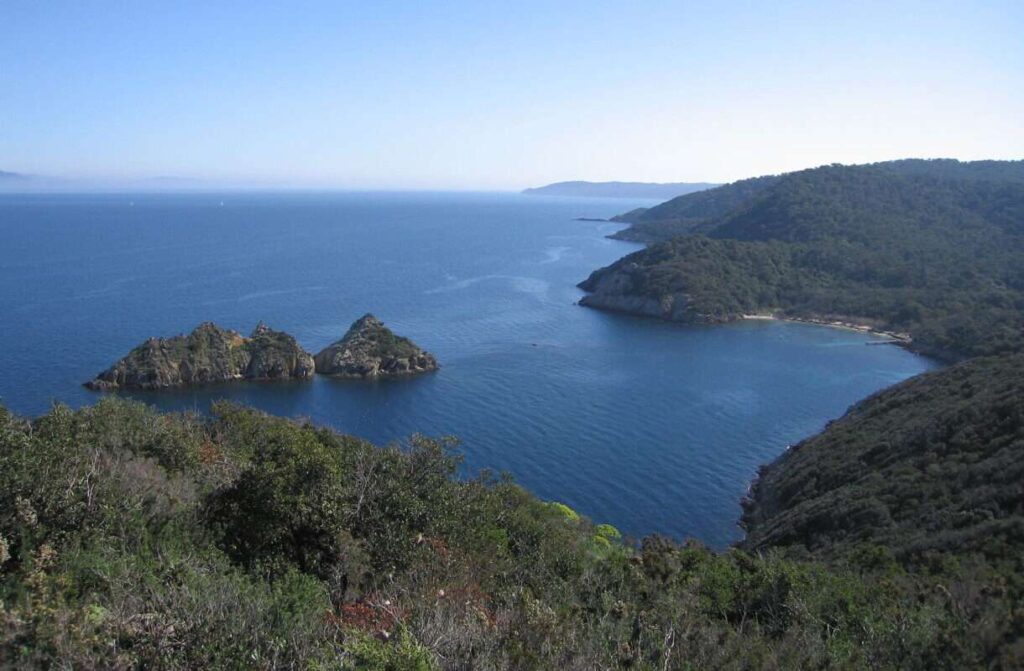
Port-Cros. It sounds like a seaside resort, but it is much more than that: a shield for the Mediterranean. Amid growing environmental problems and global biodiversity losses, this French national park shows how nature protection can be not only effective, but also community-based.
Since 1963, Port-Cros has been officially a national park – the first in Europe with a marine focus. But what makes it so special?
A treasure of sea and land
The national park covers 1,700 hectares of land and nearly 3,000 hectares at sea. The setting: rocky islands, turquoise water, quiet coves. But the real miracle takes place beneath the water’s surface.
A central element of the protection concept is the so-called “no-take reserves.” Here, it’s simple: no fishing, no diving, no water sports – absolute peace for nature. And behold: species that disappear elsewhere return here in great numbers. An emblematic example? The grouper. At Port-Cros, it swims like a king in its reefs.
Together rather than against each other
What makes Port-Cros so different: the locals were involved from the start. Fishermen, diving schools, hoteliers, and municipalities participate in creating the rules – a true collaboration.
This integration is bearing fruit. There are clearly regulated zones where traditional and sustainable fishing is allowed. And important work is also being done in the field of education – environmental education in schools, information sessions for visitors, collaborations with local organizations. Thus, nature conservation becomes a matter of the heart.
You can feel it: here, no one simply decided “from above.” On the contrary, people discussed, debated, laughed – until everyone pulled in the same direction.
Tourism: curse or blessing?
Of course, many come to discover the beauty of this archipelago. Especially in summer, the ferries and beaches are crowded. That’s good for business, but critical for the ecosystem.
That’s why visitor flows are directed in a targeted way. For example, with an underwater trail in La Palud Bay. With mask and snorkel, visitors discover the underwater world – accompanied by information panels. Anyone who has come face to face with a sea cucumber thinks twice before throwing waste into the sea.
But obviously: it remains a challenge to find the balance between nature conservation and tourism. The park management knows this – and continues to act.
Much more than just a French park
Port-Cros is no longer a local project. The park is part of the MedPAN network – an alliance of marine protected areas in the Mediterranean. Knowledge is shared, experiences exchanged, strategies developed.
Moreover, Port-Cros plays a leading role in the PELAGOS agreement – a trilateral protected area for marine mammals between France, Italy, and Monaco. Dolphins and whales must be able to cross the Mediterranean in peace.
All of this shows: Port-Cros is not just a place – it is a model. An example of how protection, science, and community can work together.
A park as a teaching master
The great success of Port-Cros is not due to a single trick. It is the interaction – between clear rules, lived collaboration, scientific support, and a good dose of passion.
Especially in times when headlines speak of dying reefs and waves of plastic, Port-Cros sends an encouraging signal: there is another way. There is hope. And yes – it is possible not only to preserve biodiversity but also to give it space again.
Perhaps it is time to remember places like Port-Cros more often. Places where nature is not conserved like in a museum, but can remain alive. Where humans and nature are not adversaries, but partners.
Because in the end, one question remains: if it works here – why not elsewhere?
By Andreas M. Brucker