
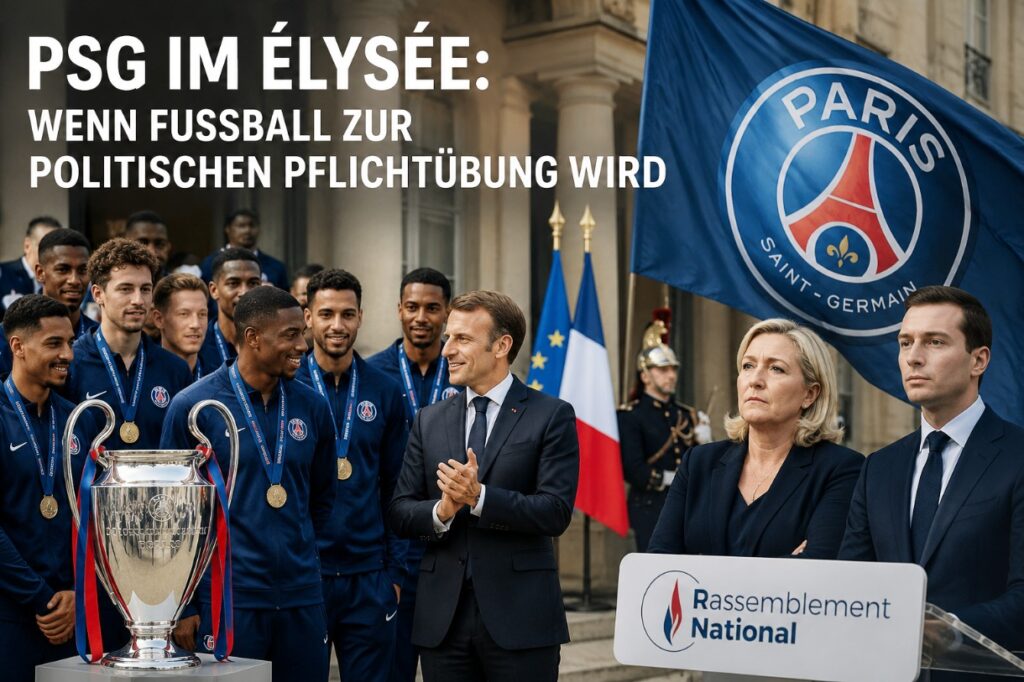
The Élysée Palace welcome event for Paris Saint-Germain confirms a trend that has been ongoing for years: football is more than just a sport in France. After the Paris club won their second Champions League title, President Emmanuel Macron welcomed the team again at the presidential palace, just as he did after their first European victory. Such gestures are no longer mere courtesy today. They reflect the special role football plays in French political life.
It has become nearly impossible for politicians to distance themselves from football. The sport continuously provides something politicians seek: an image of unity, collective emotion, and a straightforward national narrative. Millions of people watch the same match, experience the same moments of joy and frustration, and share the same symbols. Such a social phenomenon is rarely found elsewhere.
President Emmanuel Macron recognized this dynamic early on. Although traditionally known as a supporter of Olympique Marseille, he is well aware of the political impact of PSG’s European success. A French club at the pinnacle of European football allows the president to emphasize national recognition and pride without immediately risking accusations of partisan theatrics. The club’s success symbolizes France’s success.
At the same time, political circles that have grown close to football have come to see this as an obligation. Political leaders are expected to join important sporting moments, congratulate winning teams, and publicly endorse success. Refusing to do so risks being perceived as arrogant or emotionally cold. Football has thus become a fixed component of political communication.
However, the popularity of the sport also carries risks. Big victories are often overshadowed by riots, property damage, and clashes. Political leadership faces the balancing act of respecting the celebrations while ensuring order and security. Even after PSG’s recent victory, President Macron clearly condemned acts of violence surrounding the celebrations alongside his message of congratulations.
On the other end of the political spectrum, the National Rally (Rassemblement National) takes a different approach. Marine Le Pen and Jordan Bardella focus mainly on the negative side effects arising from large-scale celebrations rather than the sporting enthusiasm. For them, what matters is not the scene of success but the images of chaos, destruction, and security issues. This stance perfectly aligns with the party’s strategy of placing social order and internal security at the core of its policy message.
Here, fundamental differences between political camps become apparent. The ruling party and centrist forces seek to harness football’s unifying power for their benefit. They present the sport as an expression of national community and social cohesion. In contrast, the National Rally concentrates more on the darker aspects of these major events, appealing to citizens who directly experience public disturbances.
Thus, football has become a political stage where different narratives compete. For President Macron, football is a symbol of national unity and international standing. For the National Rally, the same event serves as evidence of lacking security and public order. Both interpretations are based on the same event but lead to completely different political messages.
This is exactly the political significance of modern football. Football offers more than mere entertainment; it provides a projection space for social debates about identity, cohesion, security, and national representation. The ball no longer just rolls on the grass. Football has entered the French political stage as an essential element in the public performance of power, community, and conflict.
Author: P. Tiko