
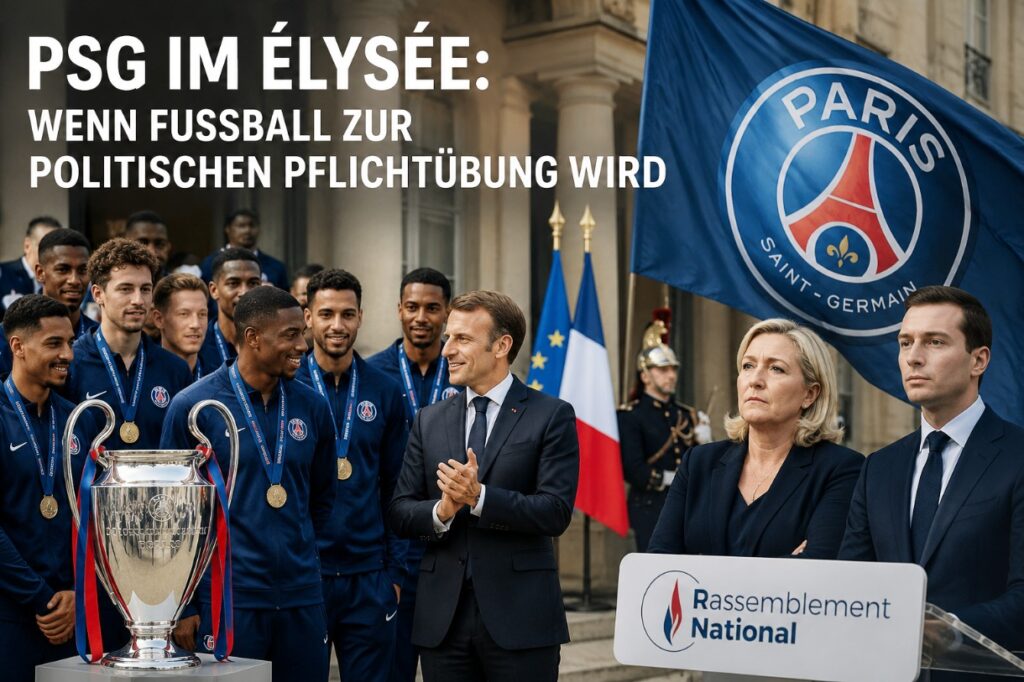
The Paris Saint-Germain reception at the Élysée Palace confirms a trend noticeable for years: football in France is much more than just a sport. After the Parisian club’s second triumph in the Champions League, President Emmanuel Macron once again welcomed the team to the presidential palace – just as he did after their first European title. Such gestures are no longer mere politeness today. They reflect the special role football has come to play in French political life.
For politicians, it is now almost impossible to distance themselves from football. The sport offers what politics constantly seeks: images of unity, collective emotions, and an easily understandable national narrative. Millions of people follow the same matches, experience the same moments of euphoria or disappointment, and share the same symbols. Few other social phenomena have such a broad impact.
Emmanuel Macron seized on this dynamic from the start. Although he traditionally presents himself as a supporter of Olympique de Marseille, he understands the political power of a European success by PSG. A French club at the top of European football allows the president of the republic to evoke national recognition and pride without immediately being suspected of partisan exploitation. The club’s success is thus stylized as a success of France.
At the same time, this proximity to football has become a necessity for politics. Senior officials are expected to accompany major sporting events, congratulate victorious teams, and publicly identify with the successes. Those who refuse this risk being perceived as distant or insensitive. Football has thus become an essential component of political communication.
However, the popularity of the sport also carries risks. Major victories are regularly overshadowed by riots, damage, or clashes. Political leadership is therefore faced with a balancing act: enthusiasm must be encouraged while ensuring order and security. After PSG’s latest triumph, Macron linked his congratulations with a clear condemnation of the violence that occurred around the celebrations.
On the other side of the political spectrum, the National Rally adopts a different approach. Marine Le Pen and Jordan Bardella focus less on the sporting euphoria and more on the negative effects of mass celebrations. For them, it is not the images of success that prevail, but those of chaos, destruction, and security issues. This position fits perfectly within the party’s political strategy, which places social order and internal security at the heart of its messages.
This shows a fundamental difference between political camps. The ruling parties and centrist forces seek to use the integrative power of football. They present the sport as an expression of national community and social cohesion. The National Rally, on the other hand, places more emphasis on the negative aspects of these major events and thus reaches citizens directly affected by public disturbances.
Football has thus become a political stage where different narratives clash. For Macron, it symbolizes national unity and international influence. For the RN, the same occasion serves as proof of shortcomings in security and public order. Both interpretations start from the same events but result in completely different political messages.
This is precisely where the political importance of modern football lies. It offers not only entertainment but also a projection surface for social debates on identity, cohesion, security, and national representation. The ball no longer just rolls on the pitch. It moves through the French political arena and has become an indispensable component of the public staging of power, community, and conflict.
Author: P. Tiko