
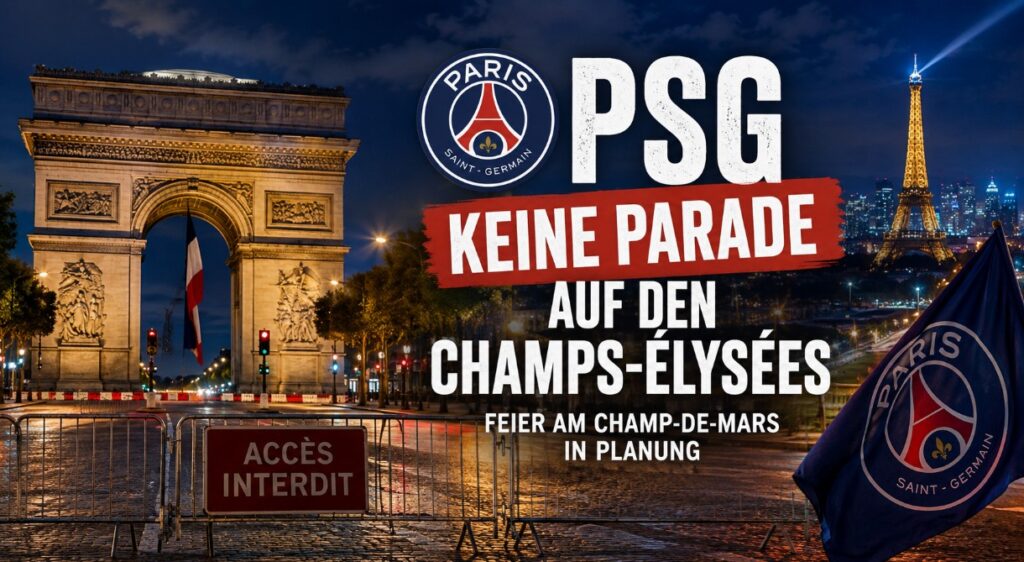
Paris loves its football nights. When the Paris Saint-Germain Football Club reaches a European final, the city vibrates like it’s under an electric shock. The cafés fill up until late at night, car horn parades invade the boulevards, at every street corner people discuss, curse, hope. Ahead of the UEFA Champions League final against Arsenal F.C., the gaze of the French capital once again rests on a possible historic evening. But one thing is already certain before kickoff: this time there will be no triumphant parade on the Champs-Élysées.
The decision seems like a small political signal amid the football fever.
Whereas after winning the European title in 2025 the images of celebrating crowds had gone around the world, the city administration and the police prefecture are now visibly applying the handbrake. The most famous avenue in France will not remain deserted in case of PSG’s success, but an official team parade is excluded. Instead, the authorities are preparing strict security measures. From Saturday afternoon, parking bans around the Champs-Élysées will be in effect, followed by road closures and traffic restrictions until the early hours of Sunday morning.
It sounds sober. Almost technocratic.
And that is exactly the message.
Paris wants to celebrate – but in an orderly way.
The memory of past football nights is deep. Not all spontaneous celebrations ended peacefully; some developed a dynamic that challenged even the most experienced law enforcement. Broken bus shelters, looted shops, garbage bins set on fire – these scenes have now shaped the political view on security at major events in France. Football generates emotions, sometimes even chaos. The Champs-Élysées in particular are considered a nerve center: symbolic, overcrowded with tourists, and difficult to control.
For this reason, those responsible are apparently considering an alternative celebration at the Champ-de-Mars, right at the foot of the Eiffel Tower. There, access could be regulated more easily, security zones more clearly delineated. It would almost seem like a festival rather than a spontaneous popular party. Some fans will wrinkle their noses, others will simply say: better this way.
Because the enthusiasm for PSG remains enormous.
For years the club has sought to firmly establish itself in the European elite. National titles have become almost routine, but the Champions League has an almost mythical character in Paris. Each final represents the weight of a historic mission. Now in front of Arsenal stands an opponent who is also aiming for European greatness – historic, tough, and tactically dangerous.
In the bars of Belleville, Saint-Germain or Montmartre, there is no other topic of conversation anymore. “If they win, the city will go completely crazy,” says laughingly the owner of a café near Place de la République. Then he becomes serious: “But maybe Paris really needs a bit more order this time.”
It is exactly between these two poles that the capital is moving at this moment: passion and control, football euphoria and thoughts about security.
The refusal of a parade on the Champs-Élysées therefore marks much more than a simple organizational decision. It shows how today major sporting events are increasingly under the sign of political and security concerns. Even joy now follows a protocol.
And yet – if PSG lifts the cup again, Paris will probably hardly sleep at all that night.