
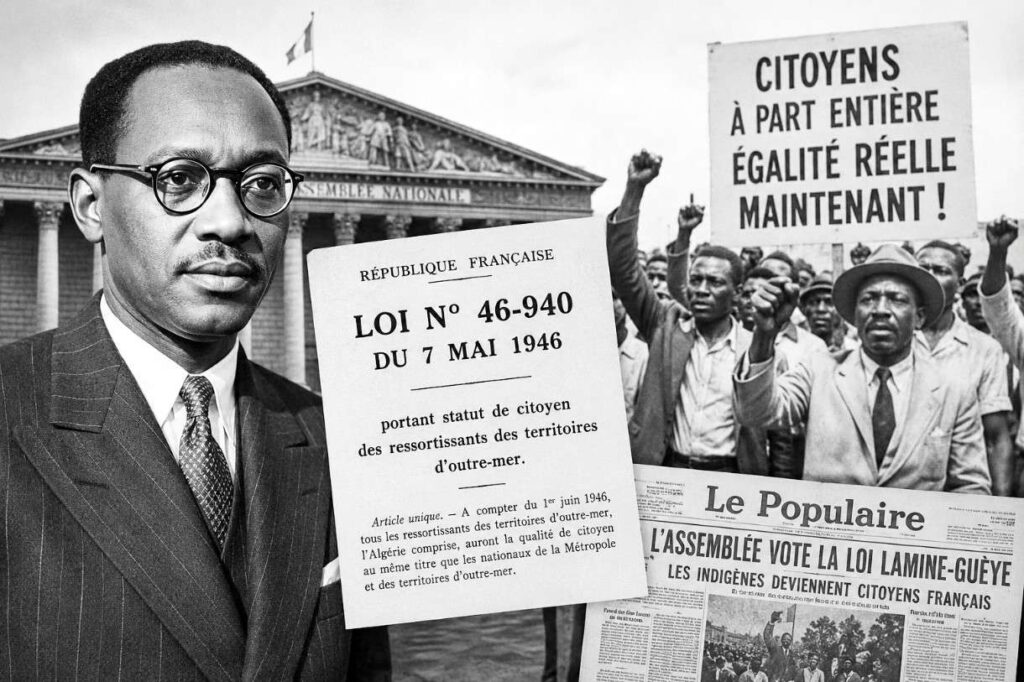
How the 1946 Lamine-Guèye Law exposed the contradictions of the French Empire
On 7 May 1946, the French National Assembly passed a law of remarkable brevity – and enormous historical significance. It consisted of a single article. Yet this one sentence profoundly altered the legal architecture of the French colonial empire: from then on, all inhabitants of the French overseas territories, including Algeria, would hold the status of French citizens – formally equal to the inhabitants of metropolitan France.
The so-called Lamine-Guèye Law emerged during a period of profound political realignment. France was marked by the Second World War, the Vichy regime discredited, and the republican ideal morally compromised. At the same time, the war had shaken the colonial order. Hundreds of thousands of soldiers from Africa, North Africa and Indochina had fought for France. Many colonial elites now demanded that the Republic finally take its universalist principles seriously outside Europe as well.
The law was named after the Senegalese politician Amadou Lamine-Guèye, then Socialist deputy for Senegal-Mauritania and mayor of Dakar. His initiative was more than a legal reform. It was an attack on the central hierarchy of the French colonial system: the distinction between “citoyens” and “sujets”, between citizens and subjects.
The end of the “indigénat”
Since the 19th century, the French Empire had been based on a dual legal system. A small part of the colonized population could obtain French citizenship under certain conditions. The vast majority, however, remained subject to the so-called “Code de l’indigénat”: a special legal system with limited political rights, administrative punitive measures, and institutionalized inequality.
For the first time, the Lamine-Guèye law officially abolished this symbolically humiliating separation. From then on, the inhabitants of the overseas territories were no longer merely “subjects” of the Republic, but citizens of France.
In the republican self-image, this was a historic step. France liked to portray itself as a universalist nation whose values were defined not ethnically or culturally, but politically: liberty, equality, citizenship. The law of 1946 now appeared to extend this idea to the colonial empire as well.
But this was precisely where the ambivalence of the reform lay.
Civil rights without political equality
The new citizenship did not at all mean immediate political equality. The real question of power remained deliberately open.
In many colonies, the system of separate electoral colleges continued to exist. European settlers and French citizens from the mainland had much greater political weight than the indigenous population. This was particularly evident in Algeria: there, two electoral bodies represented almost equally population groups of completely different sizes. Millions of Muslim Algerians remained effectively politically marginalized.
Added to this was the issue of “statut personnel.” Many inhabitants of the colonies retained their own family and civil status law, for example Islamic or customary law. The French Republic thus accepted a paradoxical arrangement: one could be a French citizen without being fully integrated into the French legal system.
The result was a graded citizenship: universalistic in principle, hierarchical in practice.
The limits of assimilation
Since the nineteenth century, French colonial policy oscillated between two guiding ideas: assimilation and association. Assimilation theoretically promised that colonized populations could become fully French through education, language, and legal adaptation. Association, by contrast, accepted cultural differences and thus permanently legitimized unequal political rights.
After 1945, France initially seemed to be moving once again toward assimilation. The terms “colony” and “empire” increasingly disappeared from official language. The Ministry of Colonies was renamed the “Ministry of Overseas France.” At the same time, the National Assembly adopted further reforms, including the abolition of forced labor in African possessions.
However, Paris’s political elites were not prepared to accept the logical consequences of genuine equality. Indeed, a fully democratized Union would have meant that the peoples of Africa and Asia would gain considerable influence over the politics of the French Republic. Republican universalism found its limit where it would actually have changed the balance of power.
The Lamine-Guèye Law made this tension visible as almost no other postwar law did.
The Beginning of the End of the Empire
From a historical perspective, the law was less the salvation of the French colonial empire than a sign of its impending crisis. Indeed, with the official recognition of colonized peoples as citizens, colonial rule became more difficult to legitimize politically.
If Africans, Algerians, or the inhabitants of Madagascar were French citizens, why should they not have had the same political rights as the inhabitants of Marseille or Lyon? Why should they have continued to be administered by governors instead of being democratically represented? Why should an empire that promised equality but organized inequality have persisted?
In the years that followed, these questions became more radical. Nationalist movements gained strength, especially in North Africa and Indochina. The war in Algeria from 1954 onwards ultimately showed brutally that the republican ideal and colonial reality were not sustainably compatible.
The Loi Lamine-Guèye was therefore not an endpoint, but rather a moment of transition: an attempt to reform the Empire through civic integration—and at the same time proof that this project had to fail because of its internal contradictions.
Today, eighty years later, the law appears as a historical turning point. Not because it eliminated colonial inequality, but because it forced the Republic to take itself seriously. The question of how universally republican values should actually apply remained an open French debate even after the end of the Empire.
The history of the Loi Lamine-Guèye reminds us that political equality rarely emerges in a single revolutionary moment. It usually begins with a legal promise—and with the long struggle to realize that promise against reality.
By Andreas M. Brucker