
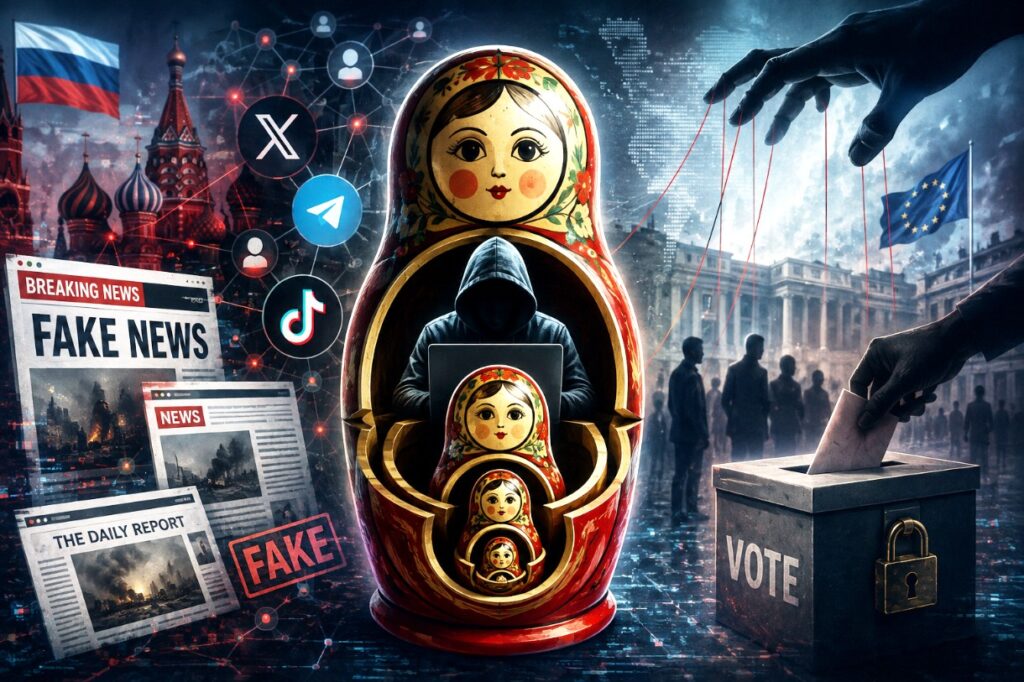
Digital influence operations from abroad have become one of the central challenges facing Western democracies. Alongside cyberattacks and traditional espionage, state and state-aligned actors are increasingly using targeted disinformation campaigns to undermine trust in political institutions. Western security authorities are focusing particularly on the Russian networks Storm-1516 and Matriochka. Both pursue the same strategic objective: to influence public opinion, intensify social tensions, and weaken Western countries’ support for Ukraine. Their methods, however, differ considerably.
Storm-1516: The Industrial Production of Disinformation
Storm-1516 is regarded as one of the most professional information networks that Western authorities attribute to Russian influence structures. According to findings by French security authorities, the network has been active since late 2023 and directs its campaigns primarily at European countries and North America.
At the heart of its activities is the systematic production of seemingly credible news. To this end, deceptively realistic websites are created that imitate reputable media outlets or regional newspapers. These so-called clone websites publish fabricated articles whose design and linguistic style are modeled as closely as possible on the originals.
Artificial intelligence is playing an increasingly important role in this process. Texts can now be created within minutes or adapted to different target groups. At the same time, modern image and video editing programs enable the production of highly convincing manipulations – from subsequently altered images to deepfakes in which people make statements they never made.
This approach is supplemented by identity theft. The names of journalists, logos of established media organizations, and institutions or non-governmental organizations are misused to create the impression of credible reporting. Coordinated networks of social media accounts then distribute the content via platforms such as X, Telegram, or TikTok, ensuring rapid reach.
Several French politicians have been targeted by such campaigns in recent years. Among other things, fabricated reports circulated about their health, alleged corruption cases, or private scandals. Even when these claims were quickly debunked, they had often already reached a large audience.
Matriochka: When Fact-Checkers Become the Target
While Storm-1516 relies on the mass dissemination of false content, the Matriochka operation pursues a different strategy. Its real attack is directed less at the public than at journalists and professional fact-checkers.
The operators also create fake documents – such as purported press articles, manipulated videos, posters, or screenshots. Editorial teams and fact-checking organizations are then specifically asked via social networks to verify this content.
At first glance, this behavior appears contradictory. In fact, however, the method pursues two strategic objectives. First, editorial teams are forced to invest significant staff resources in verifying fabricated content. Second, the public debunking of the false report itself generates additional attention. Even when media outlets expose the manipulation, the original claim often reaches a much larger audience than it would have without the fact-check.
This approach exploits a well-known psychological effect: many people later remember the sensational claim, but not its correction. As a result, disinformation can have a long-term impact even though it is demonstrably false.
A Standardized Process for Modern Disinformation Campaigns
Western security authorities observe an almost identical pattern across numerous Russian influence operations.
First, a false piece of content designed to appear as credible as possible is produced. It then appears on specially created websites or media clones resembling well-known news portals. In the next step, coordinated networks of automated or partially automated social media accounts ensure rapid dissemination.
Only then do larger accounts or political influencers often pick up the topic. Whether out of conviction, ignorance, or political calculation often plays a secondary role in the campaign’s success. What matters is that the discussion gains momentum.
Even when media outlets or authorities later clearly disprove the claims, a residual doubt often remains. This very effect lies at the core of modern information operations. The goal is not necessarily to convince as many people as possible of an obvious falsehood. Rather, it is to create uncertainty. Those who constantly encounter contradictory information are more likely to lose trust in the media, authorities, or democratic institutions.
Part of a Larger Russian Information Ecosystem
According to Western authorities, Storm-1516 and Matriochka do not operate in isolation. Instead, they are attributed to a larger network of Russian information operations.
The operation Doppelganger had already attracted particular attention. It involves near-complete copies of websites belonging to internationally known media outlets. Only the web address differs slightly from the original. This makes it easy for users to end up on fake news portals and mistake their content for authentic journalism.
This ecosystem is supplemented by Portal Kombat, a network of hundreds of multilingual web portals that spread pro-Russian narratives in numerous European languages. Together, these structures form a division-of-labor infrastructure in which content is produced, replicated, and distributed through different channels.
Experts therefore increasingly speak of an industrial form of information manipulation. Modern software, artificial intelligence, and social media make it possible to create and distribute large quantities of seemingly credible content internationally within a very short time.
Why Election Campaigns Are Particularly Vulnerable
Election campaigns offer ideal conditions for disinformation campaigns. Political debates are emotional, social fault lines become especially visible, and the media report on candidates and controversies almost around the clock.
From the perspective of foreign influence actors, this opens up several opportunities. Individual politicians can be specifically discredited, controversial issues can be artificially amplified, or existing social tensions can be further intensified. Attempts can also be made to sow doubt about the integrity of the electoral process itself.
Often, merely alleging possible manipulation or purported scandals is enough. Even if these later prove unfounded, they can cause lasting damage to trust in democratic processes.
French security authorities assume that such activities could increase further in the run-up to the 2027 presidential election. Comparable influence campaigns have already been documented in elections in several European countries as well as in the United States.
The Challenge for Open Democracies
Combating digital disinformation presents democratic societies with a fundamental dilemma. On the one hand, organized influence operations must be identified early and their impact contained. On the other hand, measures against disinformation must not impair freedom of expression and freedom of the press – central pillars of liberal democracies.
Western governments are therefore increasingly investing in specialized analysis centers, international cooperation, and technical early-warning systems. At the same time, independent media, professional fact-checking, and digital media literacy among the public are becoming increasingly important.
Storm-1516 and Matriochka illustrate how the nature of geopolitical confrontation has changed. Conflicts today are no longer conducted exclusively through military or economic means. Control over information, public perception, and social trust has become a strategic factor. For democracies, the real challenge is therefore less about preventing every individual false report than about permanently strengthening the resilience of their institutions and the public against systematic attempts at manipulation.
P. Tiko