
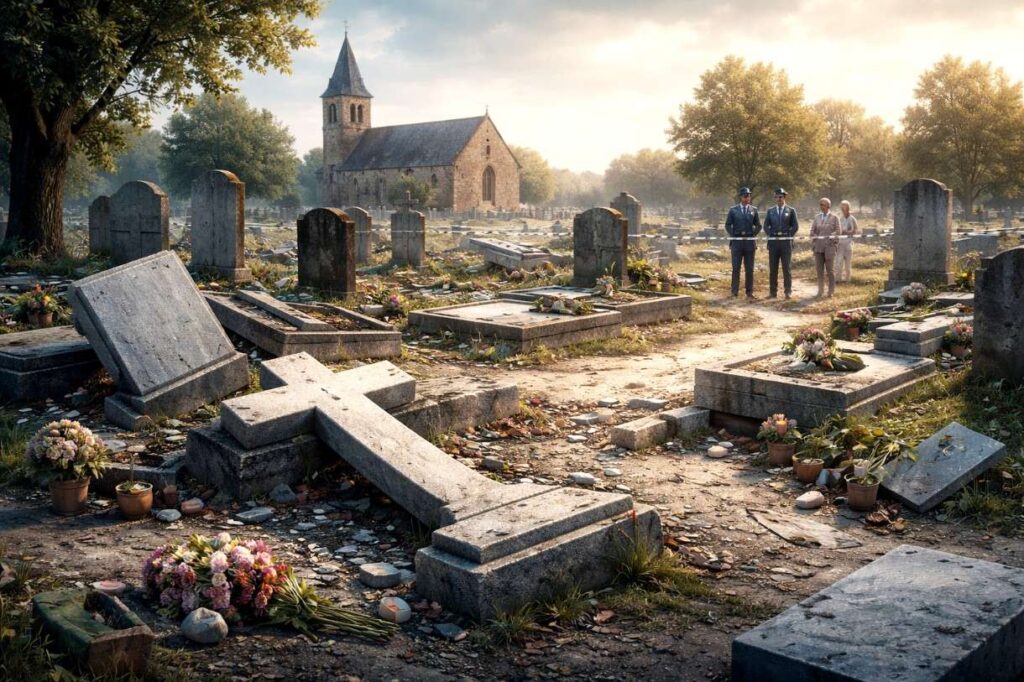
They are places of silence, remembrance, sometimes even comfort – and now these very places are being shaken. In several rural communities in western France, unknown perpetrators have vandalized cemeteries in recent days, triggering a wave of dismay.
The images are similar: toppled gravestones, broken crosses, scattered mementos. What remains is a feeling of emptiness – and an urgent question as to why.
The affected regions, including parts of Mayenne and Brittany, were long considered quiet, almost secluded. Cemeteries here are not anonymous places, but part of the collective memory. People know the names on the stones, remember stories and faces. When a grave is desecrated, it does not affect just one family – it affects the village.
Investigators are still in the dark. No claims of responsibility, no clear clues as to a motive. Was it mindless vandalism? A copycat act? Or is there more behind it after all? The uncertainty weighs heavily.
The justice system has since responded. Under the direction of the public prosecutor’s office, investigations are underway, supported by the gendarmerie. At the scene, officers are securing evidence and reviewing possible video footage – a puzzle whose pieces have so far refused to fit together.
From a legal perspective, this is a serious offense. The desecration of graves violates not only property, but also touches a deeply rooted social taboo: respect for the dead. Accordingly, the potential penalties are severe.
In the communities themselves, emotions are running high. Mayors speak of “unbearable acts,” residents react with a mixture of anger and disbelief. You hear sentences like: “Something like this has never happened here before.” And indeed – for many, it is a break with the familiar order.
Some municipalities are already openly considering consequences. More lighting, cameras, more frequent patrols – measures otherwise more commonly discussed in cities. Now they are making their way into villages that had previously managed without such precautions.
Statistically speaking, cemetery desecrations are rare. Yet their impact unfolds on another level. They touch on foundations: memory, identity, dignity. Especially in rural regions, where generations are more closely connected, every act of damage feels like a collective stab to the heart.
The coming weeks are likely to be decisive. If the authorities succeed in identifying those responsible, trust could at least be partially restored. If the acts remain unsolved, a creeping sense of insecurity threatens to take hold.
And that is precisely what concerns many: that even places of final rest no longer seem inviolable.