
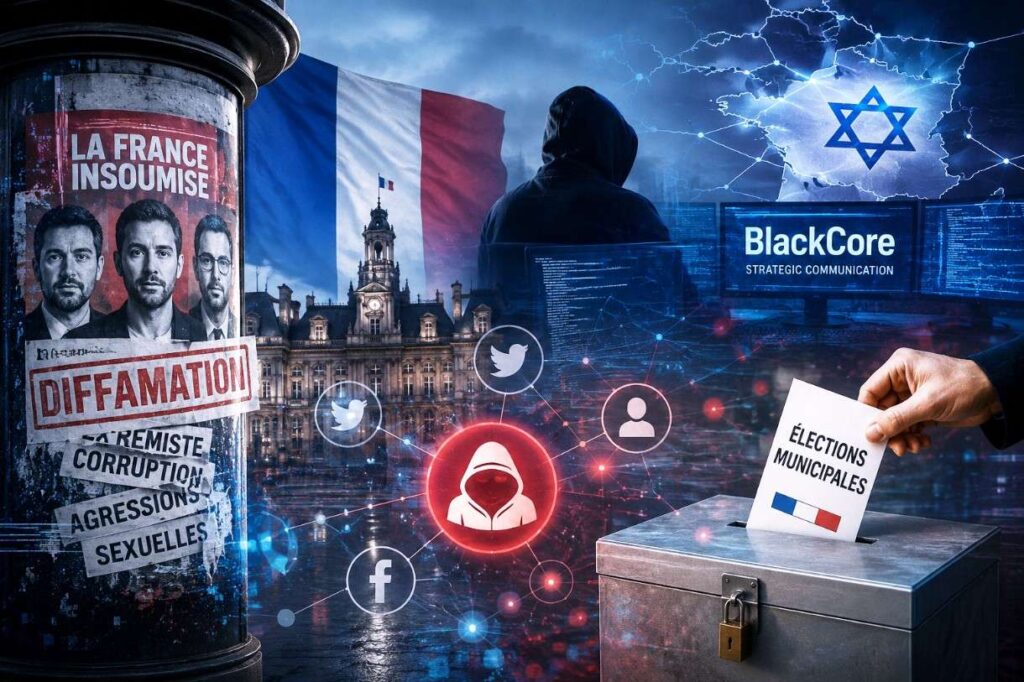
The French justice system is currently investigating a case that is occupying Parisian politics with unusual intensity: the suspicion of coordinated digital influence operations against candidates of the left-wing party La France insoumise (LFI) during the recent municipal election campaigns. At the center are accusations that organized disinformation campaigns were directed against several prominent politicians of Jean-Luc Mélenchon’s movement. Particularly sensitive is the question of whether those behind these actions may have ties to Israel.
Among the individuals involved, according to current knowledge, are LFI deputies Sébastien Delogu, François Piquemal, and David Guiraud. During the election campaign, they were the target of extensive defamatory campaigns on social networks and on specially created websites. These circulated accusations of alleged extremism, corruption, or sexual abuse. French media also report the presence of false “whistleblower” profiles and content presumably generated by artificial intelligence, created specifically to undermine the credibility of the politicians.
At the center of the investigations is a communication structure called “BlackCore.” Several French and international publications have recently linked the organization to digital influence operations. Evidence indicates that part of the activities may have been organized by Israel. However, there are currently no official confirmations in this regard. The French prosecutor’s office cautiously speaks of possible manipulation operations “in the interest of a third state.”
The investigations are conducted by the national cybercrime unit. It is being examined in particular whether there were systematic interventions in democratic electoral processes. The case comes at a time of growing concern about hybrid influence strategies from abroad. In recent years, France had focused mainly on Russian disinformation campaigns. Now it is becoming clear that digital influence operations are no longer exclusively associated with Moscow.
Politically, the affair is increasingly turning into an internal conflict. Jean-Luc Mélenchon accuses the government of deliberately wanting to downplay the issue. He speaks of a possible “state scandal” and claims that parts of an official report have been softened or withheld to avoid diplomatic tensions. French opposition politicians are now demanding full transparency on the extent of the alleged manipulation attempts.
The issue also concerns a geopolitically particularly sensitive area of the French debate. La France insoumise has been considered since the beginning of the Gaza war as one of the most critical political forces towards Israel in France. For this very reason, the case is now being interpreted far beyond the issue of individual online campaigns. However, at present, there is no publicly available concrete evidence of direct state control by Israel. Consequently, French security authorities are also expressing caution for the time being.
Regardless of the outcome of the investigations, the scandal reveals above all the vulnerability of modern democracies in the digital age. Local municipal elections were long considered political areas of limited international relevance. However, social networks, artificial intelligence, and transnational communication structures are radically changing this reality. Electoral campaigns no longer take place only in public squares or in television debates, but increasingly in anonymous digital networks whose authors are often difficult to identify.
For France, the case could therefore have far-reaching consequences. If the suspicion of organized foreign influence is confirmed, the debate on digital sovereignty, the security of electoral campaigns, and the protection of democratic institutions is bound to become much more intense.
Author: P. Tiko