
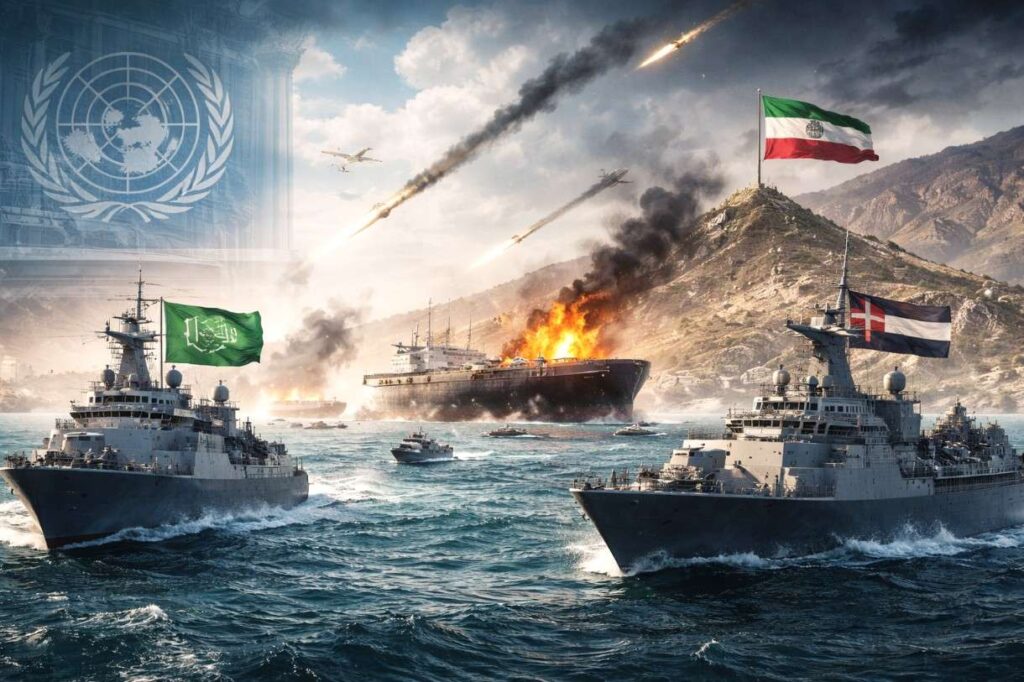
Tensions in the Middle East reach a new escalation level at the beginning of April 2026. Iran’s blockade of the Strait of Hormuz not only puts pressure on the global energy market but also tests the international security order. The six member states of the Gulf Cooperation Council are now urging the United Nations to legitimize military measures to restore free navigation – a step with potentially far-reaching consequences.
Strategic Lifeline Under Pressure
The Strait of Hormuz is one of the most important maritime chokepoints in the world. About one-fifth of the globally traded crude oil normally passes daily through this channel between the Persian Gulf and the Gulf of Oman. A blockade by Iran therefore affects not only the immediate neighboring states but the global economy as a whole.
The Gulf States – including Saudi Arabia, the United Arab Emirates and Qatar – accuse Tehran of deliberately controlling the passage and obstructing transit. Only a few ships are allowed through under conditions, which amounts to a de facto restriction of international freedom of trade. The Secretary-General of the Gulf Cooperation Council, Jassem Al-Budaiwi, spoke before the UN Security Council of a “threat to global maritime security.”
The demand for a UN mandate to use military force shows how seriously the situation is being assessed. Such a step would cross the threshold from diplomatic pressure to potentially direct military confrontation between the Gulf states and Iran.
Washington escalates the tone
In parallel to the diplomatic offensive of the Gulf states, the United States is also intensifying its rhetoric. President Donald Trump repeatedly openly threatened attacks on civilian infrastructure in Iran if Tehran is not willing to negotiate a ceasefire. This announcement marks a clear escalation compared to previous positions and once again raises questions under international law.
The targeted threat of attacks on bridges and power plants contradicts fundamental principles of humanitarian international law, especially the protection of civilian facilities in armed conflicts. With this, Washington signals that it is prepared to drastically increase pressure on Iran – possibly even independently of a UN mandate.
Military dynamics: Israel and Iran in open exchange of blows
The situation is further worsened by additional direct military actions. Iranian missile attacks on Israeli territory, including targets in Tel Aviv and Eilat, were largely intercepted according to the Israeli armed forces. Nevertheless, these attacks illustrate the increasing range and intensity of Iran’s military strategy.
Israel is responding with increased defensive measures and is keeping open the option of further retaliatory attacks. The risk of a permanent military confrontation between Iran and Israel – so far mostly conducted indirectly through proxy conflicts – is therefore increasing significantly.
Other states in the region are also becoming increasingly involved. Kuwait reported intercepting drones and rockets, showing that the conflict is expanding geographically and is no longer limited to individual parties to the conflict.
Unrest at the Pentagon: Shifts in Power in Washington
Additional uncertainty is caused by a surprising personnel decision in the USA. General Randy George was immediately replaced as Chief of Staff of the US Army. No official reasons were given, but reports suggest that the political leadership in the Department of Defense seeks a stronger alignment of the military leadership with Trump’s strategic line.
Such interventions in military leadership are unusual in the United States and could indicate internal tensions regarding future military strategy. In a phase of international crises, they reinforce the impression of an increasingly politicized security architecture.
The Role of the United Nations: Decision Pressure in the Security Council
At the center of the current developments is now the UN Security Council. The Gulf states’ demand for a mandate to militarily secure the Strait of Hormuz poses the body with a difficult decision. While Western countries may show sympathy for the concern, resistance from Russia and China is to be expected, as they traditionally emphasize sovereignty and restraint in military interventions.
The failure of a resolution could prompt the USA and its allies to act even without a UN mandate – a scenario that would further undermine the international order. Conversely, a mandate would open the door for a multinational military mission, whose risks and side effects are difficult to predict.
A conflict with global significance
The current crisis exemplifies how regional conflicts can quickly take on global dimensions. The Strait of Hormuz is not only a geographical bottleneck but a geopolitical focal point where economic interests, security policies, and international legal issues converge.
The coming days are likely to be decisive: whether it succeeds in diplomatically defusing the situation or whether the entire region slips into an open military confrontation depends largely on decisions in New York, Washington, and Tehran. One thing is already clear: The stability of the international order is at stake.
P.T.