
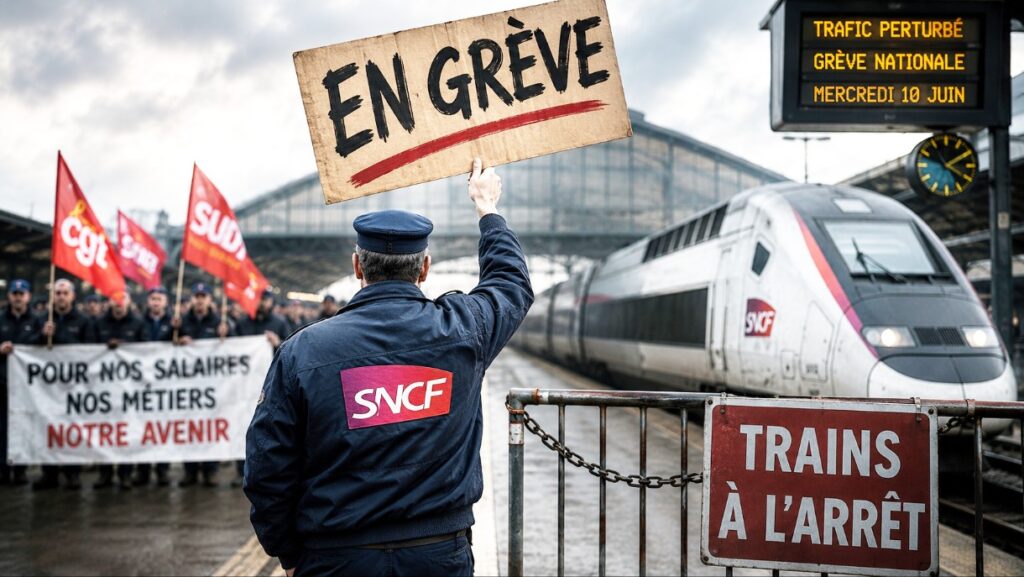
France’s rail network has come to a standstill once again. On Wednesday, SNCF employees launched a nationwide strike. Particularly remarkable is the unusual unity among the unions. For the first time since the end of 2024, the four major labor unions are pulling together. Behind this lies much more than the classic demand for higher wages.
The frustration runs deep into the structures of the French rail company.
Officially, wages are once again at the center of the protests. For years, many railway workers have complained of a gradual loss of purchasing power. Price increases in energy, housing, and food have long since eaten up the income gains of recent years. From the unions’ perspective, current salaries neither reflect the burdens of the profession nor adequately acknowledge the employees’ performance.
The company management naturally sees the situation differently. It points to measures already implemented to support purchasing power and to ongoing collective bargaining negotiations. However, this argument often meets with little understanding on the platforms and in the workshops.
But the conflict does not end with the paychecks.
The French rail landscape has been undergoing fundamental changes for years. The gradual market opening to competitors is causing significant concern among many employees. Where the SNCF was once almost alone on the rails, new providers are now entering the scene.
For the railway workers, this is not just an economic experiment.
Many fear increasing cost pressures that sooner or later could affect working conditions, staffing levels, and service quality. Union representatives warn against a development where economic efficiency is prioritized over the concept of public service. In their eyes, France’s traditional railway model is being put to the test.
The debate becomes especially emotional when it comes to subsidiaries.
In recent years, SNCF has reorganized several areas and spun off activities into independent companies. Such restructurings may seem like sober management decisions on paper. However, for many employees, they represent uncertainty.
The concern: staff could gradually be transferred to new companies where different social standards apply. The restructuring of freight transport alone had already triggered strong protests. Many railway workers see this as the beginning of a development that slowly dissolves the historic cohesion of the company piece by piece.
Some even speak of an identity crisis.
Indeed, the profession of railway worker in France has changed significantly. Digitalization, new technologies, competition, and internal reforms shape everyday work. Added to this is the question of what role the railway should play in public service in the future.
When talking to employees, one often hears similar thoughts. It’s not just about money. It’s about the future of a profession that has been closely linked to the French self-image for generations. Many employees feel the rails beneath their feet are shifting faster than ever before.
The current strike bundles all these tensions.
Wages, working conditions, corporate restructuring, and the future of rail transport merge into a shared protest movement. This is exactly what gives this day of action its special significance. It is less an isolated collective bargaining dispute than an expression of a deeper unease.
For travelers, this initially means considerable restrictions. Numerous connections are canceled or operate only to a limited extent. Long-distance and intercity routes are particularly affected, while the situation varies regionally.
But the real message of this strike is not directed at passengers.
It is addressed to politics and company management. The railway workers want to make it clear that, from their point of view, the transformation of SNCF has reached a critical point. Whether the protest will lead to concrete concessions remains open. One thing seems certain: the debate about the future of French rail has only just begun.
By C. Hatty