
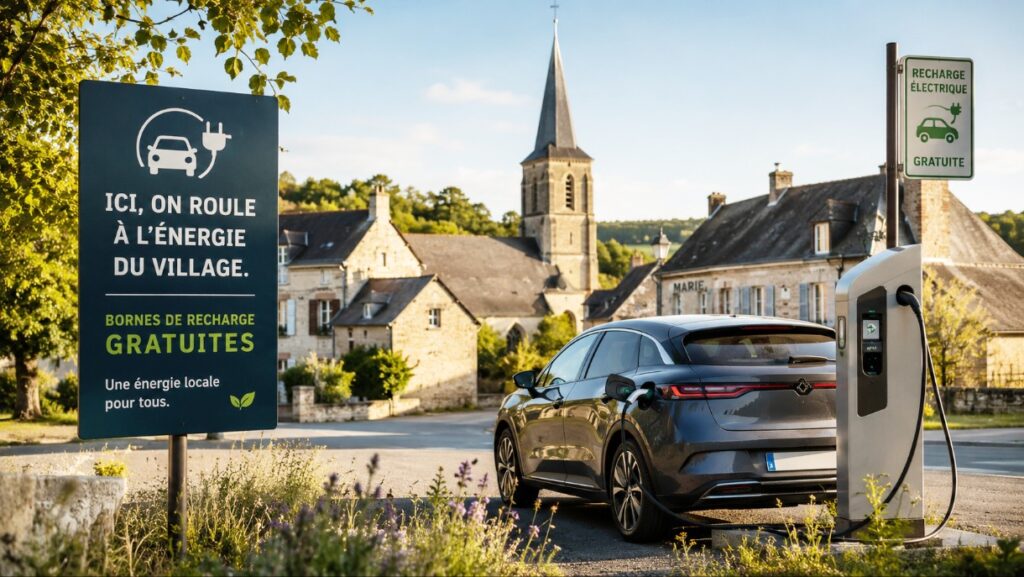
There are stories that start so small you almost overlook them. A village, a few charging stations, a mayor with a pragmatic idea. And yet it is precisely these stories that sometimes tell us more about a country than all the parliamentary debates in Paris.
Montigny-en-Arrouaise, an unassuming place in the Aisne department, is actually not one of those municipalities from which France’s future plans originate. No hip start-ups, no large research centers, no ministerial visits with camera crews. Fields, country roads, brick houses. Lots of sky. Lots of everyday life.
And now: free charging for electric cars.
What is remarkable about this lies less in the technology than in the tone. While the French energy transition often feels like a teaching project demanding sacrifices from people, this village relies on something completely different — relief. If you drive an electric car here, you charge for free. No moral finger-wagging, no complicated bonus programs, no bureaucratic contortions.
Just electricity.
Perhaps that is why the story touches a sensitive nerve in France. Because the ecological transformation has had a bad reputation in rural areas for years. Too often it sounded like bans, higher costs, and urban self-assuredness. The memory of the Yellow Vests protests runs deep. Back then, the anger flared over rising fuel prices, but actually it was about something bigger: the feeling among many people that ecological policies always affect those who have to pinch every euro twice anyway.
In the countryside, mobility means freedom — sometimes even dignity. Anyone driving forty kilometers to work in the morning doesn’t discuss traffic transition abstractly. They simply need to refuel.
This is precisely where Montigny-en-Arrouaise comes in. The municipality produces some of its electricity locally and makes it available collectively. Behind the free charging points lies an idea that sounds almost old-fashioned: energy as a common good.
That feels almost radical in a time of permanent individualization.
You sense something there that has long distinguished France — the republican idea that infrastructure should be more than just a service. Roads, schools, train stations, post offices: they once connected the center with the provinces. Today, ironically, a similar idea of collective participation is re-emerging, especially in energy supply.
Of course, the model remains fragile. What works in a small village cannot easily be transferred to Lyon or Marseille. Free charging infrastructure costs money, maintenance, and political will. In the end, someone always pays.
And yet.
The initiative possesses a force that goes far beyond its size. Because suddenly the energy transition no longer appears as a punishment but as a tangible advantage. That changes the perspective. Maybe even the mood.
For years, France has talked about the “left behind” rural areas, about skepticism, withdrawal, and political frustration. In doing so, it may have overlooked the possibility that new models could be emerging precisely there. In the countryside, there is space for solar plants, for local electricity production, for communal projects. Above all, social structures often still exist there that in large cities now seem fragmented.
People know each other.
That sounds banal but changes a lot. Those who meet the mayor personally discuss energy policy differently than those who read anonymous regulations from Paris. Trust does not arise through advertising campaigns but through closeness. Perhaps that is exactly the quiet sophistication of this project.
This is not a revolution with waving flags.
More like a village idea with surprising explosive power.
And perhaps it contains an uncomfortable truth for France’s political elite: the ecological transformation gains acceptance not where it is proclaimed most loudly but where it makes everyday life easier. People rarely follow changes out of enthusiasm for abstract goals. They follow them when life becomes more practical, cheaper, or more pleasant as a result.
Apparently, this little village in the Aisne understands that better than some ministries.
While big strategies continue to be formulated in Paris, somewhere between fields and church towers a few residents charge their cars for free. Almost unspectacular. And precisely for that reason, the scene feels like a quiet counterpoint to the overheated French ongoing debate.
No big ideology.
Just an outlet on the village square — and the sense that change sometimes begins where no one is watching.
An article by M. Legrand