
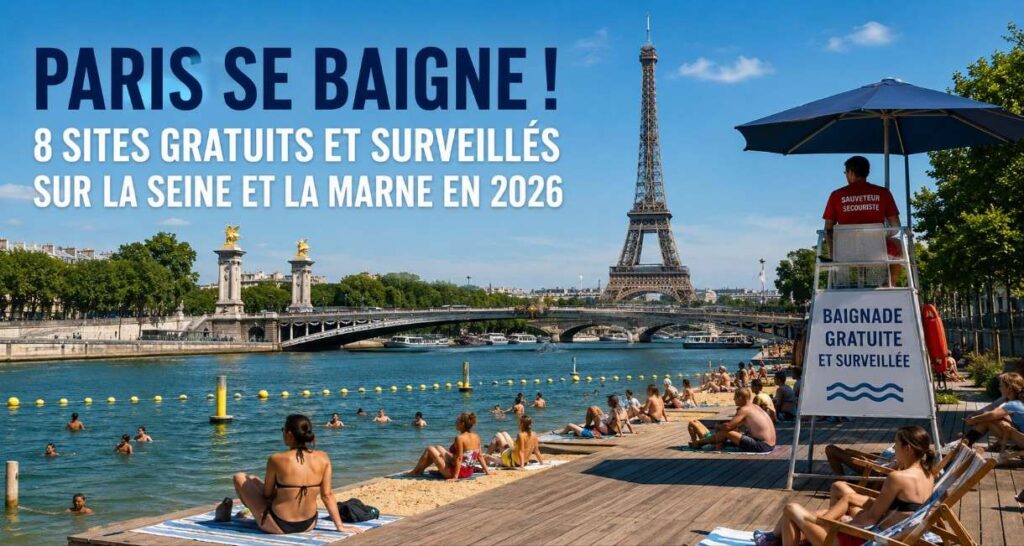
Only a few years ago, it sounded almost like a nostalgic postcard from another time: people swimming in the Seine in the middle of Paris. In the summer of 2026, this scene is now truly part of the city. Eight free and secured swimming areas along the Seine and the Marne are opening their gates to the public, marking a new step in reclaiming the rivers as living spaces.
Three new swimming areas within Paris are particularly in the spotlight. They combine relaxation, sport and city life in a way that was barely imaginable for a long time. At the Bras de Grenelle, opposite the Statue of Liberty on Île aux Cygnes, a swimming area is being created with a spectacular backdrop. Anyone entering the water here swims with a view of one of the city’s most famous icons.
In the east of the capital, the largest facility awaits visitors. The Bercy swimming area offers several pools, generous sunbathing lawns and plenty of space for families, athletes and sun seekers. In the heart of the historic centre, a new site between Pont Louis Philippe and Pont Marie is also set to replace the current swimming area at the Bras Marie. All three facilities are freely accessible and supervised by lifeguards during opening hours.
But it is not only Paris that benefits from this development. The options are also growing along the Marne. The popular swimming areas in Joinville-le-Pont and Maisons-Alfort are returning after their successful launch. In recent summers, they already attracted many visitors who enjoyed the rare pleasure of swimming directly in the river. Sunbathing lawns, safe access points and designated swimming areas create an almost holiday-like atmosphere on the outskirts of the capital.
Who would have thought that the Seine, of all places, could one day become a swimming paradise?
For years, swimming was considered out of the question. Pollution, shipping traffic and health risks made the rivers unsuitable for recreational activities. Many Parisians knew the Seine only as a backdrop for walks or boat trips.
The turnaround began with an ambitious cleanup program. Billions were invested in improving water quality. Old sewer lines were modernized, faulty connections repaired and new storage systems built to better manage pollution during heavy rainfall. The 2024 Olympic Games acted as an accelerating factor. Suddenly, the water quality of the Seine was in the international spotlight.
However, the project is not without challenges. Water quality remains a sensitive issue. After heavy rainfall, additional pollutants still enter the rivers. Therefore, regular checks are carried out. If a limit value is exceeded, the authorities temporarily close some swimming areas. For visitors, this occasionally means a restriction, but at the same time, this approach ensures a high level of safety.
This is precisely one of the biggest differences from the past. The new swimming areas are not improvised access points to the water, but professionally managed facilities with clear safety standards. Visitors receive up-to-date information about water quality and benefit from continuous monitoring.
Moreover, the project is changing people’s relationship with their rivers. The Seine and the Marne have long ceased to serve only as transport routes or as backdrops for tourist photos. They are once again developing into places for meeting, relaxation, and city life.
Is this not exactly the kind of urban development that many European metropolises aspire to?
Paris is sending a powerful signal with this. Almost a century after the swimming ban, a tradition that generations of residents had lost is returning. The rivers are once again becoming part of everyday life. Children splash along the banks, families spend warm summer days on the sunbathing lawns, and office workers treat themselves to a refreshing dip after work.
The eight swimming areas along the Seine and Marne therefore represent much more than just summer fun. They symbolize the successful effort to connect nature and the city more closely. What once seemed impossible now feels surprisingly natural. And honestly: a dip in the cool water with a view of the Paris skyline sounds like a very good idea.
An article by M. Legrand