
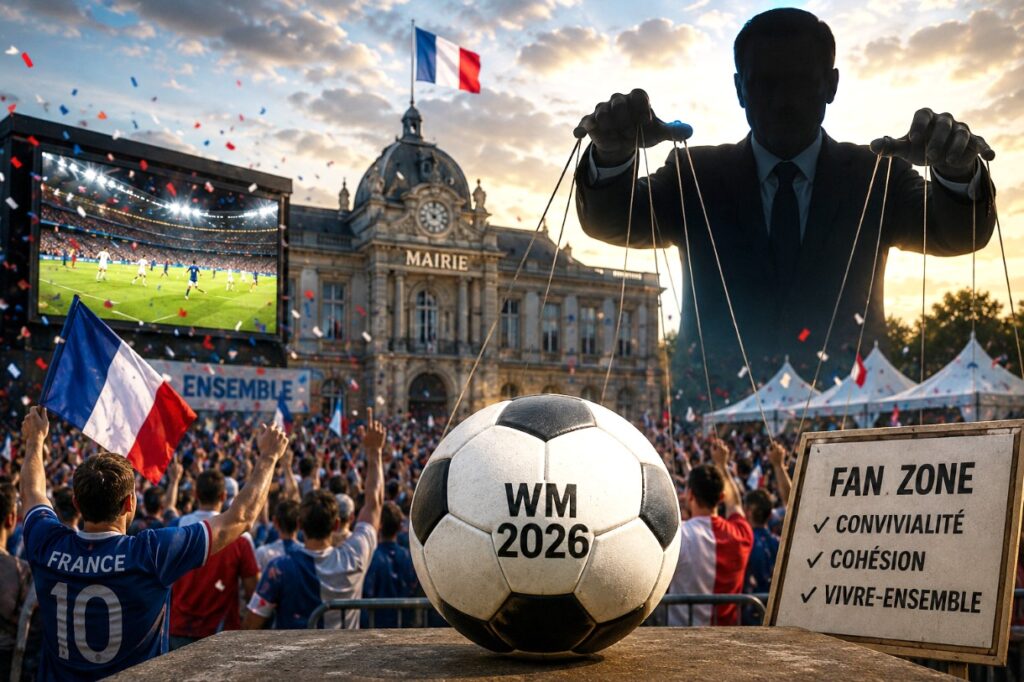
The Soccer World Cup is returning. For one month, billions of people around the world will watch the matches of the best national teams. Streets will be filled with jerseys, restaurants and bars will become gathering places for fans, and public squares will turn into arenas of celebration. This scene is familiar. But alongside the sporting competition, there is another contest—far less visible, yet just as politically significant. It is the staging and use of the event by politics.
An interesting example of this is the city of Mulhouse in Alsace. When announcing a public fan zone for the 2026 World Cup, Mayor Frédéric Marquet did not merely present a sports-related program. He also positioned the event as a means of social cohesion and as a message to younger generations. This intention is understandable. At the same time, the move clearly illustrates a trend that has been observed in recent years: major sporting events are increasingly becoming platforms for political communication.
The Symbolic Power of Sport
Political decision-makers have long recognized the unifying power of sporting success. Victories by national teams often create a shared sense of emotion stronger than many political campaigns. Football shapes identity across social, cultural, and political boundaries. That is precisely where its value lies for politics.
Busy fan zones convey the image of a vibrant city. Public broadcasting demonstrates a commitment to citizens. Images of people enjoying themselves in front of big screens are ideal for social media, municipal publications, and political communication. Sport offers positive emotions, high levels of attention, and a rare form of social unity. These are particularly attractive resources in an age of polarization.
An International Phenomenon
This trend is not limited to France. The host countries of the 2026 World Cup—the United States, Canada, and Mexico—are investing heavily in accompanying events, fan festivals, and public meeting places. Officially, the focus is on shared experiences and enthusiasm for football, but these projects also serve the purposes of location promotion, city marketing, and political self-presentation.
Major sporting events have historically been closely linked to political interests. From the 1936 Berlin Olympics and the 1978 FIFA World Cup in Argentina to the recent debates surrounding Qatar 2022, sport and politics have rarely been separate worlds. The 2026 World Cup is no exception. This time, however, it is not a single country’s international image strategy that takes center stage, but political use at the regional level is evident.
Between Community and Self-Presentation
The key question, then, is not whether politics uses sporting events, but how it does so.
Basically, there are few reasons to oppose municipalities hosting fan zones. Such events create spaces for exchange, support local hospitality businesses, and offer a shared experience even to people with limited financial means. At a time of increasing social division, shared public experiences can certainly play a positive role.
The problem arises when symbolic politics replaces concrete politics. Fan zones may promote community, but they do not solve structural problems. They neither improve the quality of education nor reduce youth unemployment or social inequality. When political communication suggests that social challenges can be solved through a single major event, a gap emerges between staging and reality.
Economics of Attention
The modern World Cup functions as a giant attention-generating machine. Sponsors use it for product marketing, the media compete for ratings and advertising revenue. Digital platforms benefit from global discussion. Political actors also try to link their own messages to the emotional momentum of the tournament.
This does not necessarily mean manipulation. Rather, politics follows the same mechanisms as other social actors. Those who want to attract attention focus on topics that interest people. Football is undoubtedly one of them.
Nevertheless, a critical perspective is important. The greater the emotional impact of an event, the greater the temptation to use its appeal for one’s own purposes. The boundary between legitimate civic communication and political self-promotion is often blurred.
In the summer of 2026, stadiums in North America will be full, and millions of fans around the world will be cheering in front of their screens. There is no doubt that sporting competition is at the center. But what happens outside the stadium is just as interesting. Fan zones, public events, and calls for social cohesion tell a second story of politics, communication, and public perception.
Football remains a festival of emotions. Precisely for this reason, it has also been a suitable instrument of political staging for decades. The 2026 World Cup will powerfully demonstrate how closely the two are intertwined.
Author: P. Tiko