
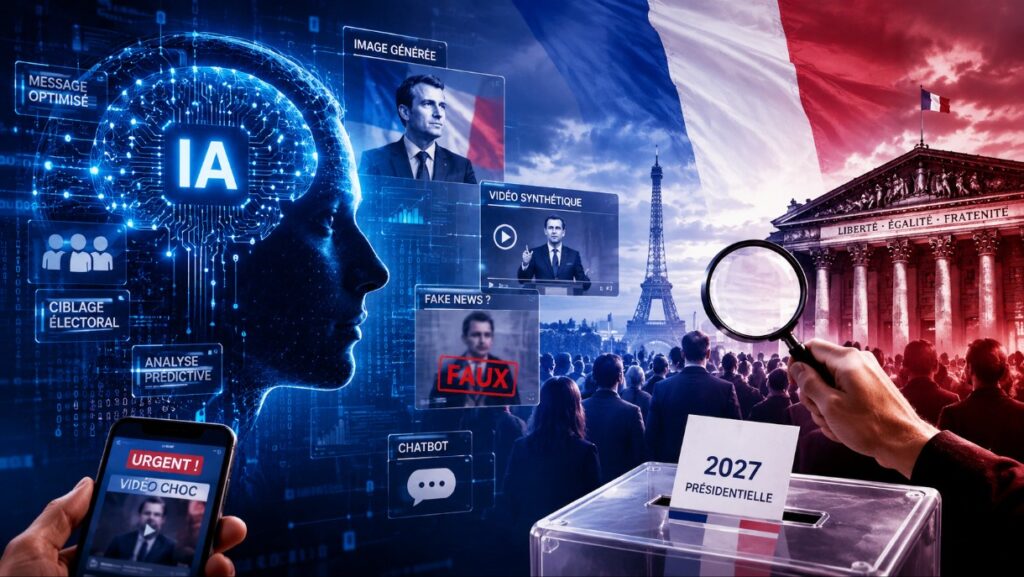
The French presidential election of 2027 is still in the future. But one thing is already clear today: The upcoming campaign will not only be shaped by parties, candidates, and media. It will be the first French presidential election in which artificial intelligence plays a central role.
The technology itself will not run as a candidate. It will not cast votes or put up campaign posters. Nevertheless, its influence on political opinion formation is likely to be greater than that of many traditional actors. What has so far been reserved for humans – writing speeches, creating campaign materials, analyzing voter groups, or developing political messages – can now be performed by algorithms within seconds.
This opens up new possibilities for parties. Election campaigns will become more efficient, cost-effective, and precise. Small political movements will gain access to tools that were previously only available to large organizations with extensive financial resources. Programs can be targeted towards different voter groups, content can be distributed automatically, and audience reactions can be evaluated in real time.
But the same technology that could democratize political competition also carries significant risks for democracy itself.
The real problem does not lie in artificial intelligence’s ability to generate convincing texts or images. More dangerous is its ability to blur the line between reality and fiction. Even today, deceptively realistic videos, manipulated audio recordings, or artificially generated images are hardly distinguishable from authentic material. With every technological advancement, the barrier to their widespread dissemination decreases.
Democratic societies, however, rely on a fundamental consensus about reality. Citizens can debate political solutions as long as they at least refer to shared facts. But if it is no longer clear whether a video is genuine, a quote is authentic, or a digital conversation partner is even human, this foundation begins to falter.
The real danger therefore does not lie in voters believing false information en masse. Far more consequential would be a state of general uncertainty in which every piece of information appears suspicious and every claim is perceived as potential manipulation. Where trust in verifiable facts fades, democratic debate becomes increasingly impossible.
Europe has responded to this development with new regulations. But experience shows that technological innovations usually progress faster than political legislation. While authorities formulate rules, platforms and software providers are already developing the next generation of digital tools.
The challenge for the 2027 presidential election will therefore be less technical and more political. Parties will have to disclose how they use artificial intelligence. Media will need to further develop their verification mechanisms. And citizens will need to learn to question digital content more critically than before.
Artificial intelligence is neither an enemy nor a savior of democracy. It is a tool. Whether it strengthens or weakens the political system ultimately depends on the rules under which it is used.
The 2027 election will not be decided by machines. But it could be the first in which machines significantly determine how political reality is perceived. That is exactly why this development deserves the full attention of the public today.
Author: Andreas M. Brucker