
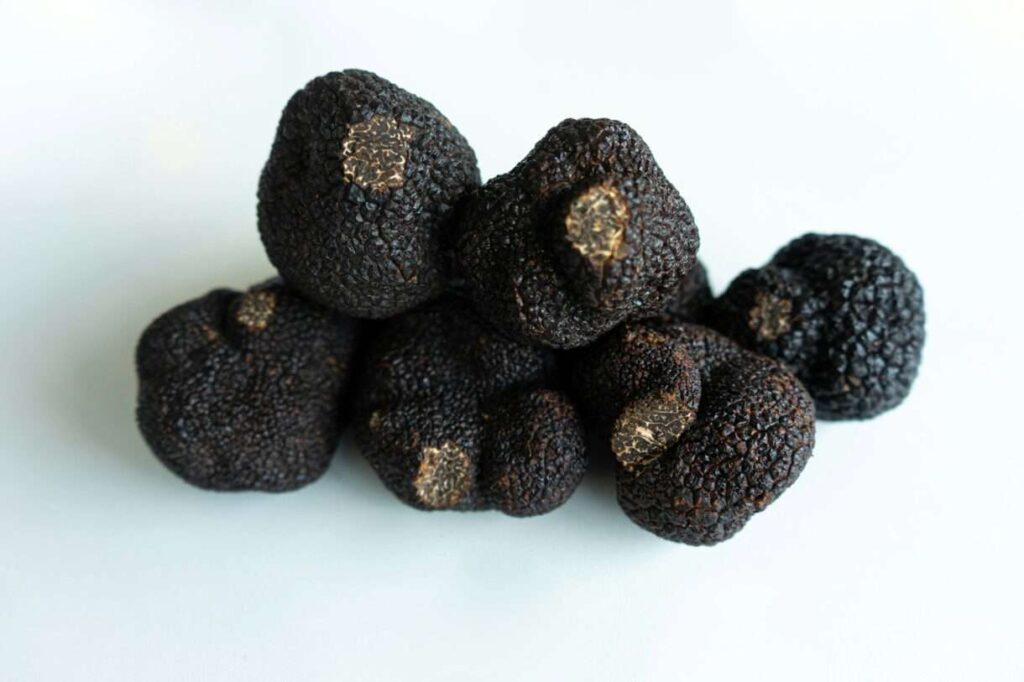
Those who think of black truffles usually picture gentle hills in Périgord, chalky white plateaus in Vaucluse, or the stark elegance of the Drôme. The Tuber melanosporum belongs to the collective memory of French cuisine, to those hidden treasures that mature underground and turn a simple dish into a small celebration. But beyond these classical strongholds, a new truffle region is quietly emerging – in the Alpes-Maritimes.
Between the Mediterranean and the foothills, between mild breeze and mineral austerity, a terrain unfolds here that is surprisingly suited to the black truffle. It is a quiet revolution, carried by farmers, career changers, and the realization that agricultural maps are changing. Not loud, not spectacular, more like how truffles themselves grow: invisible, patient, stubborn.
The black truffle does not follow the rules of traditional agriculture. It cannot be sown, harvested on schedule, or industrialized. Its life takes place in secrecy, in symbiosis with the roots of certain trees, primarily downy oaks and holm oaks. This mycorrhizal connection requires a finely balanced interplay of soil, climate, and time. Calcareous, dry soils, little organic matter, but minerals. Warm summers, mild winters. Dryness followed by targeted moisture. A balancing act.
These very conditions can be found in the hinterland of the Alpes-Maritimes, far from the postcard Riviera. At 400 to 1,000 meters altitude, where the landscape becomes rougher and the oaks are guardians of ancient terraces, many things suddenly come together. Anyone standing here, between barren slopes and wide skies, quickly senses: This is no coincidence.
Meanwhile, the truffle is no newcomer to this region. In the 19th century, France was one of the largest producers worldwide, and the southeast also contributed its share. However, wars, rural depopulation, and the gradual overgrowing of formerly open areas caused these delicate tubers to disappear. Forests grew denser, soils colder, and the truffle retreated. Too tedious, too uncertain, too slow – so was the verdict of a time that loved efficiency.
Today, the focus is shifting again. In communes like Coursegoules or the hinterland of Grasse, truffle orchards are being established once more. Modern truffle cultivation works with mycorrhizal young plants, inoculated in the lab, carefully planted, and scientifically monitored. Yet despite all the technology, one thing remains non-negotiable: Patience is required. Five, sometimes ten years pass before the first tubers mature. And even then, every year remains a gamble. Clearly, this is not for the impatient. But that is exactly where the charm lies.
Climate change, a global threat, shifts local possibilities. In traditional cultivation areas, extreme summers are taking a toll on truffles. In middle elevations, however, such as those offered by the Alpes-Maritimes, new opportunities are emerging. Warm days, cooler nights, still sufficient rainfall. The truffle follows these subtle shifts, regardless of traditions.
Economically, production remains manageable, but its value is enormous. Black truffles sometimes fetch prices that even seasoned restaurateurs find hard to swallow. Near Nice, Cannes, or Monaco, supply meets an audience that values quality and seeks closeness. Direct marketing, small tastings, truffle hunting with dogs – all of this connects agriculture with experience. A little down-to-earth, a little luxury. It works.
In the end, however, it’s about more than money. Truffle culture requires attention, observation, respect for natural rhythms. The harvest, the cavage, remains a moment of quiet tension. Dog and human, a sign in the ground, then the find. No triumphant shout, rather a smile. As if one had received back something that was long cherished.
The truffle from the Alpes-Maritimes will not outrank the big names. It doesn’t have to. Its strength lies in discretion, in slow growth, in harmony with a landscape that offers more than sun and sea. Beneath the oaks of the hinterland, a quiet future matures. Deep in the soil. And quite valuable.
Author: Andreas M. Brucker