
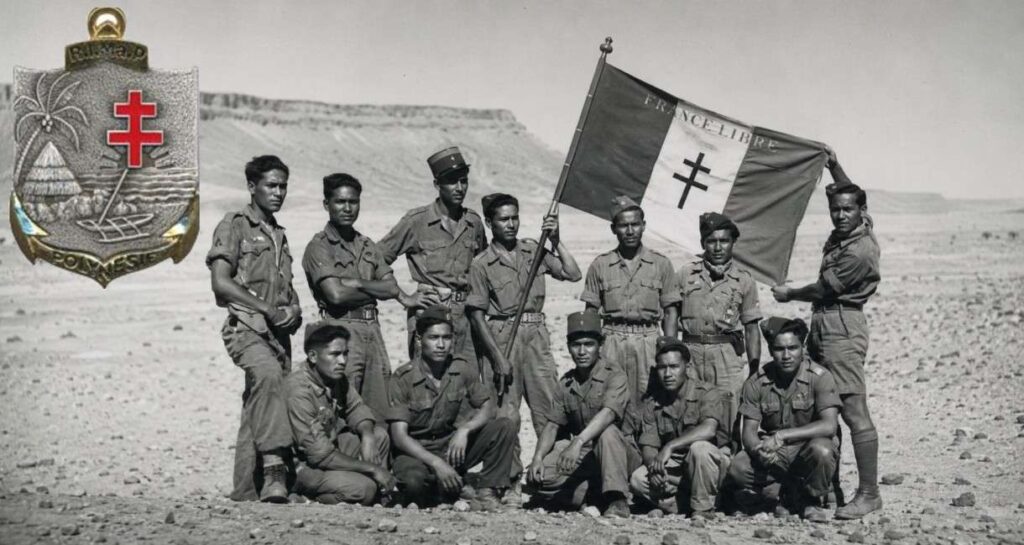
One morning in 1940, a peculiar calm hangs over Papeete, known only to island harbors. Fishermen pull their boats ashore, merchants open their shops, somewhere the clinking of dishes comes from an open window. The world seems far away. Europe even more so. And yet the news reaches Tahiti like a distant thunderclap: France has fallen.
The defeat against Hitler’s Germany shook even those places barely appearing on European maps. French Polynesia lies more than 15,000 kilometers from Paris, scattered across the endless blue of the Pacific. For many residents, France represents something abstract – an idea, a distant country, a name on official documents. And yet it is right here that one of the most remarkable stories of the Résistance begins.
It is about the Tamarii volontaires.
Tamarii – simply means “children” in Tahitian. But these children of the Pacific soon go to a war whose brutality could hardly have been greater. They leave coral reefs, breadfruit trees, and lagoons to fight Rommel’s tanks in the sandstorms of North Africa. Some see snow for the first time. Others die in a world that until then seemed hardly imaginable to them.
Why did young Polynesians volunteer for a war on the other side of the globe?
Perhaps the answer begins with a feeling that is difficult to translate. Not patriotism in the European sense. Not that pathetic homeland rhetoric known from the speeches of the 20th century. Rather a mixture of adventurousness, loyalty, and pride – along with the desire not to stand idly by.
When General de Gaulle sends his famous appeal from London on June 18, 1940, his voice initially reaches the South Seas only in fragments. But the message has an effect. France must live on, despite occupation, despite surrender, despite Vichy.
In September of the same year, Tahiti decides in favor of the Free French Forces.
Today this may seem like a footnote in history. At the time, however, this step carried enormous symbolic power. While large parts of the French colonial empire still hesitate or submit to the Vichy regime, a remote archipelago in the Pacific takes the side of de Gaulle.
You have to imagine this: a few islands in the middle of the ocean help to save the idea of France.
In the streets of Papeete, young men gather to register. Many wear sandals, some come directly from the plantations or small fishing villages. They are not professional soldiers. Some barely speak French. Most have no clear picture of Europe. But they sign up.
The families say goodbye to their sons with tears and songs. Old photographs show serious faces, sometimes shy, sometimes proud. Flower wreaths hang around the volunteers’ necks. Women wave at the quay. Children run alongside the trucks.
And then the ships slowly disappear on the horizon.
For many, this begins a journey of no return.
The crossing alone is already a trial. For weeks, the route stretches across the Pacific, onward toward America, then across the Atlantic. The war makes every route dangerous. German submarines lie in wait for supply ships. The men sleep cramped in stuffy rooms, seasick, exhausted, and full of uncertainty.
A veteran remembered decades later how strange the smells on board already seemed to him – oil, metal, machine smoke. Nothing anymore reminded him of the scent of seawater and Tiare flowers.
In the training camps, the Polynesians finally meet soldiers from other parts of the world: Kanaks from New Caledonia, North Africans, Frenchmen from the motherland, legionnaires, men from sub-Saharan Africa. The Free French Forces then resembled a strange mosaic. An empire in exile.
The Tamarii volontaires mainly join the Bataillon du Pacifique.
Even the name today sounds almost poetic. Back then it meant marching, drill, dust, and fear.
In 1941, the men first fight in the Middle East, especially during the Syria-Lebanon campaign. Many experience real combat for the first time there. Bullets strike walls, comrades collapse beside them. War loses every romantic notion within a few hours.
But their true place in history is established a year later at Bir Hakeim.
In the middle of the Libyan desert.
In the midst of this incredible heat.
There, between May and June 1942, the Free French Forces defend an isolated position against the offensive of Field Marshal Erwin Rommel. For sixteen days, they withstand German and Italian attacks.
Bir Hakeim later develops into a myth of the France libre – almost like proof that France still exists militarily.
Among the defenders: men from Tahiti.
The idea still holds something surreal. Polynesians, raised among coconut palms and tropical rainfalls, suddenly fight in a stony desert against Stukas and panzer divisions.
During the day, the sun burns mercilessly. At night, the temperature drops drastically. Dust everywhere. Explosions everywhere.
The German attacks come in rapid succession. Artillery tears up the ground, airplanes circle in the sky like birds of prey. Many soldiers fight until total exhaustion. Water remains scarce. Sleep as well.
And yet they hold their ground.
Perhaps for this very reason, Bir Hakeim still has an almost legendary sound to it today. The battle tells not only of military resistance. It tells of people who refuse to give up, even though their situation seems hopeless.
For the Tamarii volontaires, the fight demands a high price. Some die in the desert, others return wounded. Still others carry the memories with them their entire lives – images of fire, screams, and burned vehicles.
A former fighter later described the nights in the desert as a “sky full of thunder.” A phrase like from a novel, yet bitterly real.
Their journey does not end in North Africa.
A part of the Polynesian soldiers then fights in Italy. There they experience a completely different world: mountains instead of sand, rain instead of heat, mud instead of dust. The front runs through destroyed villages and narrow valleys.
Then comes the return to France.
Many Tamarii volontaires set foot for the first time on the land they have been fighting for for years.
What might they have thought?
Perhaps wonder. Perhaps disappointment. Perhaps pride.
Because France during the war does not resemble the glorious republic from the stories of colonial officials. Cities lie in ruins, streets are bombed out, people are starving.
Some Polynesians later take part in the landing in Provence and fight their way further north. The liberation of France has many faces – including those of young men from the Pacific.
They experience the winter months in the Vosges especially brutally.
Cold almost becomes an additional enemy for the tropical soldiers. Hands freeze to the rifle, breath freezes in the air, snow covers the landscape like a foreign substance. Some soldiers see ice for the first time ever.
A veteran later told, laughing, that he had initially believed the snow was “making the earth sick.” This short sentence contains the entire strangeness of their experience.
And yet they keep marching.
The war finally ends in 1945.
Europe celebrates liberation, Paris rejoices, bells ring. But the history of the Tamarii volontaires surprisingly quickly disappears from collective memory.
But why actually?
Perhaps because national memory often follows simple lines. The Resistance has its heroic figures: the Maquisard, the Parisian resistance fighter, the officer of the 2e DB. All of that is true. But alongside these, there were also those soldiers from the colonies and overseas territories, whose stories were told less often.
The men from Polynesia only partly fit into the classic French self-image of the post-war period. Too far away. Too exotic. Too unknown.
For a long time, they appear at most on the margins in schoolbooks.
Yet their story reveals a great deal about France itself.
Because the Free French Forces never consisted exclusively of Frenchmen from the motherland. Without soldiers from Africa, the Pacific, the Caribbean, and North Africa, de Gaulle would hardly have been able to maintain his military legitimacy. The “Free France” was always also a global project.
That is precisely where the true power of this story lies.
The Tamarii volontaires fought for a country that many hardly knew. Some had never seen Paris. Some only understood Europe’s political debates fragmentarily. And yet they chose to stand against fascism and subjugation.
That has a quiet greatness.
No loud heroic pose.
Rather dignity.
Perhaps their story touches so deeply today because it shifts the familiar perspective on the Second World War. Suddenly, the conflict no longer appears merely as a European catastrophe but as a global event that even reached remote islands.
The war crawled into the South Seas.
And the South Seas responded.
In Polynesia itself, it took decades for the memory of the volunteers to become more visible again. Silence prevailed for a long time. Many veterans hardly spoke about their experiences. Traumas rarely found words back then.
Only later generations began to ask questions.
Grandchildren rummaged through old boxes, found yellowed letters, medals, photographs in uniform. Historians reconstructed the paths of the soldiers. Documentary films appeared. Memorial plaques were erected.
Today ceremonies in Tahiti commemorate the Tamarii volontaires. Names that seemed almost forgotten are resurfacing.
And yet, there is something fragile about this remembrance.
Perhaps because the last contemporary witnesses are disappearing.
Or perhaps because our present rarely has patience for quiet stories. Big headlines dominate, fast images, brief outrage. The story of the Polynesian volunteers, however, demands attention. It unfolds its power slowly, almost like an ocean current.
One must listen.
The question of identity is particularly moving. Were the Tamarii volontaires French? Polynesian? Both?
The answer is probably more complicated than any national anthem.
Many felt deeply connected to their island, their language, and their traditions. At the same time, they fought under the French flag. This coexistence of different affiliations continues to shape numerous overseas territories of France today.
For this very reason, their commitment sometimes seems like a silent contradiction in history: men from colonized regions saving the honor of a European nation through their service.
That sounds almost paradoxical.
And yet, that is exactly what happened.
In France itself, interest in the forgotten chapters of wartime is now growing. Historians are increasingly focusing on colonial troops, African Tirailleurs, Caribbean soldiers, or indeed the volunteers from Polynesia. The national sphere of remembrance is slowly opening.
Slowly though – very slowly.
Those who follow the official ceremonies today on May 8 see presidents, veterans’ associations, fluttering tricolors under the Arc de Triomphe. The ritual seems familiar, almost unchangeable.
But behind this state choreography exist countless individual stories.
One of them begins on small islands in the Pacific.
With young men saying goodbye to their families.
With ships leaving the horizon.
With fear.
With courage.
And with that peculiar hope that even people from the most remote corners of the earth can influence the course of history.
Perhaps that is the real meaning of the Tamarii volontaires.
Not only in military successes.
But in the memory that freedom is sometimes defended from places where no one is looking.
An old veteran once said roughly that they had set out back then “because France needed help.” He offered no further explanation.
Perhaps that is enough.
Because some decisions carry no great theoretical justification. They arise from attitude, from loyalty, from a sense of what is right.
The young men from Polynesia apparently had plenty of that.
And so today, decades later, they stand like silent figures at the edge of the great history – long overlooked, never quite gone.
Every year on May 8th in Europe, the victory over Nazi Germany is celebrated, while somewhere in the Pacific, the sea still crashes against the coral reefs of Tahiti. Almost like back then.
Only now do we finally know more precisely the paths some of the island children once took.
Paths through deserts.
Through snow.
Through war.
And deep into the history of France.
An article by M. Legrand