
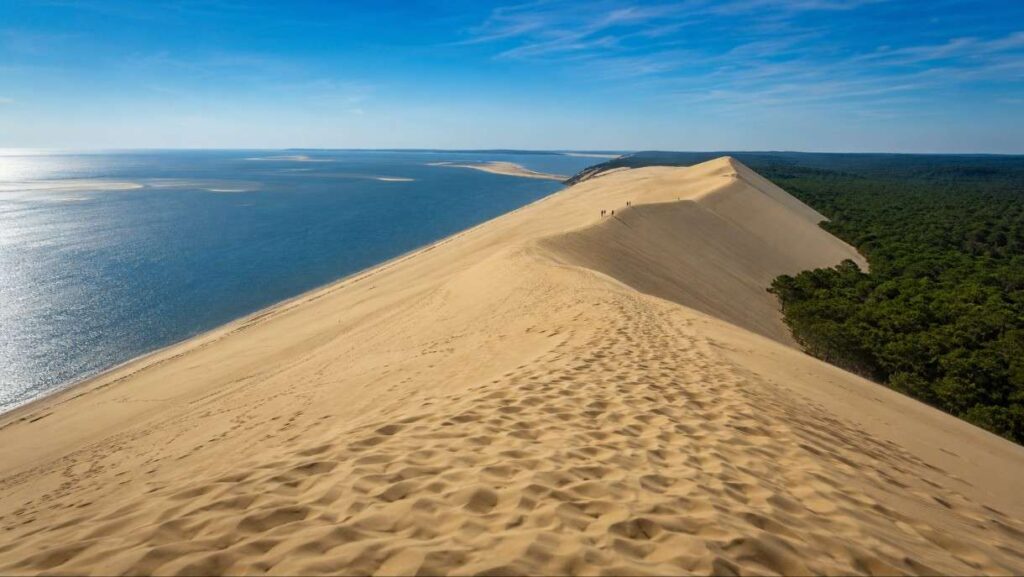
Those who find themselves in front of the Dune of Pilat for the first time experience a moment of astonishment. Like a huge wall of sand, the dune rises at the entrance to the Arcachon Basin and clearly dominates the surrounding landscape. On one side the Atlantic sparkles, on the other stretches an apparently endless pine forest. In between is a miracle of nature that attracts millions of visitors every year and simultaneously represents one of the most dynamic landscape formations in Europe.
With a height of about 101 meters, the Dune of Pilat is considered the tallest mobile dune in Europe. But its dimensions are by no means fixed. Wind, waves and storms continuously shape this enormous mass of sand. For this reason, the height, width and volume vary from year to year. The dune resembles an enormous organism in constant movement.
Its formation began several millennia ago. After the end of the last Ice Age, huge quantities of sand settled along the French Atlantic coast. Ocean currents transported the material along the coast, while strong winds carried it inland. Thus, over many generations, the large dune systems of Aquitaine were formed. The current Dune of Pilat developed step by step over about 4,000 years.
Particularly fascinating is its movement. Unlike a rock mountain, the dune does not remain fixed in its place. Every year it moves on average from one to five meters towards the east. The principle behind this phenomenon is almost simple: the wind pushes the grains of sand along the seaward side, which has a gentle slope. Upon reaching the crest of the dune, they slide down the steeper side facing the forest. This process repeats endlessly. Thus, the entire dune slowly but steadily shifts inland.
The consequences of this movement can be observed impressively on site. In many places, only the tips of the pines protrude from the sand. Some trees are still struggling against the enormous masses of sand, while others disappear completely beneath it. Those walking in the adjoining forest often find partially buried tree trunks – silent witnesses of a transforming landscape.
Not only nature has had to yield to the dune. Over the decades, the sand has engulfed roads, buildings, and even military installations from the Second World War. What was once visible today is hidden under millions of tons of sand. Isn’t that surprising? While humans often try to shape landscapes permanently, nature here writes its very own story.
The height of the dune also changes regularly. Many visitors think that the sand mountain grows skyward every year. In reality, the trend is much more fluctuating. In some years the dune increases in height, in others it loses several meters. Strong winter storms can remove large amounts of sand, while calmer phases favor new deposits. Experts have rather observed a slight decrease in the maximum height for a few years.
Another influence is climate change. The rising sea level and the increased frequency of extreme weather events put more pressure on the entire Atlantic coast. Storms attack the dune more intensely and change the distribution of the sand. However, scientists consider these developments in a differentiated way. Movement and transformation are indeed part of the very essence of the Dune of Pilat. Without wind and erosion, this unique landscape in its current form would not exist.
This is precisely where its special charm lies. The dune reminds us that nature is not a static backdrop. Everything changes – sometimes slowly, sometimes surprisingly quickly. Whoever ventures up the steep climb of the sand giant today and lets their gaze wander over the Atlantic, experiences a place that might already look a little different tomorrow.
Perhaps this is exactly what makes the Dune of Pilat so fascinating. It impressively demonstrates that change is not a sign of weakness, but part of the natural balance. And let’s be honest: how many places show a new face every year?
An article by M. Legrand