
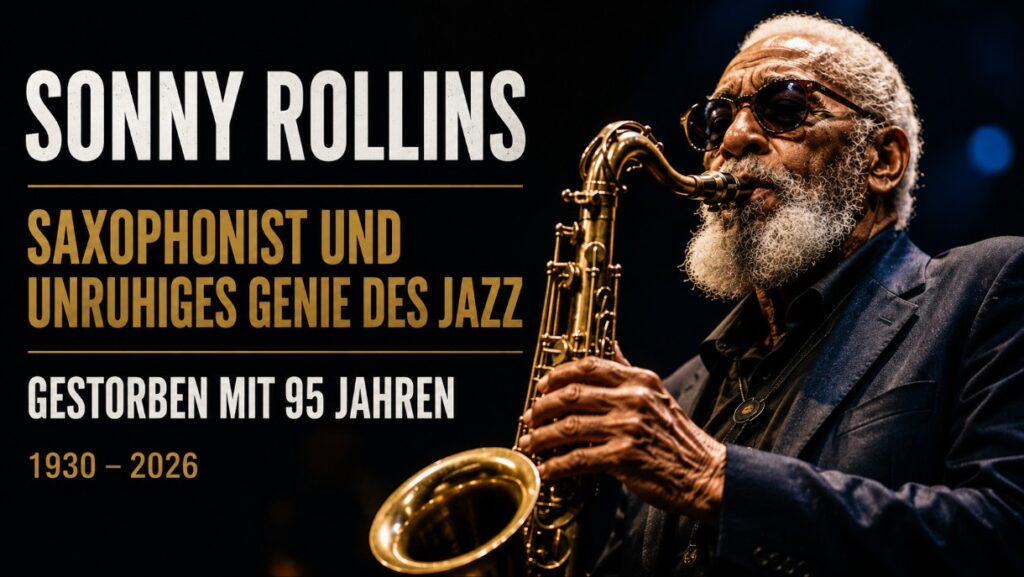
Jazz has lost one of its last giants. American tenor saxophonist Sonny Rollins passed away at the age of 95 in his home in New York State. With him, not just a simple old-school musician disappeared, but an artist who had continuously reinvented jazz for decades — a persistent and uncompromising artist who constantly questioned himself.
Rollins was not just part of a generation that played bebop; he was part of a generation that breathed it. His tone was distinctive: intense and rough, yet at times loose, and on the other hand playful and lively like a street musician on a hot summer night in Harlem. Many jazz fans considered him a musician worthy of standing shoulder to shoulder with John Coltrane and Charlie Parker, an honor rare in the jazz world.
Despite this, Rollins never felt that he was complete.
He called himself a “work in progress” until the end of his life, saying he was an unfinished piece. This one sentence says a lot about the life of this man. While other artists eventually preserved their own style like a family recipe, Rollins doubted everything — even his own masterpieces. Listening to old recordings was often painful for him. Too many mistakes, too much stagnation, too little truth.
Perhaps that was exactly his greatness.
Theodore Walter Rollins, born in Harlem in 1930, grew up in a musical family. His father played the clarinet, his sister the piano, and his brother the violin. At first, they tried to raise him as a pianist, but the boy was not very interested. Playing baseball on the street was much more fun. Then he discovered the saxophone. It was a decisive moment. At the age of 11, he held his first instrument, the alto saxophone, in his hand. From that moment, his journey began.
From his teenage years, Rollins played with legends like Thelonious Monk, Miles Davis, and Bud Powell. At that time, the New York jazz scene was a huge whirlwind of genius, drugs, and sleepless nights mixed together. Rollins became addicted to heroin early on, which led him to prison and even homelessness in Chicago. His career was on the verge of disappearing.
In 1954, he made a bold decision.
At an addiction treatment center in Kentucky, he fought to reclaim his life. Afterwards, Rollins spoke about a spiritual awakening. He said life suddenly acquired depth. Jazz was the same.
The following period was the one that made him immortal. The album “Saxophone Colossus,” released in 1956, is considered a milestone of hard bop. Tracks like “St. Thomas” still sound fresh and vivid, as if recorded just last night. Rollins’ playing was more than just technical skill. It had humor, irony, and sometimes a slightly provocative edge. He was as adept at telling musical stories to his audience as someone telling jokes in a pub.
And he did something that almost no one understood.
He suddenly disappeared in the midst of his prime. He neither performed nor recorded, but instead spent hours practicing alone, looking down over the East River from the Williamsburg Bridge in New York. There, he searched for a new sound and sought himself. Some might call it madness, but it was typical Sonny Rollins.
When he returned in the early 1960s, jazz had already changed. Free jazz was pushing aside the clear structures of bebop. Many musicians were confused by the new chaos, but Rollins was different. He dived into that change, experimented, and bewildered both fans and critics. For him, being lost was more frightening than failure.
Even people unfamiliar with jazz were unconsciously listening to Sonny Rollins’ music at some point. In the early 1980s, the nostalgic saxophone solo he played on the Rolling Stones’ song “Waiting on a Friend” introduced him to millions of people.
Rollins remained active even in old age. In his 80s, he continued to perform on stage, practiced daily, and trained as rigorously as a national athlete. That was until lung disease forced him to retire. His final performance was in 2012.
In his later years, his interviews often revealed calmness. There was constant self-criticism, but also a peace that came from reconciling with his own transience. Regarding unreleased recordings, he once said: After death, you can’t control anything anyway. To be honest — that might actually be a good thing.
What Sonny Rollins left to the jazz world is not a figure longing for nostalgic childhood.
He was a relentless explorer.
Author: C. Hatty