
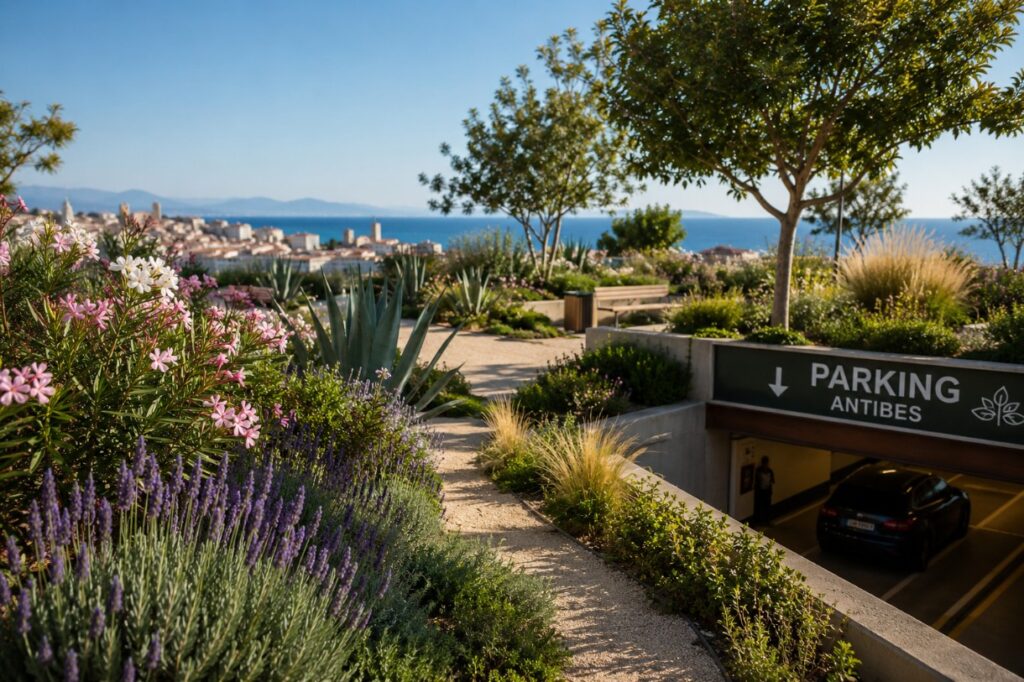
Anyone entering the space for the first time hardly thinks of concrete. Oleanders sway in the wind, lavender spreads its fragrance, grasses add light accents between agaves and shade-giving trees. The scene resembles a mature Mediterranean garden that has been part of the landscape for decades. However, this impression is deceptive: beneath this green oasis lies a parking garage.
Exactly in this lies the uniqueness of a remarkable project in Antibes on the Côte d’Azur. On a huge concrete slab, a garden was created that meets the challenges of a changing climate. What initially seems like a design experiment has developed into a flagship project for modern urban planning in the Mediterranean region.
The initial situation was anything but simple. A parking deck usually provides very poor conditions for plants. The available soil layer is limited, rainwater drains only partially, and every additional load must be carefully calculated. Large trees, dense shrub clusters, or extensive irrigation systems quickly encounter technical limits.
Instead of fighting these conditions, the planners chose a different path. They consistently oriented themselves towards the nature of the Mediterranean region. Why use plants that constantly require water when the area has, for centuries, nurtured species that handle drought excellently?
Today, lavender, robust grasses, oleander, agaves, and resilient shrubs shape the scene. The trees were also carefully selected. They provide shade, withstand summer heat, and require significantly less water than many classic urban trees. The result looks surprisingly natural — almost as if the vegetation had found its place on its own.
Behind this approach lies a long-term strategy. Antibes has been relying on so-called Mediterranean gardens for years. The goal is not only an attractive design of public spaces. Rather, green areas are meant to be created that will endure even when summers become hotter and dry periods longer.
At the same time, the understanding of urban greenery is changing. For decades, lush green lawns were considered ideal. Today, many municipalities in southern Europe show that such concepts reach their limits. A lawn in dry regions often resembles a thirsty guest who never gets enough. Mediterranean plants, on the other hand, manage with far fewer resources while still offering color, structure, and habitat for numerous insects.
A central role is played by water management. In a region increasingly suffering from drought, every saved liter counts. Therefore, Antibes relies on modern drip irrigation. Water reaches the roots directly instead of evaporating over large areas. This system is supplemented by the use of treated water and digital technologies that detect leaks early.
But the garden above the parking garage tells another story as well. It represents a change in thinking. Landscape architects and botanists today plan not only for the present but already consider the conditions of the coming decades. Which tree species survive longer heat waves? Which plants tolerate heavy rainfall after months of drought? Which combinations promote biodiversity?
The answers to these questions now shape many projects on the Côte d’Azur. The goal is green spaces that function largely autonomously and require little maintenance. Nature is not a decoration here but a model.
This approach is gaining importance especially in densely built cities. Where sealed surfaces once dominated, shady places to stay are now emerging. Plants cool their surroundings, store water, and create habitats for birds, insects, and other animals. At the same time, they improve people’s quality of life. Who doesn’t like to seek a spot under a tree on a hot summer day instead of on heated concrete?
The garden above the parking garage in Antibes impressively shows what such solutions can look like. It combines technical infrastructure with nature without one crowding out the other. Cars find their place underground while a lively green space grows above.
Perhaps that is the true message of this place. The future of the city is not necessarily created by more and more technology or ever new buildings. Sometimes a look at nature’s strategies suffices. For thousands of years, it has known ways to cope with heat, drought, and change.
Antibes has embraced this idea — and created a garden that serves as an inspiration far beyond its boundaries. Among lavender, oleander, and shade-giving trees grows not just greenery. Above a parking garage grows a vision of how cities can remain livable in a warmer world.
An article by M. Legrand