
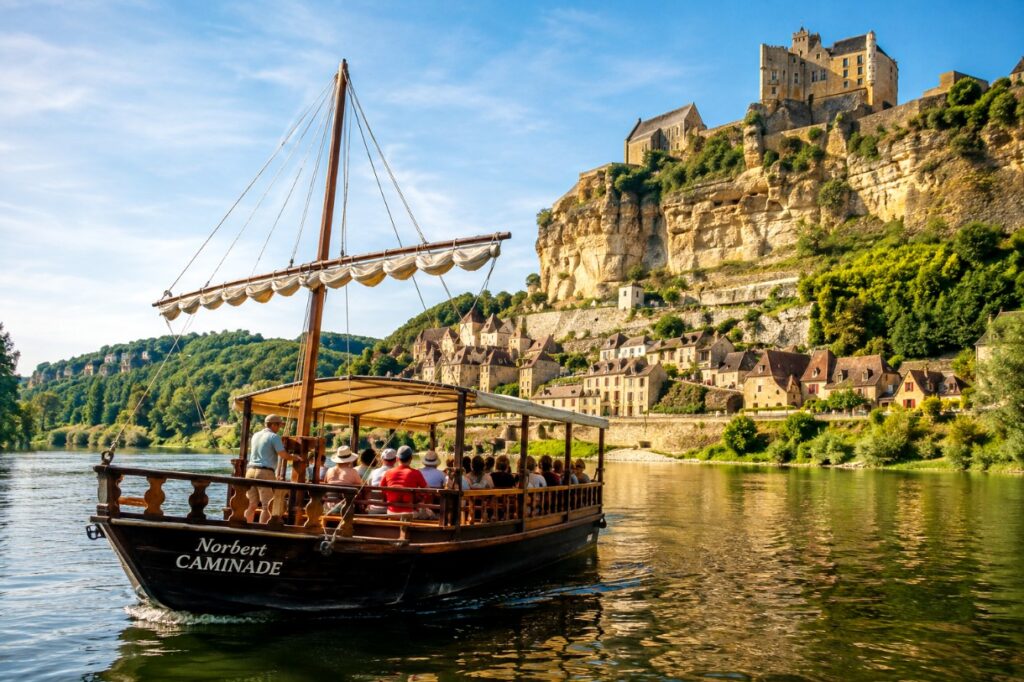
Unusual boats with broad hulls and flat bottoms glide across the calm waters of the Dordogne. Today, travelers sit aboard and enjoy the scenery. Around two centuries ago, these boats carried timber, wine, salt and other goods – and in doing so kept an important part of the regional economy running.
The gabarres of the Perigord therefore tell far more than just the story of old boats.
Those who step aboard take a short journey through time.
When the Dordogne Was Still a Trade Route
Long before railway lines and modern roads criss-crossed the country, the Dordogne was one of the region’s most important transport routes. For centuries, the Gabariers, the boatmen of these traditional vessels, used the river to carry goods from the Perigord towards Bordeaux.
The gabarres’ flat bottoms were ideally suited to the sometimes shallow water. They carried timber for Bordeaux’s famous cooperages, wine, walnut oil, chestnuts, truffles, salt and iron. Even cannons from the Perigord’s forges found their place on board. On the return journey, coffee, sugar, spices and salted cod reached the region.
A trade route on the water.
However, this had little in common with today’s leisurely sightseeing cruises. Floodwaters, rapids, sandbanks and suddenly changing water levels demanded a great deal from the boatmen. They had to know every stretch of the river.
Villages That Lived From the River
Trade on the Dordogne shaped numerous places along its banks.
In La Roque Gageac, now recognized as one of France’s most beautiful villages, up to two hundred gabarres called at the port every year in the 18th century. Merchants, fishermen and craftsmen lived from the constant arrival and departure of the boats.
Then the 19th century brought major change.
The railway transported goods faster and more reliably. It also did not depend on the Dordogne’s water level. Gradually, the gabarres disappeared from people’s everyday lives. An era came to an end.
Fortunately, their story was not over.
The Return of the Gabarres
Since the 1980s, replicas of the historic boats have returned to the Dordogne. They are modeled on traditional examples while meeting today’s safety requirements.
And honestly: where better to understand the history of this valley than from the water?
Seen from the Dordogne, the Perigord Noir reveals a different face. Limestone cliffs rise majestically above the river, old villages seem to grow directly from the rock, and castles stand like stone sentinels over the valley.
The Chateau de Castelnaud is particularly impressive from this perspective. During the trip, the boat guides tell stories of the Gabariers, life on the river, the landscape and small tales that appear in no guidebook.
In between, nature takes over the programme.
A grey heron waits motionless on the bank. With a little luck, a kingfisher darts across the water like a blue arrow. High above the valley, a black kite circles overhead.
Experiencing the Perigord Differently
That is probably the special appeal of a trip on a gabarre: the river pleasantly compels its guests to slow down.
Why always rush from one sight to the next?
During the trip, the Dordogne sets the pace. Reflections dance on the water’s surface, cliffs drift gently past, and medieval villages reveal views hidden from the road.
At the same time, the gabarres keep the memory of a vanished world alive. The boat guides speak of navigation techniques, dangerous stretches of river and the hard daily lives of the men whose work once supported entire families and villages.
History suddenly takes on a human face.
Cultural heritage is not found only in castles, churches or medieval lanes. It also lives on in old professions, inherited knowledge and stories passed down from generation to generation.
Today, trips on the gabarres are among the defining experiences of the Perigord Noir. And that is hardly surprising.
For around an hour, they give their passengers something that is sometimes lost in modern travel: time to look.
The Dordogne flows peacefully on, castles appear behind the trees, and for a brief moment one can almost believe that the heavily laden boats of past centuries are once again making their way to Bordeaux.
Two centuries have passed.
The river flows on.
M. Legrand