
Sometimes a single branch of a river is enough to change the world.
In Avignon, it does not even take ten minutes. A few steps across the Édouard Daladier Bridge, past the hum of scooters, tourist groups and the heavy walls of the City of Popes — and suddenly another time opens up. The sounds cease. The light changes colour. The wind smells of water, fig leaves and dry grass. Ahead lies the island of Île de la Barthelasse, this strange, quiet island in the middle of the Rhône, larger than some small towns and yet almost invisible in its rural character.
Anyone arriving here for the first time looks back at Avignon in surprise. There, on the other side, history imposes itself in monumental portions: the Papal Palace, medieval façades, the festival, souvenir shops, endless queues in front of cafés. Here, the clocks seem to tick only reluctantly.
Barthelasse seems like the opposite of European old-town romanticism.
And perhaps that is precisely where its strength lies.
While many cities today polish their historic centers like theatrical backdrops, this island preserves something unfinished, resistant. No grand staging. No perfect worlds of experience. Instead—poplar-lined avenues, vegetable fields, small jetties, leaning fences, and paths where only a tractor passes in the morning. Those who walk here can hear their own footsteps again. Strange, isn’t it? Right next to one of the most visited places in southern France, a landscape suddenly begins that is almost silent.
The Rhône seems slower here. As if the river, too, wanted to rest for a while.
The island has been part of Avignon’s life for centuries, although tourists often overlook it. Long before the historic center became a UNESCO symbol, Barthelasse supplied the city with vegetables, fruit and herbs. The Rhône’s alluvial soil created fertile ground, deep and dark, ideal for agriculture. Apricots, peaches, zucchinis, eggplants and those heavy, sun-warmed tomatoes that in Northern Europe almost seem legendary still grow here.
In the morning, just after sunrise, trucks head to the Les Halles market. Crates of asparagus, melons or herbs disappear into the kitchens of Avignon’s restaurants. A chef once said that Barthelasse can be recognized by the scent of its herbs. Perhaps that sounded a little pompous—but after lunch beneath the plane trees, you understand what it means.
Because the island also shapes the region’s cuisine. Not loudly. Not decoratively. But quietly, in a southern French way, when only a few ingredients are enough. Olive oil. Garlic. Thyme blossom. Roasted vegetables. Lamb from Provence. Pike-perch from the Rhône. To go with it—a simple Côtes du Rhône, lightly chilled, and somewhere the cicadas begin their nervous concert.
Often, nothing more is needed.
Barthelasse does not have exciting gastronomy in the modern sense. No molecular theatre. No culinary fireworks for Instagram. Its strength lies elsewhere: in an almost old-fashioned honesty. You sit beneath the trees, look at the river, and eventually realise that no one here is in a hurry. Even the waiters sometimes seem as though they have made a private agreement with the speed of the mistral.
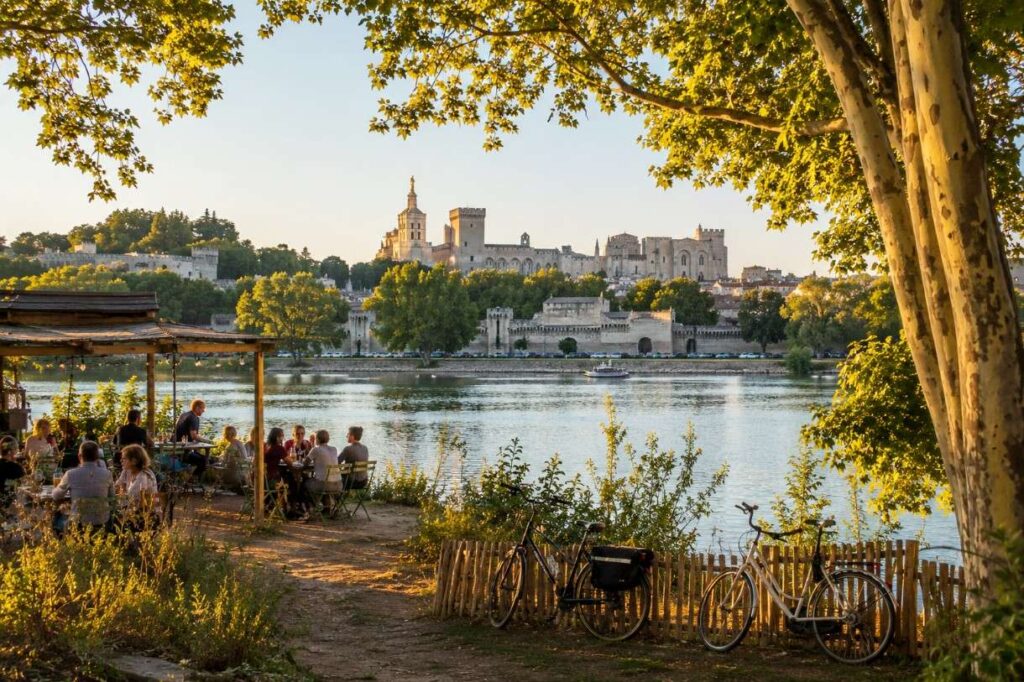
Of course, there are the typical guinguettes here—simple summer establishments by the water, half restaurant, half family celebration. Children run between the tables. Glasses clink on the terraces. Somewhere, chanson plays softly. And in the background, Avignon rises like a film set made of stone.
From Barthelasse, the city shows its most beautiful side.
Perhaps even its most genuine.
Because from this distance, Avignon loses its tourist excess. The walls suddenly seem less monumental, almost soft in the evening light. The Papal Palace then hovers above the treetops like a memory from another century. You understand why painters and photographers have sought precisely this view for decades. Not in the middle of the historic center, but outside—at a distance.
Distance changes everything.
People live on the island who experience this luxurious way of life every day. Some families have done so for generations. Others arrived later, drawn by the peace and the feeling of living both in the city centre and completely outside it. Many houses are hidden behind oleander hedges or tall trees. Some plots look improvised, almost as if they had grown together by chance. That is precisely what gives it its charm. Barthelasse rejects perfection.
On summer days, cyclists ride along the narrow paths by the river. Runners go for their morning jogs while mist still drifts over the water. Fishermen sit motionless on the bank, as if they have all day free—probably they really do. In the evening, couples arrive with picnic blankets. Then the western sun colours the Rhône copper, and suddenly southern France looks once again like it does in old films.
And yet this idyll carries a certain fragility within it.
The island has always lived to the rhythm of the river. The Rhône remains unpredictable. Floods here are not an exception, but part of history. Time and again, the river has flooded parts of Barthelasse, destroyed paths, entered homes, and reminded residents that nature cannot be tamed for long.
Perhaps this is precisely where the islanders’ particular mentality comes from. Those who live here accept a certain degree of uncertainty. The landscape changes. Paths disappear. Ground shifts. The Rhône sometimes recedes—and sometimes takes everything else with it.
At a time when many places seem sterile and organized, almost like a hotel catalogue, Barthelasse has something pleasantly wild about it. It does not follow the rules of tourist efficiency. No one here is constantly trying to attract attention.
The island simply exists.
That may sound banal, but it means something rare.
After all, many European cities are now struggling with their excessive staging. Old towns are turning into consumer backdrops. Cafés look alike from Lisbon to Prague. Everywhere, the same interior design ideas, the same photo spots, the same menus in five languages. Bartelasse almost defiantly avoids this rhythm. Perhaps that is precisely why more and more people are discovering it—mostly those looking not for sights, but for atmosphere.
Atmosphere is difficult to commercialize.
And it often arises where something remains imperfect.
On windy days, the Mistral lashes the island. Then the poplars rustle like ocean waves. Cyclists struggle against the gusts. The Rhône suddenly seems grey and serious. And soon afterward, complete silence reigns again. This changing light belongs to Provence just as much as lavender or pastis, though hardly anyone talks about it. Anyone who spends a few hours on Barthelasse will begin to understand that southern France has less in common with postcard idylls and more with these constant changes of wind, water and sun.
Perhaps this is precisely why the people of Avignon love their island so much: because it offers them refuge without forcing them to leave the city. A small escape from everyday life. Getting on a bicycle for a while during the day, crossing the bridge, sitting beneath the trees and watching the river—and sometimes that is enough to put one’s thoughts in order.
It sounds simple.
And it really is simple.
But simple things often have the greatest impact.
Barthelasse reveals its true charm especially in the evening. As soon as the day begins to cool and the heat slowly fades from the ancient stones, the mood changes almost imperceptibly. Voices grow quieter. The light sinks deeper. Seagulls fly over the water. Across the river, Avignon begins to glow. The windows of the Papal Palace shimmer gold, and the city’s silhouette is reflected in the Rhône.
From the island’s perspective, Avignon seems almost unreal—like a historical backdrop that someone carefully built on the other side of the river.
And it is precisely at this moment that you suddenly understand the true wealth of this place.
Not luxury in the classical sense. No glamour. No exclusivity. But space. Silence. Air. A corner of Provence that still escapes the constant spectacle. Those who sit there sometimes hear only the water lapping against the riverside stones and, somewhere in the distance, the clatter of a bicycle.
Nothing else is happening.
Fortunately.
Article by M. Legrand