
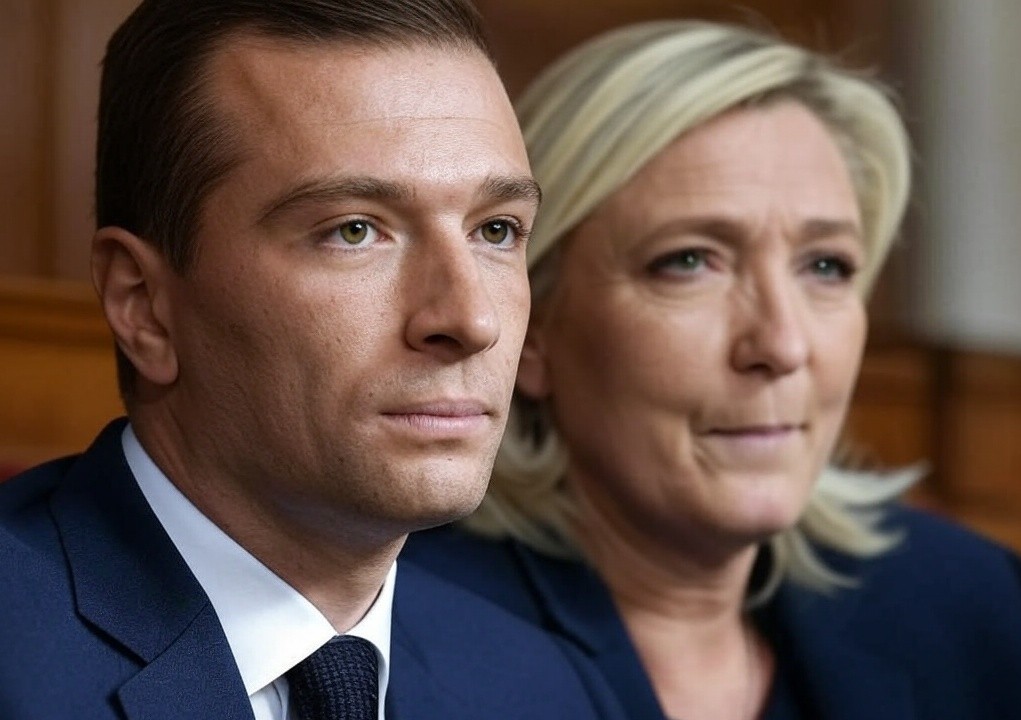
It still happens discreetly, almost silently. No official press photos, no joint statements, no demonstrative symbolism. And yet the development says a lot about the state of French politics ahead of the 2027 presidential election: The Rassemblement National is increasingly being treated as a potential governing party by foreign diplomats.
Particular attention was drawn in recent weeks to the meeting between Jordan Bardella and the German ambassador in Paris, Stephan Steinlein. The conversation is said to have taken place already in February in a deliberately informal setting. The encounter was hardly officially commented on. But the mere fact that Berlin is seeking direct exchange with the RN chairman marks a political change of considerable significance.
Until a few years ago, the RN was regarded in many Western capitals as a political force outside the accepted republican spectrum. Diplomatic contacts existed only sporadically, usually remaining at a technical level and strictly below symbolic visibility. Today, this attitude is visibly changing.
From protest camp to possible governing party
The main reason for this development lies in the political reality of France itself. The RN is no longer merely a protest movement on the fringes of the system. Since the presidential elections in 2017 and 2022, the party has structurally established itself at the political center of power struggles. Marine Le Pen reached the runoff twice, Jordan Bardella further professionalized the party organization, and in polls, the nationalist right-wing camp is now moving at a level that makes a victory in 2027 no longer seem unrealistic.
Added to this is the legal uncertainty surrounding Marine Le Pen. Her conviction in connection with the affair involving parliamentary assistants to the European Parliament has triggered a strategic transition phase within the RN. Should her possible ineligibility ultimately be confirmed, Bardella would almost automatically rise to become the presidential candidate.
For foreign governments, this fundamentally changes the diplomatic logic. Embassies serve not only to maintain existing relationships but above all to prepare for political changes of power. Diplomats must get to know potential decision-makers early, analyze their networks, and assess their foreign policy positions. Exactly this process now seems to be taking place at the RN.
The lesson from Trump and European right-wing shifts
The experience of 2016 still influences many European foreign ministries. Donald Trump’s election victory caught many Western diplomats largely unprepared. Contacts with the Republican Trump camp were often insufficient at the time, and political assessments proved to be flawed. This experience shapes the current approach to populist or nationalist parties in Europe.
The attitude towards the RN thus increasingly follows a pragmatic pattern: political approval is not the priority, but strategic preparation. Diplomats want to know how a possible President Bardella or a government involving the RN would position themselves regarding the European Union, NATO, the war in Ukraine, or relations with Washington and Moscow.
Especially in the area of security and European policy, the RN remains difficult to calculate for many partner states. Although the party has significantly moderated its rhetoric towards the EU and NATO in recent years, doubts about the long-term strategic reliability of the camp around Marine Le Pen remain in several European capitals.
The German Special Case
The development in relations with Germany is particularly remarkable. Hardly any other country viewed the Front National, later the RN, with comparable skepticism for decades. There are historical as well as political reasons for this.
The Franco-German partnership has formed the foundation of European integration since the 1950s. Parties that openly questioned this integration idea or adopted nationalist tones were traditionally viewed with considerable suspicion in Berlin. Added to this were the long-standing close contacts of the Front National with Russian interests as well as recurring controversies over historical relativizations within the old party milieu under Jean-Marie Le Pen.
That a German ambassador is now seeking direct dialogue with Bardella is therefore much more than diplomatic routine. It signals recognition of a new political reality: Berlin now at least considers a power gain by the RN possible.
However, this change by no means implies political closeness. Rather, it is a form of sober risk management. Germany is trying to be prepared for various scenarios – including those it would politically prefer to avoid.
International De-demonization
At the same time, the RN benefits from a broader European trend. National-conservative or right-wing populist parties are no longer isolated exceptional cases in Europe. In Italy, Giorgia Meloni is Prime Minister, in the Netherlands migration-critical forces dominate political debate, and in several Central and Eastern European countries, national sovereignty concepts have shaped government policy for years.
This automatically also changes the perception of the RN. What was once considered a radical French peculiarity now increasingly appears as part of a Europe-wide political trend.
This development significantly facilitates diplomatic contacts. The political cost of talks with the RN has decreased. While such meetings were once quickly interpreted as taboo breaches, today they are regarded in many places as an expression of professional foreign policy preparation.
Particularly symbolic are reports of contacts between RN representatives and Israeli diplomats. Just a few decades ago, such an approach would have been hardly conceivable given the historical burdens of the Front National. The RN has been intensively striving for international de-demonization for years and tries to present itself as a respectable conservative force in foreign policy. Parts of international diplomacy now seem willing to at least pragmatically acknowledge this development.
A cautious normalization
Nevertheless, the new openness towards the RN remains marked by caution. Most meetings take place discreetly, often without public communication. Embassies avoid demonstrative gestures and make sure not to suggest political support.
This restraint is explained by the continuing high sensitivity of the topic in France itself. The RN continues to strongly polarize society. Many European governments want to avoid being indirectly drawn into the French presidential election campaign through overly visible contacts.
At the same time, however, there is growing recognition that political isolation is no longer a realistic strategy. The RN today has a stable voter base, organizational professionalism, and considerable media presence. Among parts of the French population, the party is no longer seen simply as an opposition to the system, but as a possible government alternative.
This is precisely the real significance of the recent diplomatic contacts. They mark less an ideological rapprochement and more the recognition of a power option. The RN is no longer viewed exclusively as a permanent opposition actor but as a potential bearer of state responsibility.
In the world of diplomacy, this difference is fundamental. Because diplomats do not only speak with today’s governments. They always prepare for the governments of tomorrow.
By Andreas M. Brucker