
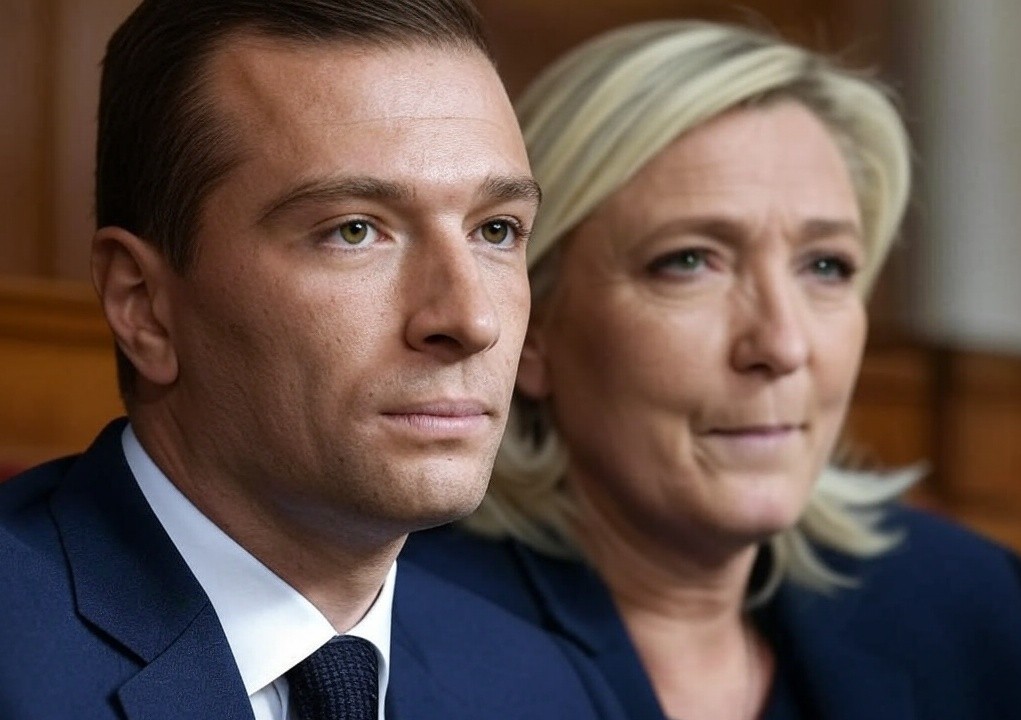
The French Rassemblement National finds itself in a paradoxical situation. Never before has the party been so close to power – and yet, it has rarely been so unclear who will actually lead it. While France’s political center continues to weaken and the traditional parties of the left and the conservative right suffer from structural weakness, Marine Le Pen’s camp is already preparing for the 2027 presidential election with remarkable discipline. However, at the center of this preparation is no longer just the question of electoral success. What has become decisive is the ability to be perceived as a credible governing party.
This shift marks a profound transformation within the RN. For decades, the party defined itself primarily as a protest movement against elites, globalization, and European integration. Today, it is attempting to take the final step from an opposition phenomenon to a potential state party. This very transition represents the true strategic challenge.
The Long March Towards Normalization
Marine Le Pen has systematically driven the transformation of her party since taking over the Front National in 2011. The so-called “dedemonization” aimed to shed the legacy of her father Jean-Marie Le Pen and integrate the RN within the institutional framework of the French Republic. Anti-Semitic provocations largely disappeared from the party’s public discourse; instead, issues of everyday life, purchasing power, and social insecurity came to the forefront.
This course has proven politically successful. In the 2022 presidential election, Marine Le Pen reached over 41 percent of the vote in the second round – a historic high for the French far-right party. At the same time, the RN achieved a breakthrough in the National Assembly. Gradually, the party evolved from one of protest to one with territorial anchorage.
It is precisely this local anchoring that is now changing the political dynamics. The RN today has mayors, regional politicians, and a growing network of municipal officeholders. This reduces a previous Achilles’ heel: the difficulty of obtaining the necessary 500 sponsorship signatures for a presidential candidacy. The party now no longer sees this hurdle as an existential threat.
Government Competence Instead of System Criticism
Within the RN, it seems to have been recognized that the political conquest of France might fail less due to mobilizing its own electorate than due to doubts among moderate voters. Therefore, the programmatic work is increasingly focusing on credibility and administrative seriousness.
Several thematic blocks are already fixed: purchasing power, internal security, migration policy, economic sovereignty, and reindustrialization. What is new, however, is the tone. The party strives to appear less alarmist and more statesmanlike. Particularly in economic policy, the RN tries to avoid previous imprecision.
This especially concerns the European question. Just a few years ago, the exit from the euro was central to the party’s platform. Marine Le Pen’s position was seriously damaged in the 2017 TV debate against Emmanuel Macron, as her economic concepts appeared improvised and technically underdeveloped. The party leadership took lessons from this. Today, the RN hardly speaks of an institutional break with the EU anymore but prefers the term “sovereignty” within European structures.
The party is also seeking a balance in social policy. On the one hand, it wants to maintain its popular protective promises towards workers, employees, and rural milieus. On the other hand, it tries not to alienate economically liberal and conservative voter groups. This balance could be decisive in 2027.
Marine Le Pen or Jordan Bardella?
Above all, however, there is legal uncertainty surrounding Marine Le Pen. The proceedings concerning the alleged fictitious employment of parliamentary assistants in the European Parliament could have significant political consequences. The expected appeals decision in 2026 already influences the party’s strategic planning.
Officially, Marine Le Pen remains the “natural candidate.” Internally, however, the RN is preparing two scenarios in parallel. The first is the party leader’s fourth presidential candidacy – a model of continuity. The second scenario would be handing over to Jordan Bardella, the young party chairman and currently the most popular politician of the French right.
This dual preparation reveals a structural tension. Marine Le Pen still embodies the social and protectionist line of the RN. Her discourse strongly targets economically vulnerable voter groups, workers in structurally weak regions, and those parts of France that feel excluded from the liberal globalization model.
Jordan Bardella, by contrast, represents a modernized right-wing with a stronger identity focus and partly economically liberal accents. His style is more media-savvy, less confrontational, and more tailored to urban middle classes. He appeals to conservative voters who have become alienated from the Republicans but have long harbored reservations about the RN.
Herein lies a strategic risk. Although the RN demonstrates a facade of unity, different ideological focuses could become visible in the medium term. The party must prevent a tactical dual strategy from turning into an open succession rivalry.
The Crisis of the Political Center
However, the rise of the RN is not explained solely by its own professionalization. Equally decisive is the weakness of its opponents. Emmanuel Macron has dominated French politics since 2017 but has not built a stable political successor organization. The centrist camp increasingly appears personalized and exhausted.
At the same time, the traditional right remains divided. Les Républicains have struggled for years over their political identity between liberal-conservative governing capacity and national-conservative rapprochement to the RN. The left, in turn, appears fragmented and strategically disoriented.
In this constellation, the RN benefits from a historic trend: the progressive decoupling between cultural elites and parts of the lower and middle classes. Issues of purchasing power, migration, and public security now hold political centrality in France that structurally benefits the party.
Added to this is a European context. Right-wing nationalist parties in many countries have evolved from anti-system movements to possible government actors – in Italy, the Netherlands, or parts of Scandinavia. The RN closely observes these developments. The goal is to present its own claim to power as part of a broader European normalization of national-conservative parties.
The crucial question remains open: Can a party whose identity was based on opposition for decades actually govern without losing its political core? The RN is approaching this point faster than expected. Yet, the more realistic the prospect of power becomes, the more the political debate shifts from outrage to responsibility.
The French presidential election of 2027 could therefore be less a classic election campaign than a test of institutional maturity. No longer is the RN’s protest ability the focus, but its capacity to generate trust in stability, administrative competence, and economic predictability.
That Marine Le Pen’s legal future could determine which face this transformation will take gives the upcoming election a special dynamic. France may thus be witnessing the beginning of a premature succession within the political force poised to assume control of the Fifth Republic for the first time.
Author: P. Tiko