
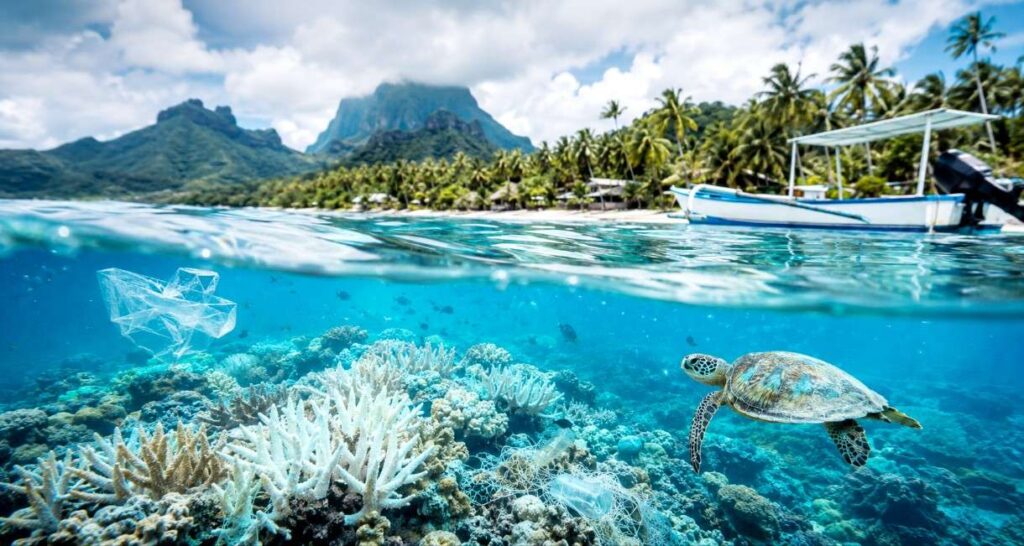
For those arriving in French Polynesia for the first time, the landscape looks almost like a visual trick. The sea glows turquoise, as if someone had poured color into liquid glass. Rays swim beneath the boats, sea turtles slowly rise from the depths, looking like ancient creatures from another era. And beyond the coral reefs, dolphins leap from the water, as if they had come to confirm for themselves the myth of the last paradise.
But where this postcard-like idyll begins, marine researchers have been recording a quiet alarm for years.
It is not loud. Not dramatic. Not Hollywood-style destruction or sudden mass die-offs. Rather, the order of the ecosystem is slowly shifting—centimeter by centimeter, degree by degree.
Polynesian lagoons are among the most biodiverse marine areas in the Pacific. Coral reefs form vast underwater cities there. Thousands of species live within this fragile web of limestone, light, and currents. Fish hide among coral branches, young marine life grows there under protection, and sharks patrol the reef edges like guardians of an ancient system.
And yet, something is beginning to collapse.
The problem begins with “heat.” More precisely, with too much heat.
The oceans store most of the heat caused by human-induced climate change. For people, an increase of one or two degrees often sounds harmless, but for corals, this change means stress—serious stress. Corals respond with a kind of biological emergency shutdown. The microscopic algae that live symbiotically with them leave the coral tissue. What remains are eerily white reefs.
Scientists call this phenomenon coral bleaching.
The term sounds almost elegant, but in reality it is a struggle for survival.
When the algae disappear, corals not only lose their color but also their most important source of energy. If high temperatures persist, entire sections of reef die off. What is lost then resembles the collapse of a major city underwater. Fish lose their hiding places, food chains are disrupted, and coasts lose their natural breakwaters.
In Polynesia, this change has not yet appeared as dramatically as in parts of Southeast Asia or the Caribbean. Not yet.
These short words now carry the weight of a threat.
However, there are still regions where reefs appear to be remarkably resilient. The vast expanse of French Polynesian waters protects some atolls from immediate overexploitation. Some islands are extremely remote and have very few inhabitants. Nature has, so to speak, gained some time.
But how long will that last?
Marine heatwaves are now also striking remote regions of the Pacific. Scientists no longer call them exceptional events, but a new reality. The sea is changing its nature. Slowly. Steadily.
And almost invisibly.
Perhaps that is the true tragedy of this change. Burning forests produce shocking images. Melting glaciers do too. But the death of coral reefs happens silently. Underwater. Far from news broadcasts.
Tourists sometimes snorkel over already damaged reefs without noticing the difference. The sea is still blue. The sun still shines. The scenery still works.
Like a play whose stage looks magnificent even though chaos already reigns behind the curtain.
Then there is the rubbish.
Even on remote atolls, fragments of plastic now wash ashore—bottles, fishing nets, packaging, tiny plastic particles. The Pacific functions like a vast transport system for the global throwaway society. What is thrown into the sea in Asia, America, or Europe is often carried thousands of kilometres by ocean currents.
The absurdity of this situation is almost literary: places with hardly any industry are fighting waste from all over the world.
Sea turtles mistake plastic bags for jellyfish. Seabirds feed colourful pieces of plastic to their chicks. Microplastics enter fish and corals and ultimately end up on human plates as well.
At times, it seems as though humanity has inscribed its own restlessness into the sea—ground down into billions of tiny particles.
A fisherman from the Tuamotu Islands once told a French journalist that the sea used to “smell clean.” Now, he says, he regularly finds plastic in the stomachs of his catch. Such words carry a weight that no statistic can match.
Because suddenly this is no longer merely a matter of environmental policy.
It is also a matter of losing what feels familiar.
Fishing is also altering the balance of ecosystems. Polynesia is considered a region with relatively moderate fishing pressure, yet pressure on certain species is still increasing. Large predatory fish in particular are coming under growing stress — tuna, sharks, and several reef fish.
Sharks in particular play an important role in marine ecosystems. They regulate the populations of other species, thereby stabilizing complex food webs. When these apex predators disappear, the entire ecological hierarchy is disrupted.
Humans are not simply removing individual animals.
They are doing the same as pulling support beams out of a building.
Especially paradoxical is the cultural perception of sharks. For decades, Western films have portrayed sharks as monsters. By contrast, in many Pacific cultures, sharks have traditionally been regarded as spiritual beings or guardians. Now, these very ancient predators themselves need protection from human activity.
What a strange story.
And there is another process that most people never experience directly. But it may change everything: ocean acidification.
The ocean absorbs large amounts of carbon dioxide from the atmosphere. As a result, the chemical composition of the water gradually changes. For organisms that produce calcium carbonate, such as corals and certain shellfish, this is a serious problem. Their structures grow more slowly, become more fragile, or dissolve more easily.
In other words: the ocean is losing stability at the molecular level.
This progression is not a particularly dramatic topic. No one eagerly films changes in water chemistry. And yet, it is probably precisely there that the future of tropical seas will be decided.
Polynesia appears to be a symbolic place in this global crisis. For decades, the Western imagination has projected images of primitivism and purity onto these islands. Paul Gauguin turned it into art. Travel guides turned it into business. Today, influencers are turning it into a digital landscape of longing.
But what happens if even what was thought to be “untouched” is no longer untouched?
Perhaps that is where the real shock lies.
Polynesia is no longer merely telling a regional environmental history. Rather, these islands show just how global the ecological crisis has become. Even regions that are comparatively less industrialized, have low population density, and contain large protected areas can no longer escape the effects of human-caused change.
The atmosphere has no borders. The same is true of ocean currents.
Of course, countermeasures also exist. Marine protected areas have been established in some archipelagos. Local communities are once again embracing traditional forms of sustainable resource use. Scientists are attempting coral cultivation and reintroduction programs. In some areas, certain fishing methods are being banned or protection of shark populations is being strengthened.
All of this helps.
But is it enough?
This is precisely where the debate is changing. For a long time, people believed that local conservation measures could absorb many of the problems. Now even optimists are beginning to realize that local solutions alone can hardly counter global causes.
Even a perfectly protected atoll remains dependent on global emissions. A clean beach will not stop the Pacific plastic gyre. Even strictly managed fisheries cannot prevent marine heatwaves.
Humanity is currently experiencing a strange historical situation: never before have we possessed so much technological power, yet we seem astonishingly clumsy at protecting the stability of our planet.
Perhaps that is precisely what explains the growing melancholy in many environmental debates.
In the past, conservation was often discussed with confidence. Today, much of it sounds more defensive — as if it were an attempt to at least delay losses.
And yet, scenes of hope are emerging in Polynesia. Young marine biologists are working with local fishers. Children are learning traditional knowledge about lagoon ecology at school. In order to recover, some communities completely protect certain reef areas for a period of time.
It is a small step.
But perhaps that is exactly where real change begins.
Not with huge conferences or sentimental speeches, but with people treating their immediate environment differently.
The lagoons of Polynesia still look like a promise. Turquoise. Quiet. Beautiful in an almost unreal way.
But beneath that beauty, a struggle is underway that is far greater than the islands themselves. It is no longer simply about corals or fish. What is at stake is whether modern society can learn to live within ecological limits.
Or will even the most remote paradise ultimately become merely a backdrop for a lost equilibrium?
Article: M. Legrand