
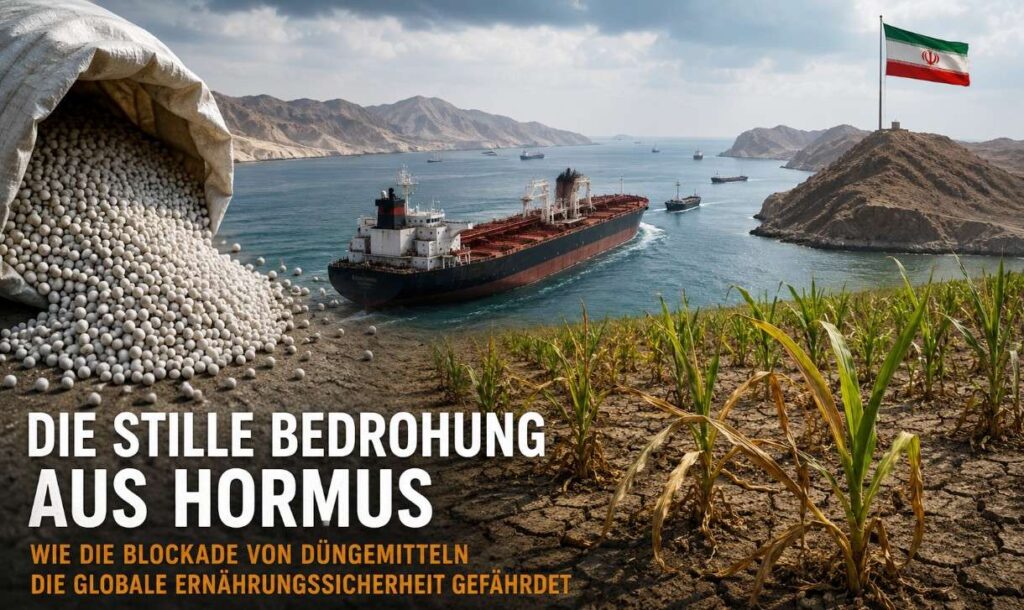
The Strait of Hormuz has been regarded as a pivotal hub of the global economy for decades. Every day, oil and liquefied gas tankers pass through the narrow strait between Iran and Oman. However, the region’s central importance to global agriculture is less well known. As conflict in the Middle East intensifies, Iran’s blockade of the strait is putting pressure not only on energy markets but also on fertilizer supplies, potentially having serious consequences for billions of people.
International organizations are warning of the possibility of developments that go beyond rising agricultural commodity prices. Modern agriculture relies heavily on nitrogen, phosphate, and potassium fertilizers. If a significant part of these supply chains is disrupted, yields of staple food crops such as rice, wheat, and maize could decline, with particularly severe effects in already vulnerable regions of Africa and Asia.
The Persian Gulf: Center of the Global Fertilizer Industry
The countries of the Persian Gulf play an important role in global nitrogen fertilizer production. Qatar, Saudi Arabia, the United Arab Emirates, and Iran have abundant natural gas reserves, the key raw material for producing ammonia and urea. Urea in particular is the most widely used nitrogen fertilizer worldwide.
According to estimates, around one third of global seaborne fertilizer trade originates in this region. Urea exports, with a share of approximately 30–35%, are particularly affected, and the Persian Gulf region is also highly important for ammonia trade.
This infrastructure has been severely damaged by the months-long blockade of the Strait of Hormuz. Numerous cargo ships are avoiding the route or are delayed for safety reasons, while airstrikes have also damaged production facilities. Qatar’s Ras Laffan industrial complex is reported to have been particularly heavily affected.
Several countries in the region have reduced or temporarily suspended production. As a result, not only has export capacity declined, but precursor products needed by other fertilizer manufacturers are also becoming scarce on the global market.
Why There Are No Strategic Fertilizer Reserves
Unlike oil, fertilizer has hardly any internationally coordinated emergency reserves. Global agriculture operates within limited time windows, and sowing and fertilization cycles cannot be significantly postponed. If fertilizer supplies are delayed, crop yields may decline irreversibly.
Fertilizer production is also energy-intensive. Natural gas is used not only as an energy source but also as a basic chemical feedstock for ammonia synthesis. Rising gas prices have an immediate impact throughout the supply chain.
The current situation is similar to the instability seen during the 2007/08 food crisis and after Russia’s invasion of Ukraine in 2022. At that time, fertilizer prices surged within a few months, and many developing countries had to expand subsidies or reduce imports.
Today, the situation in some regions is more severe. Many countries have high public debt, weak currencies, and limited fiscal capacity, while their populations continue to grow rapidly.
Africa Particularly Vulnerable
This crisis could hit several African countries particularly hard. Many countries in sub-Saharan Africa import substantial amounts of fertilizer from Persian Gulf countries. Sudan, Tanzania, Somalia, Kenya, and Mozambique in particular are likely to be heavily affected.
A structural problem in African agriculture is its production system centered on smallholder farmers, who have very limited reserves. Rising operating costs can hardly be mitigated in these areas.
Even a small price increase forces farmers to reduce fertilizer use. In the short term, this can lower production costs, but in the long term it significantly reduces yields. Maize and grain cultivation in particular are highly sensitive to nitrogen shortages.
The situation in countries such as Malawi is even more urgent. Agriculture there depends almost entirely on imported fertilizer, and it is both the most important sector of the economy and the foundation of food security.
The UN is therefore warning of the possible spread of a hunger crisis. Millions of people could fall into acute food insecurity.
Risks in densely populated, intensive-farming Asia
The situation in Asia is even more complex. India, Pakistan, Bangladesh, and Sri Lanka are among the world’s largest fertilizer consumers. These countries have intensive agricultural structures and depend heavily on regular nitrogen supplies.
Rice production in particular requires large quantities of urea. Supply delays or price increases have a direct impact on production volumes and food prices.
For decades, India has sought to guarantee stable prices for farmers through subsidy programs worth billions of dollars. However, even the government in New Delhi is facing financial limits. The Narendra Modi government is therefore actively promoting the efficient use of fertilizers and alternative cultivation methods.
Pakistan is suffering from another problem: energy shortages. Limited gas supplies have forced several fertilizer plants to reduce production.
In densely populated Asian countries, rice, wheat, and corn form the core foundation of food security. Even small declines in production can lead to major social and political tensions.
Brazil and the global agricultural market
Latin America is also not immune to this crisis. Brazil, a major exporter of soybeans, sugar, and corn, imports around one-fifth of its fertilizer from the Persian Gulf region.
Brazil’s importance extends beyond domestic supply, playing a central role in the global supply of feed and agricultural products. A decline in Brazil’s harvest could further intensify rising global prices.
International fertilizer prices are currently rising sharply. Experts expect prices in the first half of this year to be 15–20% higher than in the previous year. Rising transport and energy costs are also contributing.
Even more problematic is market instability. Many importing countries delayed orders in the hope of easing tensions, but if panic buying now occurs, further sharp price increases are feared.
A problem beyond a simple fertilizer crisis
This situation shows how closely energy, security, and food policy are interconnected. Agriculture depends heavily not only on fertilizers, but also on smooth transport, fuel supplies, and stable raw material markets.
Another uncertainty has now been added. Meteorologists are concerned that a strong El Niño event could return at the end of the year. In the past, El Niño has caused droughts, crop damage, and extreme weather events.
If climate stress and geopolitical crises occur at the same time, chain reactions unfold worldwide. Particularly vulnerable countries have few resources to mitigate such shocks.
Even if the blockade of the Strait of Hormuz is lifted in the short term, the repercussions will continue for months. Production disruptions cannot be made up immediately, and a global shortage of transport capacity makes it difficult to process backlogged goods quickly.
The current crisis exposes the structural weaknesses of globalized agriculture. The food supply of billions of people depends on a few geopolitical chokepoints. If even one of them becomes unstable, the entire supply chain can be shaken.