
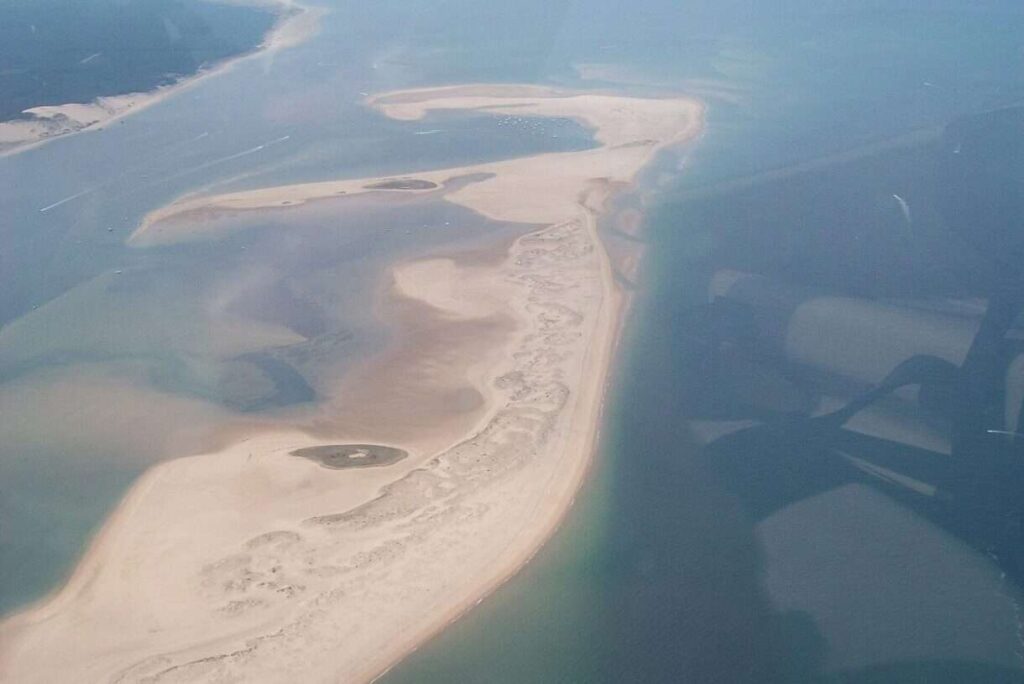
Those who reach the entrance to the Arcachon Basin for the first time rarely forget the view. Directly opposite the famous Dune du Pilat lies a fascinating landscape of sand, water, and sky: the Banc d’Arguin. This constantly shifting natural area has been one of the best-known landmarks of the French Atlantic coast for decades. But today, this unique piece of nature faces an uncertain future.
The changes are happening rapidly. Where a several-kilometer-long sandbank once stretched out just a few years ago, the area has now noticeably shrunk. Storms, high waves, and strong sea currents relentlessly erode the fragile formation. The winter months in particular leave their marks. After several severe storm events, entire sections of the sandbank disappeared beneath the waves. Those who visit the area regularly often notice the changes within just a few months.
Movement, however, is actually part of the nature of the Banc d’Arguin. For centuries, wind, tides, and sea currents have continuously reshaped the landscape. The sandbank migrates, changes its form, and adapts to the forces of the Atlantic. Fishermen and sailors knew this spectacle long before scientists began to systematically observe its development.
But today, it is noticeable that the changes are clearly accelerating. Many experts see this as a sign of the increasing strain on coastal regions from extreme weather events. Nature still follows its own laws, but the intensity of these processes seems to be increasing. The result is visible right before the eyes of visitors: the sandbank is losing both area and stability.
What at first glance might seem like a landscape problem actually has far-reaching consequences. The Banc d’Arguin is much more than just an impressive sand landscape. Since its designation as a nature reserve, it has served as a refuge for numerous animal and plant species. Especially in a time when natural habitats are becoming increasingly rare, this place holds invaluable significance.
Over two hundred bird species have already been observed here. Some spend the summer on the Atlantic coast, while others pause here during their long migrations between Northern Europe and Africa. For migratory birds, the Banc d’Arguin is like a rest stop in the middle of a long and exhausting journey.
The area is especially known for its terns. Year after year, they find ideal breeding conditions on the sandy surfaces. But precisely these surfaces are increasingly shrinking. Where once numerous birds built their nests, there is often little space left today. This puts nature under pressure.
The plant world is also suffering from these developments. Some protected species have already disappeared from the areas most affected by erosion. Thus, the changes affect not just individual animals or plants, but the entire ecological balance of the reserve.
Sometimes, a walk along the coast is enough to understand the fragility of this system. A strong gust of wind lifts sand grains, waves crash against the shore, continuously reshaping the landscape. Everything seems both powerful and vulnerable at the same time. Exactly this is the special fascination of this place.
The impacts, however, extend far beyond nature conservation. Oyster farming in the Arcachon Basin also feels the effects. The region is one of the most important oyster areas in France. Numerous families have lived from this tradition for generations.
But the changes in sandbanks and seabeds are making work harder for oyster farmers. Some oyster parks are increasingly silting up; others lose their original conditions due to changed current patterns. Equipment and facilities that were once optimally positioned suddenly find themselves in unsuitable locations. For the businesses, this means additional costs and uncertainty.
Locals observe the developments with mixed feelings. On the one hand, they know the Banc d’Arguin has always been a lively and changeable place. On the other, concerns are growing that the current changes have reached a new dimension. No one can say for sure today what the landscape will look like in ten or twenty years.
This is the great challenge. Nature cannot be stopped and can only be controlled to a limited extent. At the same time, awareness grows about how valuable such habitats are for future generations. The Banc d’Arguin reminds us that even the most famous landscapes are not eternal.
Anyone who has once looked out over the wide sandy surfaces quickly understands why this place fascinates so many people. The light is constantly changing. Seagulls glide over the water. In the distance, the Dune du Pilat rises as the Atlantic continuously shapes and forms the coast. It is a spectacle that reveals both beauty and transience.
Will the Banc d’Arguin one day grow again and regain lost areas? Or are we currently witnessing the beginning of a profound transformation that will permanently change the face of this unique landscape?
So far, there is no clear answer. The only certainty is that the famous sandbank of Arcachon is under more pressure today than ever before. It is thus not only a symbol of the beauty of the French Atlantic coast but also an impressive example of the challenges many coastal regions face in the 21st century.
The Banc d’Arguin remains a natural wonder. But its fate shows how quickly even seemingly unchangeable landscapes can be shaken.
An article by M. Legrand