
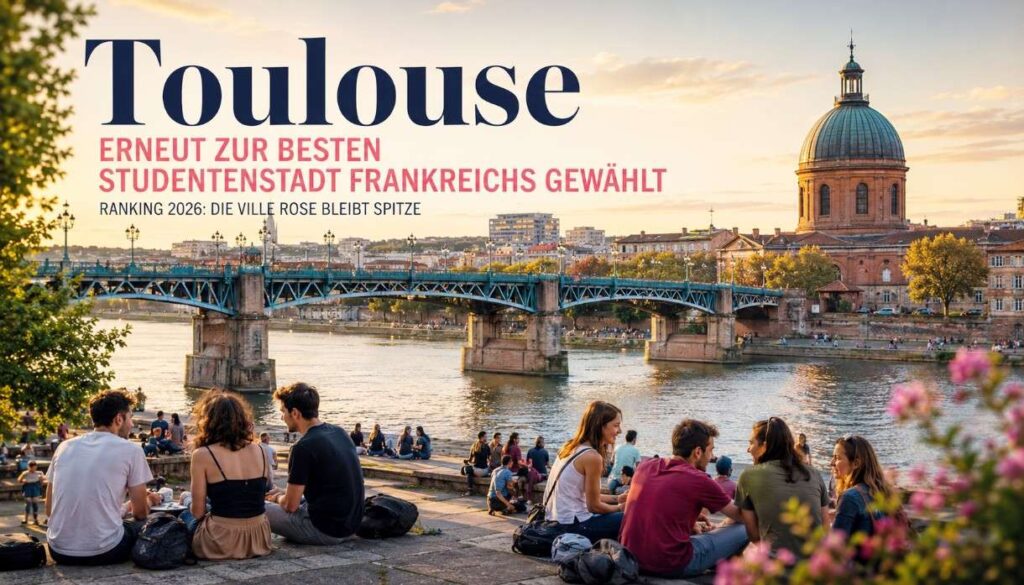
There are cities you visit. And then there are cities where you live for a few years and never really leave. Toulouse belongs to the second category.
The “Ville Rose,” whose facades glow pink in the warm southern light, once again holds the title of the best student city in France. For the second time in a row, it tops the national comparison, thus confirming a reputation that extends far beyond lecture halls and university boundaries. Toulouse is more than a place of study. The city feels like a promise for that rare balance many young people seek: demanding education on one hand, quality of life on the other.
Those walking through the streets around Place du Capitole encounter this promise step by step. In the morning, students stream with coffee cups to seminars; in the afternoon, the banks of the Garonne fill up; and in the evening, squares and alleys turn into improvised meeting places. While studying is certainly central to daily life here, it does not determine its entire rhythm.
This is where the uniqueness of the city lies.
France has numerous traditional university locations. Paris attracts with prestige, Lyon with economic dynamism, Grenoble with scientific excellence. Toulouse, on the other hand, combines various qualities into a remarkably coherent whole. The city is home to more than 100,000 students and is therefore one of the most important university centers in the country. Yet the feeling of an anonymous education factory rarely arises.
Maybe it’s because of the distances. Maybe because of the climate. Maybe also because of a South French calmness, which remains noticeable even during exam periods.
Many students describe Toulouse as a metropolis in a manageable size. Everything seems reachable. The university, the concert, the favorite café, and the nearest park are often only a few minutes apart. While other large cities consume time and energy daily, Toulouse almost seems like a counter-model. Why spend hours in overcrowded transportation when life is waiting right outside the door?
This proximity also shapes the cultural life.
Concerts, theater, festivals, and exhibitions here are not occasional luxuries but normal city life. The boundaries between the student scene and the urban cultural offerings blur. Newcomers quickly find a connection. Those who stay constantly discover new facets.
In addition, Toulouse benefits from another advantage that increasingly counts in times of growing uncertainty: career prospects.
The city is seen as the heart of the European aerospace industry. Where elsewhere future technologies are talked about, they often arise right here on site. Research centers, technology companies, and engineering firms shape the economic landscape. For students in technical, scientific, or economic fields, this opens up an exceptionally dense network of internships, projects, and career opportunities.
Studies in Toulouse often do not end at the university door.
Of course, the Ville Rose has its challenges as well. The housing market is under pressure, rising popularity is driving up rents, and infrastructure must keep pace with the influx of new residents. But compared to the problems of other French metropolises, these difficulties seem manageable so far.
It is precisely in this that a greater change is reflected.
For a long time, Paris was considered almost indispensable for ambitious students. The capital combined prestige, career opportunities, and academic renown. Nowadays, the image of studying is changing. Young people increasingly evaluate university locations based on criteria that were previously seen as secondary. How high are the living costs? How well does mobility function? Are there green spaces? Is there room to live beyond studying?
Sounds logical? This development indeed marks a profound cultural change.
Universities no longer compete only with their research results. Cities compete for talent. And talents no longer look for libraries open 24/7, but for places where future and present can be united.
Toulouse currently seems to understand this need better than many other cities.
That is also why the success in the current ranking is hardly surprising. It is less an accolade for individual universities than a praise for an urban ecosystem that connects education, work, leisure, and quality of life.
Rennes and Montpellier follow shortly after and also show that medium-sized metropolises are gaining increasing importance.
Nevertheless, Toulouse remains the reference for the time being.
Anyone sitting by the river on a summer evening while students discuss, musicians unpack their instruments, and the last rays of sun gild the brick facades quickly understands why. After all, what is the point of the best university if life around it cannot keep up?
Toulouse gives a remarkably convincing answer to that question.
An article by M. Legrand