
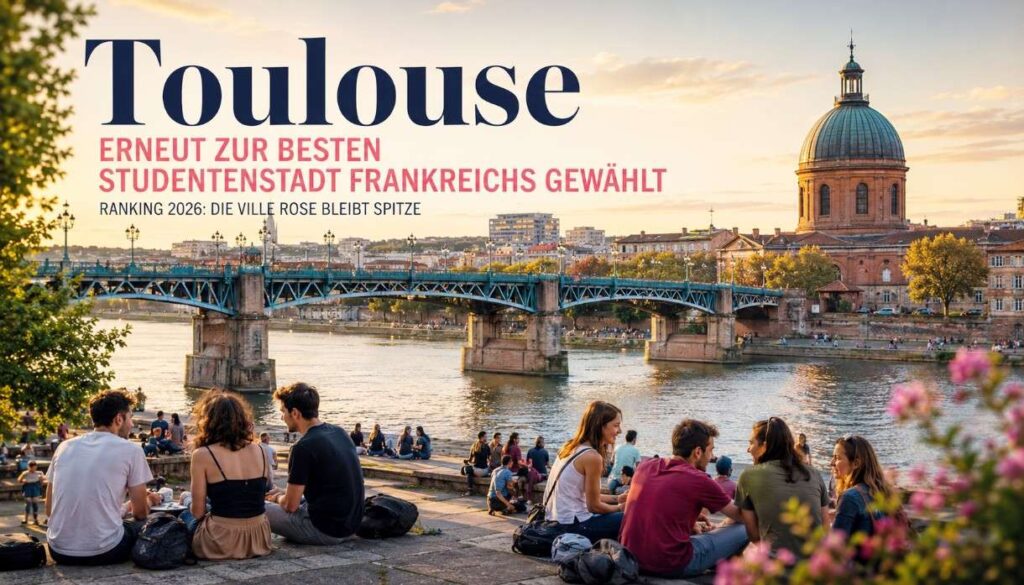
There are cities you visit. And there are cities you live in for a few years and never quite leave. Toulouse belongs to the second category.
The “Ville Rose,” whose facades shimmer pink in the warm southern light, once again holds the title of the best student city in France. For the second time in a row, it leads the nationwide ranking, confirming a reputation that has long extended beyond lecture halls and university boundaries. Toulouse is more than a place to study. The city feels like a promise of that rare balance many young people seek: demanding education on one side, quality of life on the other.
Those strolling through the streets around Place du Capitole encounter this promise at every turn. In the morning, students flood seminars carrying coffee cups; in the afternoon, the banks of the Garonne fill up, and by evening, squares and alleys transform into improvised meeting spots. Studies certainly form the core of daily life here, but they do not dictate its entire rhythm.
This is the city’s distinctive feature.
France boasts many traditional university hubs. Paris attracts with prestige, Lyon with economic dynamism, Grenoble with scientific excellence. Toulouse, however, combines various qualities into a remarkably harmonious whole. The city has more than 100,000 students, making it one of the country’s major university centers. Yet, it rarely feels like an anonymous educational factory.
Perhaps this is due to the distances. Perhaps the climate. Perhaps also to a southern French calmness that remains palpable even during exam periods.
Many students describe Toulouse as a metropolis in a manageable format. Everything seems within reach. The university, the concert, the favorite café, and the next green space are often only a few minutes apart. While other large cities consume time and energy daily, Toulouse almost feels like a countermodel. Why spend hours in overcrowded transport when life awaits right outside your door?
This proximity also shapes the cultural life.
Concerts, theater, festivals, and exhibitions are not an occasional luxury here but part of the normal city scene. The lines between the student scene and the urban cultural offer blur. Newcomers quickly find connections. Those who stay constantly discover new facets.
Toulouse also benefits from another advantage that grows in importance amid increasing uncertainty: career prospects.
The city is considered the heart of the European aerospace industry. While future technologies are discussed elsewhere, they often come to life here on site. Research institutions, technology companies, and engineering firms define the economic environment. For students in technical, scientific, or economic fields, this creates an exceptionally dense network of internships, projects, and job entries.
Studies often do not end at the university door in Toulouse.
Of course, the Ville Rose has its challenges. The housing market is under pressure, growing popularity drives rents upward, and infrastructure must keep pace with the influx of new residents. But compared to the problems of other French metropolitan areas, these difficulties so far seem manageable.
This reflects a larger change.
For a long time, Paris was seen as virtually indispensable for ambitious students. The capital concentrated prestige, career opportunities, and academic fame. Today, the perspective on studying is changing. Young people increasingly evaluate university locations by criteria once considered secondary. How high are living costs? How well does mobility work? Are there green spaces? Is there room to live alongside studying?
Sounds obvious? In fact, this development marks a profound cultural shift.
Universities no longer compete solely with their research achievements. Cities compete for talent. And talents no longer seek libraries open around the clock but places where future and present can be reconciled.
Toulouse currently seems to understand this need better than many other cities.
For this reason, the success in the current ranking hardly comes as a surprise. It is less an award for individual universities than a praise for an urban ecosystem that combines education, work, leisure, and quality of life. Rennes and Montpellier follow closely behind, demonstrating that medium-sized metropolitan areas are increasingly gaining importance.
Nevertheless, Toulouse remains the reference for now.
Anyone sitting by the river on a summer evening, while students discuss, musicians unpack their instruments, and the last sun rays gild the brick facades, can quickly sense why. After all, what use is the best university if life around it cannot keep up?
Toulouse provides a remarkably convincing answer to this question.
An article by M. Legrand