
There are cities that you visit. And there are cities where you live for a few years and never quite leave. Toulouse belongs to this second category.
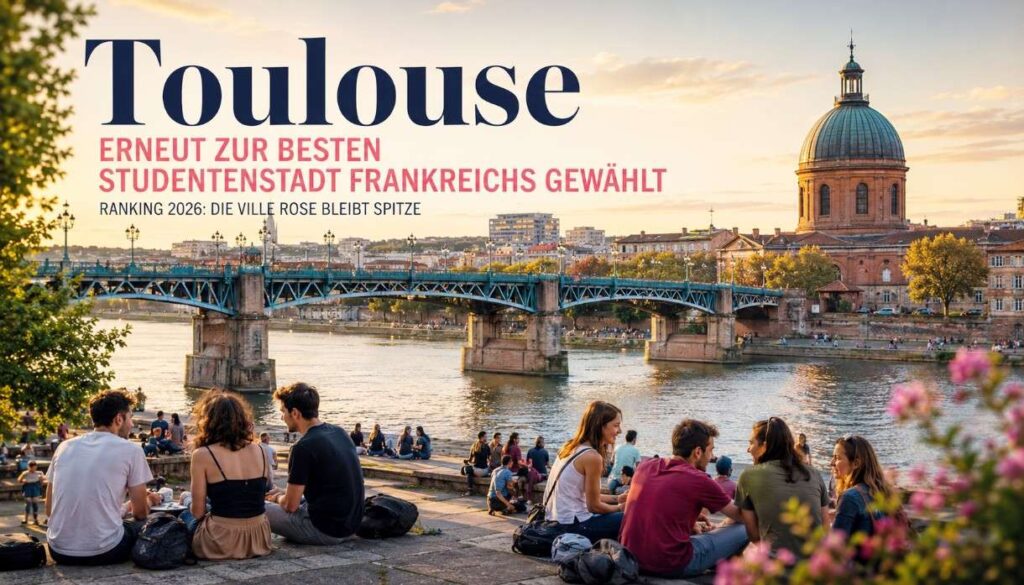
The “Pink City,” whose facades shine pink under the warm southern light, once again holds the title of best student city in France. For the second consecutive time, it tops the national ranking, thus confirming a reputation that goes far beyond lecture halls and university borders. Toulouse is not just a place of study. The city feels like a promise of a rare balance that many young people seek: demanding education on one side, quality of life on the other.
When strolling through the streets around the Place du Capitole, this promise is palpable at every step. In the morning, students flock with their coffee cups to seminars, in the afternoon the banks of the Garonne fill up, and in the evening, squares and alleys transform into impromptu meeting points. Studies are certainly at the center of daily life, but they do not dictate its entire pace.
This is the whole peculiarity of the city.
France has many prestigious university sites. Paris attracts with its prestige, Lyon with its economic dynamism, Grenoble with its scientific excellence. Toulouse, on the other hand, combines different qualities to form a remarkably harmonious whole. The city has more than 100,000 students, making it one of the country’s major university centers. Yet, one rarely gets the impression of an anonymous education factory here.
Perhaps this is due to the distances. Maybe the climate. Perhaps also a typically southern serenity, noticeable even during exam periods.
Many students describe Toulouse as a human-sized metropolis. Everything seems accessible. The university, the concert, the favorite café, and the next green space are often just a few minutes’ walk from each other. While other big cities consume time and energy daily, Toulouse seems almost a counter-model. Why spend hours in crowded public transport if life is waiting just outside the door?
This proximity also shapes cultural life.
Concerts, theater, festivals, and exhibitions are not an occasional luxury here but an ordinary element of urban life. The boundaries between the student scene and municipal cultural offerings fade. Newcomers quickly find their place. Those who stay continually discover new facets.
Toulouse also benefits from another advantage, which is becoming increasingly important in these times of growing uncertainty: career prospects.
The city is considered the heart of the European aerospace and space industry. Where elsewhere the technologies of the future are discussed, they often come to life here, on site. Research centers, technology companies, and engineering offices shape the economic fabric. For students in technical, scientific, or economic fields, this is accompanied by an exceptionally dense network of internships, projects, and career beginnings.
Studies in Toulouse therefore often do not stop at the university door.
Of course, the Pink City also faces its challenges. The real estate market is under pressure, growing popularity is driving up rents, and infrastructure must keep pace with the arrival of new inhabitants. However, compared to the problems of other French metropolises, these difficulties are currently manageable.
This reflects a deeper change.
For a long time, Paris was the almost only option for ambitious students. The capital combined prestige, career opportunities, and academic renown. Today, the perception of studying is evolving. Young people evaluate study locations according to criteria that were previously marginal. What is the cost of housing? What is the quality of mobility? Are there green spaces? Is there still room to live outside of studies?
Does that seem obvious? This change actually marks a profound cultural revolution.
Universities no longer compete only based on their research performance. Cities compete for talent. And talents no longer look for libraries open 24/7, but places where future and present harmonize.
Toulouse seems to understand this need better than many other cities currently.
That is why their success in this current ranking is hardly surprising. It is less a reward for a few institutions than a tribute to an urban ecosystem that links education, work, leisure, and quality of life. Rennes and Montpellier follow closely, also showing that medium-sized metropolitan areas are gaining importance.
For now, Toulouse remains the reference.
When you sit one summer evening by the river, while students debate, musicians take out their instruments, and the last rays of the sun gild the brick facades, you quickly understand why. What use would the best university be if life around it couldn’t keep up?
Toulouse provides a remarkably convincing answer to this question.
An article by M. Legrand