
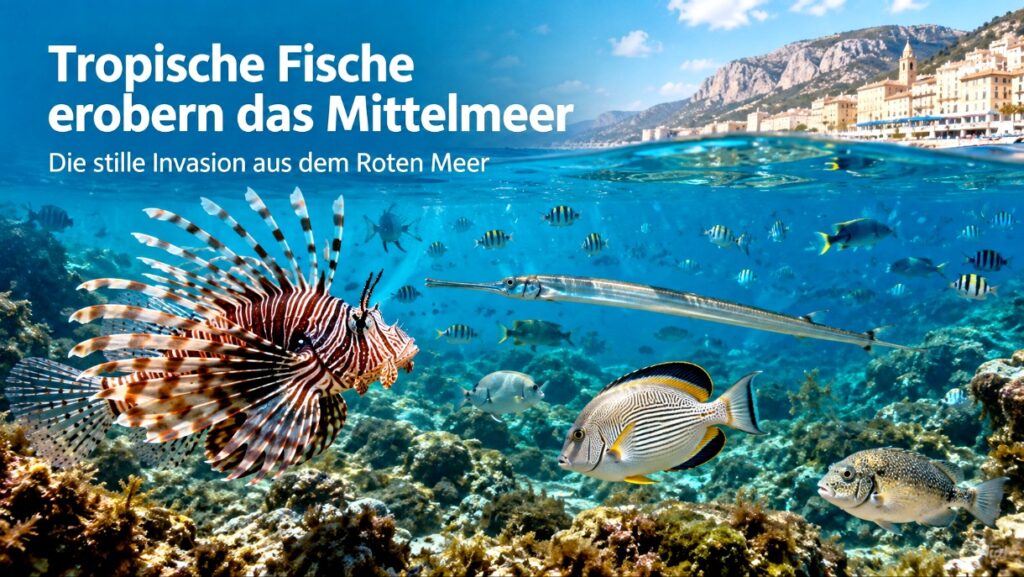
The Mediterranean is changing its face. What was considered a scientific curiosity only a few decades ago is now one of the most striking developments in marine biology: More and more tropical fish species from the Red Sea are spreading through Mediterranean waters. Experts refer to this as the so-called “Lessepsian migration” – a process that is transforming entire ecosystems, presenting fisheries with new challenges and increasingly occupying coastal protection authorities.
This development began in 1869 with the opening of the Suez Canal. For the first time, an artificial waterway connected the Red Sea with the Mediterranean. Initially, however, the exchange of marine species remained limited. The highly saline Bitter Lakes in the canal long formed a natural barrier that prevented many organisms from passing through.
Over the decades, however, this obstacle disappeared. Water conditions became more similar, making it significantly easier for marine life to pass through the canal. The expansion of the Suez Canal and ongoing climate change also contributed. The eastern Mediterranean in particular is warming noticeably – ideal conditions for numerous tropical species.
Several hundred species from the Red Sea have now permanently established themselves in the Mediterranean. These include more than 80 fish species, with more being added every year. Some remain barely noticeable, while others spread rapidly and sustainably transform their new habitat.
One particularly well-known species is the striking lionfish. With its fan-shaped fins, it looks spectacular, but its venomous spines make it dangerous for divers and fishers. At the same time, it is among the most efficient predators of the introduced species. It eats numerous small fish and crustaceans, putting pressure on native populations.
Rabbitfish also have major impacts. These herbivores feed on algae almost continuously. What initially sounds harmless is transforming entire habitats in many places. Where dense algae beds once provided shelter for numerous marine creatures, bare rocks often remain today. In some regions of the eastern Mediterranean, scientists already speak of veritable underwater deserts.
Trumpetfish and various pufferfish species are also becoming increasingly widespread. Some pufferfish contain highly toxic substances and must never be eaten. At the same time, they create problems for fishers by damaging nets and displacing native species.
There are several reasons why these tropical fish are establishing themselves so successfully. In addition to rising water temperatures, the overfishing of many stocks, the decline of natural predators and changes in coastal habitats play a decisive role. Added to this is the remarkable adaptability of many tropical species, which colonize new habitats with astonishing speed.
For now, most of these newcomers are concentrated in the eastern Mediterranean off the coasts of Israel, Lebanon, Turkey and Cyprus. But individual species have long since reached Sicily, Sardinia, the Balearic Islands and even the French Mediterranean coast. As the Mediterranean continues to warm, this trend is likely to continue, even though the cooler waters in the northwest have so far remained a natural boundary.
Biologists now speak of a gradual tropicalization of the Mediterranean. Not only fish, but also algae, mussels, crustaceans and jellyfish are following the same path. The changes strikingly demonstrate how profoundly human intervention and climate change can affect a balance that has existed for millions of years. The Mediterranean remains the Mediterranean – but beneath its surface, a new and unusual mix of native and tropical life forms is gradually emerging.
Author: C.H.