
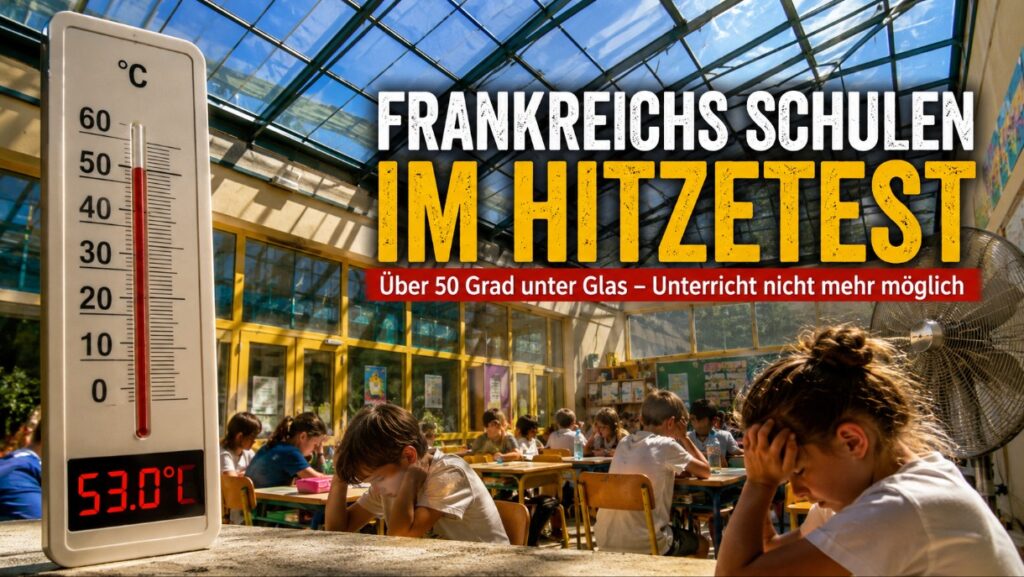
“This is a tropical greenhouse,” described a representative of the primary school in Souston, southwestern France. What might initially seem like an exaggeration was surprisingly accurate. At Isle-Verte primary school in the Landes department, temperatures exceeding 50 degrees were measured under the large glass roof. As a result, the school was closed on Thursday and Friday.
Several children complained of fatigue, some felt unwell, and some students experienced nausea. It is hard to imagine lessons in such an environment. The school was built in the 1980s; parts still use simple glass windows, and around 350 students attend. Architectural elements that once brought light and openness have now become a true heat trap.
The events in Souston carry significance beyond regional news in southwestern France. They symbolize a phenomenon affecting the entire country. France is currently experiencing an unusually early and intense heatwave, which meteorologists say is a historic weather event for May. By the end of May, temperatures reminiscent of midsummer were recorded. In Angoulême-La Couronne, the temperature rose to 37.8 degrees, a new record for the month.
This raises a problem that has long been discussed only theoretically: Are France’s public buildings able to cope with the future climate?
Many schools were built at a time when extreme heat was rare. Large windows were considered modern, and complex shading systems were often deemed unnecessary. Today, the downside of this construction method has become apparent. When sunlight hits glass surfaces for several days without interruption, classrooms and courtyards become places that store heat.
In the short term, municipalities are taking practical measures. Opening windows at night, running fans at full power, and using water sprays to gain some coolness. However, these measures are only temporary solutions to an increasingly serious problem.
The real challenge lies in renovating the buildings. Increasing shade through trees and sunshades, improving insulation, natural ventilation, greened schoolyards, and reducing paved areas are considered important elements. These require considerable expenses. Especially smaller municipalities face difficulties addressing climate adaptation of infrastructure while being required to make other investments.
The schools in Souston therefore appear like warning signals. Children are a group particularly sensitive to heat. Once classrooms reach temperatures more like greenhouses than places of learning, it is no longer a matter of comfort but one of health and safety.
What is happening today in Landes may become commonplace in many places tomorrow. French schools are consequently becoming an early warning system for climate adaptation. It is no longer a question of whether public facilities have to cope with frequent heatwaves. The crucial point is how quickly this can be achieved.
Andreas M. B.