
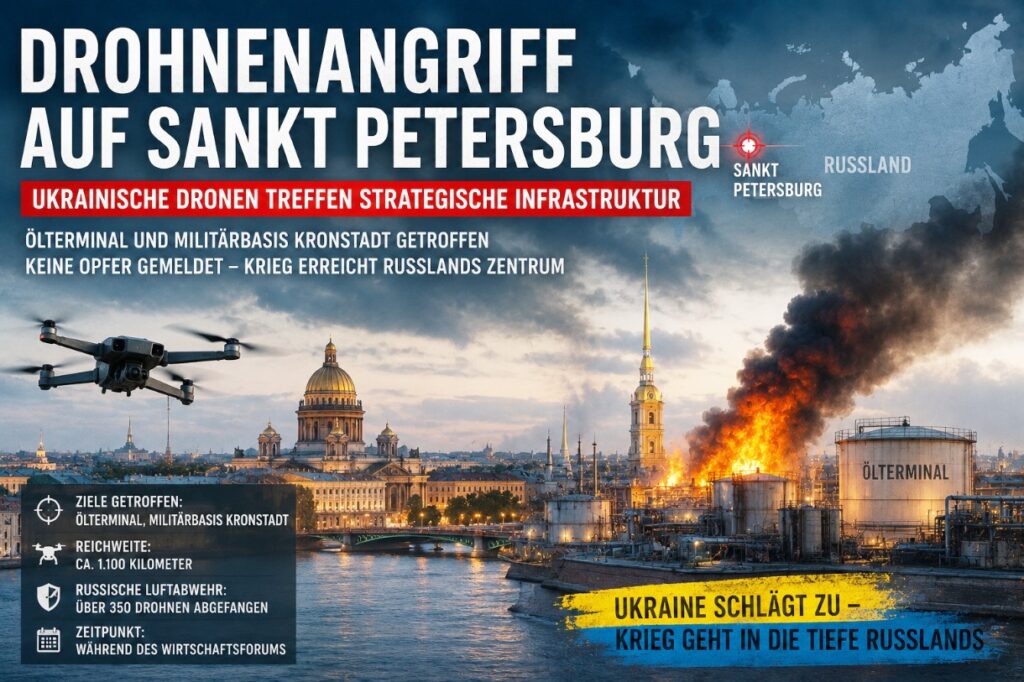
The war in Ukraine has reached a new geographical dimension. With a large-scale drone attack on Saint Petersburg, Ukrainian forces have succeeded in targeting one of Russia’s most important economic and symbolic centers. The attacks occurred precisely at the start of the International Economic Forum in Saint Petersburg, an event that has served for years as a showcase of Russian economic strength for the Kremlin.
According to Russian authorities, multiple targets in and around the metropolis were hit. Although local officials initially reported no casualties, they confirmed damage to various infrastructure facilities. Ukrainian President Volodymyr Zelensky stated that among the targets was also an oil terminal, which according to Ukrainian sources is used for military purposes. Facilities at the Kronstadt naval base were also attacked.
A Strategic Shift in Perspective
The significance of the attack lies less in the immediate damages than in its symbolic effect. Saint Petersburg is located about 1,100 kilometers from the Ukrainian border. Ukraine’s ability to reach targets at this distance highlights the increasing range and precision of its drone systems.
While Ukrainian forces’ attacks in the early years of the war focused mainly on border regions, strategic facilities deep in the Russian hinterland are now increasingly targeted. Oil terminals, refineries, airfields, ammunition depots, and military production sites are favored targets.
The Ukrainian leadership pursues several goals simultaneously. On the one hand, military capacities are to be weakened. On the other, the aim is to increase the economic costs of the war for Russia and to dispel the impression that large parts of the country are spared from the direct consequences of the conflict.
Russia’s Air Defense Under Pressure
Moscow responded with reports of one of the largest air defense operations since the beginning of the war. According to the Russian Ministry of Defense, more than 350 Ukrainian drones were shot down over Russian territory during the night. About 50 of these were intercepted in the Leningrad region alone.
Regardless of the exact numbers, the development shows how heavily Russia’s air defense is now burdened. Ukraine increasingly relies on large-scale swarm attacks to overwhelm defense systems and slip individual drones through defensive lines.
The Kremlin therefore faces a strategic dilemma. The more air defense systems are deployed to protect cities and critical infrastructure in the interior, the fewer resources remain to protect military facilities or the frontline areas.
Escalation on Both Sides
The attack on Saint Petersburg coincided with a further intensification of Russian attacks on Ukrainian territory. Numerous people were killed in missile and drone strikes across several regions of Ukraine. The industrial city of Dnipro was particularly hard hit, registering a significant share of recent casualties.
In the Russian-controlled part of the Donetsk region, local authorities also reported civilian deaths following a Ukrainian drone attack on a bus. As with many incidents in occupied areas, the claims are difficult to verify independently.
The reciprocal attacks underline that the war is increasingly moving away from the actual front lines. Infrastructure, energy supply, transport hubs, and economic facilities are coming increasingly into focus on both sides.
The War Changes Its Face
More than four years after the start of the Russian invasion, the conflict is in a new phase. The large maneuver battles of earlier years have largely given way to a form of war of attrition, in which drones, precision weapons, and attacks on strategic infrastructure play an increasingly important role.
The attack on Saint Petersburg exemplifies how the logic of war has changed. Geographical distance no longer offers reliable protection. Modern drone technology enables attacks on targets far behind the front lines, extending the costs of the war across the entire national territory.
For Russia, this means a growing challenge to internal security. For Ukraine, it is an attempt to increase the military and economic burden on the adversary. For Europe, it is yet another sign that despite all diplomatic efforts, the war shows no signs of de-escalation anytime soon.
The attacks on Saint Petersburg therefore mark not only another military incident. They symbolically represent a conflict that is increasingly technologized and whose range extends far beyond the actual battlefields.
Author: P. Tiko