
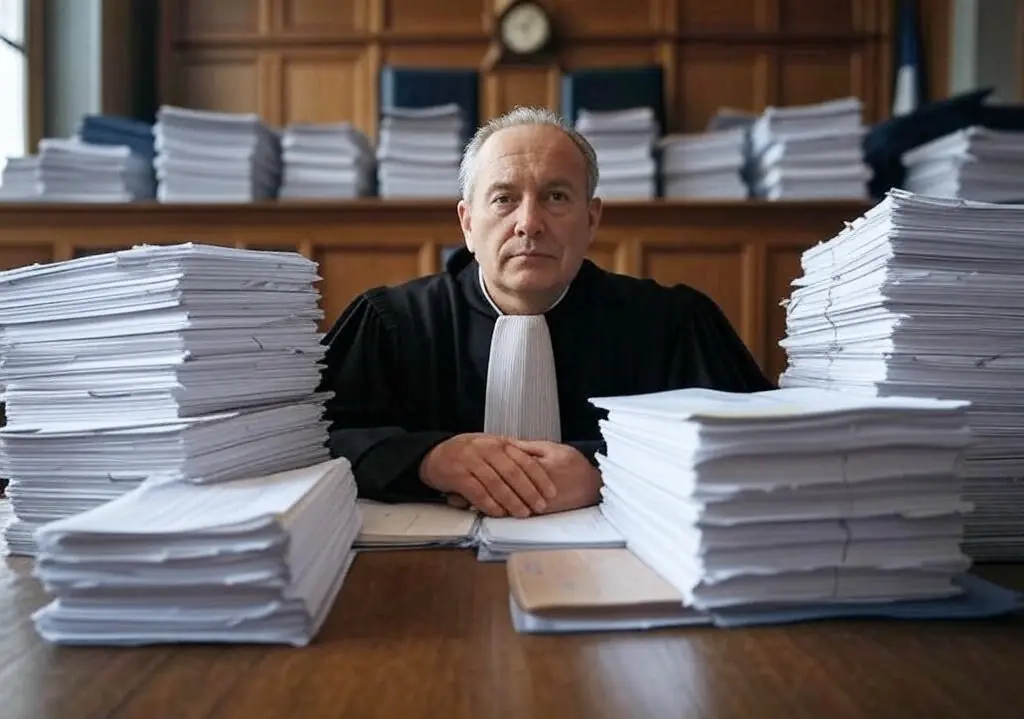
Why justice in major cases like those against Nicolas Sarkozy usually takes months to deliver a verdict
When a criminal court or an appeals court tries a complex case with tens of thousands of pages of files, investigations lasting years, and numerous parties involved, the verdict is generally not given immediately after the trial concludes. In especially high-profile cases, such as those against former French president Nicolas Sarkozy, several months may pass between the end of the oral hearings and the announcement of the judgment. This lapse usually causes misunderstanding among the public, but is based on strict legal requirements.
A gigantic volume of documents
Contrary to what media coverage often conveys, a judicial process is not limited to the few weeks of a public trial. Judges must evaluate the entire file, which in lengthy economic or corruption cases can consist of several tens of thousands of pages.
This includes interrogation transcripts, wiretaps, expert reports, investigation reports, bank documents, as well as filings and arguments from both the defense and the prosecution. Each document must be contextualized and assessed for its probative value.
The drafting of a legally solid verdict
A verdict does not consist solely of establishing guilt or innocence. Judges are required to thoroughly justify their decision.
In recent years, this obligation to provide reasoning has gained great importance, not least because of the jurisprudence of European courts. Judges must explain in an understandable way why certain facts are considered proven, why certain defense arguments are rejected, and how the relevant legal norms are applied to the established facts.
Especially in politically or socially sensitive cases, every formulation carries weight. Insufficient or ambiguous reasoning can make the judgment subject to appeal or challenge before a higher court.
A collegial decision-making process
In France, important criminal proceedings are often decided jointly by several professional judges. After the trial concludes, the deliberation phase begins, the so-called deliberation procedure.
In this phase, the judges discuss their assessments, compare their legal evaluations, and analyze various interpretations of facts and legal questions. The goal is to reach a common decision. Although all judges share responsibility for the judgment, the written drafting is usually assigned to a rapporteur or presiding judge.
Only this collective decision-making process can require considerable time.
The particular complexity of financial and corruption crimes
Cases against politicians, senior officials, or executives often present additional difficulties. The alleged crimes are often much more complex than typical offenses of everyday criminal law.
Corruption, undue influence, illegal election campaign financing, or the embezzlement of public funds require proving complex facts. Investigators and judges must reconstruct not only acts but also intentions, agreements, and decision-making processes.
While in a flagrant crime the facts are usually clear immediately, in economic and political proceedings events often have to be worked on that occurred ten or fifteen years ago.
Preparation for subsequent appeals
Judges know that in prominent cases sentences are almost always challenged. Appeals and proceedings before supreme courts are the norm in such situations.
Therefore, courts strive to formulate their decisions with special care. All essential arguments of the parties must be considered and answered. This prevents higher courts from concluding that key points have been overlooked.
A matter of the credibility of justice
For many jurists, long deliberation times are not an expression of bureaucracy or slowness, but a necessary consequence of legal processes in a state governed by the rule of law. A sentence handed down in days in an extremely complex case could give the impression that the decision was not sufficiently thorough.
As representatives of justice often emphasize, in principle the same legal rules apply to prominent politicians as to any other citizen. The main difference is not in the application of the law, but in the volume of the file, the complexity of the facts, and the exceptional public attention.
In this context, several weeks or even months between the end of the trial and the verdict are understood less as a sign of judicial slowness and more as the result of a thorough and careful review process. The deliberation time is also a time of legal rigor. A sentence must not only withstand review in higher courts but also meet the demands of a rule of law that bases its decisions on transparency, comprehensibility, and legal soundness.
Author: Andreas M. Brucker