
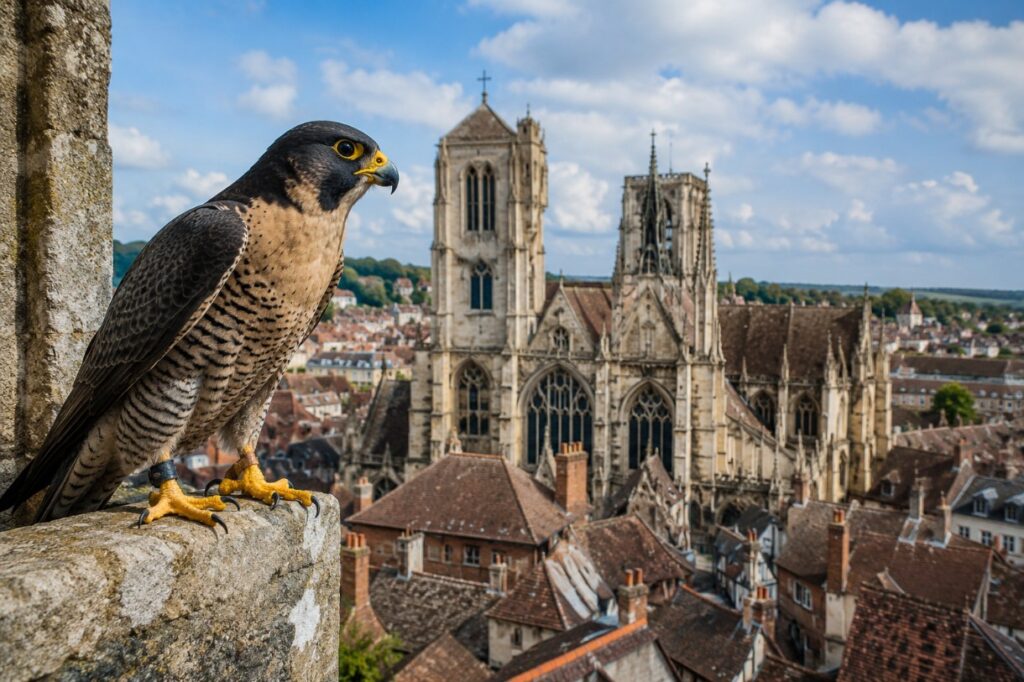
For a long time, city centres belonged to the pigeons. They perched on cornices, invaded train stations, swooped over market squares and turned historic façades into their personal residence. In many French towns, it was almost a law of nature. But in Troyes, another shadow now charts its course across the sky: that of the peregrine falcon.
And it is disrupting the established order.
A pair of falcons now officially lives on the town cathedral. Perched high, more than forty metres above the ground, a nesting box has even been installed there. At first glance that may seem romantic – almost like a small return of wild nature among the Gothic towers and old roofs. In reality, it is also a very concrete urban policy.
Because pigeons cost money. A lot of money.
Their droppings eat into stone façades, dirty squares and damage historic buildings. Municipalities invest substantial sums each year in cleaning and maintenance. In towns where the architecture is protected as historic monuments, costs quickly mount up. The idea then becomes very logical: why not bring back their natural enemy?
The peregrine falcon is perfectly suited to this. It is considered one of the fastest predators in the world and, by its mere presence, it creates a disturbance among pigeons. Experts speak of a “repulsion effect.” The birds feel a constant danger, alter their flight paths and gradually leave certain areas. No need for large captures or controversial sterilization programs – nature solves the problem itself. Pretty clever, actually.
What is particularly remarkable is above all the story of this return. In the 1970s, the peregrine falcon was almost on the verge of extinction in France. Pesticides and the destruction of its habitats had greatly decimated its population. Today, this raptor is precisely rediscovering the city. And it is even biologically coherent: tall church steeples, modern apartment blocks or industrial areas resemble the cliffs where these birds once nested.
The city replaces the mountain.
Some residents now watch the falcons with an almost childlike fervor. Ornithologists station themselves in squares with binoculars, families suddenly stop in front of the cathedral to look up. This also changes the way the city itself is perceived. Amid asphalt, traffic and concrete, the feeling is reborn that nature does not exist only in the countryside.
That is probably where the true fascination lies. The peregrine falcon is much more than an elegant pest controller. It symbolically embodies a new idea of urbanity – a city that no longer completely distances animals, but tries to live with them.
And the pigeons?
They are gradually realizing that the sky above Troyes is no longer theirs alone.
Andreas M. B.