
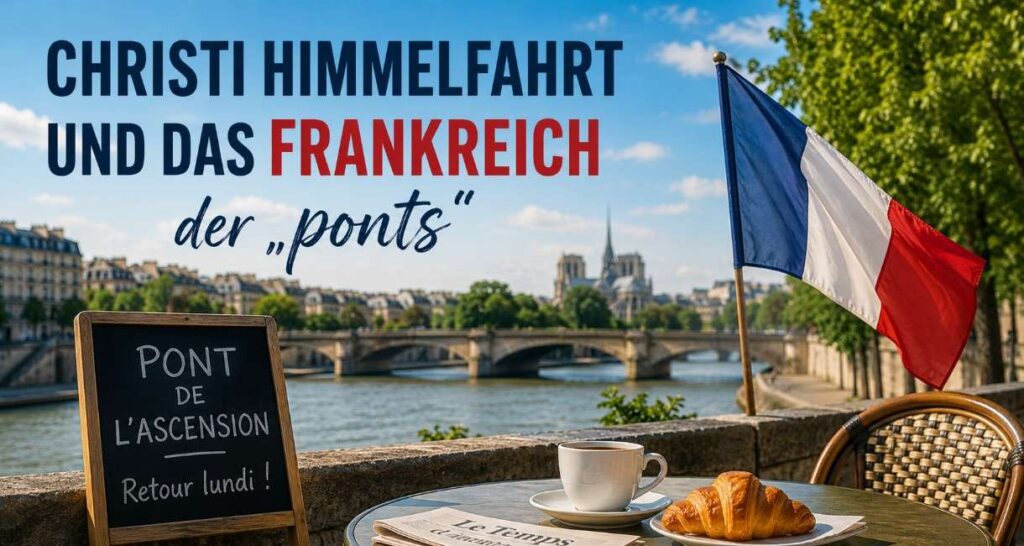
Ascension Day.
In Germany many men push wheelbarrows along rural paths, the barbecue coals crackle at campsites, on the highways traffic gets stuck heading to the Baltic Sea or the Alps. The holiday often seems like a mini collective vacation with a crate of beer. Noisy, uninhibited, sometimes a little strange.
And then there is France.
There this day also has religious roots, but around Ascension Day an almost ritual cultural event takes place every year: the famous «pont». The bridge. If a holiday falls on Thursday, almost half of France also takes Friday off. Four days of rest. Four days to breathe. Four days to live.
The country simply stops.
Schools empty, offices fall silent, in small towns handwritten notes hang on the doors of shops. «Retour lundi.» Back on Monday. Period. No excuses. No heated explanations. No regrets.
And there is something deeply human about that.
France has that almost lost ability not to see leisure as a weakness. Those who enjoy a long weekend there are not automatically seen as lazy or unambitious. On the contrary. The break is part of life like the baguette at dinner or the coffee on the balcony in the morning.
Of course, entrepreneurs complain about production losses. Of course, some protest about “too many holidays.” Of course, not everything in France unfolds romantically either. But even so, the country clings to this small cultural rebellion — against total availability, against constant pressure to perform, against the feeling of having to justify every free minute.
And, to be honest: there is a bit of envy towards the French for it.
Because while around here it is often proudly said that “despite the holiday, I worked,” the French master another skill: conscious interruption. They understand that a country doesn’t collapse because people disconnect once.
Maybe that’s why some things work.
Anyone strolling through French villages these days immediately senses that special atmosphere. Children on bicycles. Busy street cafés. Families that truly dedicate time to each other. Not an artificially optimized leisure time scheduled minute by minute. Rather a collective exhale.
Almost like a silent pact of society: enough for now.
You could smile. Or mock. Germans like to do that. Then words like “work ethic” or “economic location” come up. But at the same time, exhaustion has been growing there for years. Burnout numbers are rising, urban centers seem rushed, conversations constantly revolve around efficiency, crises, and productivity.
Human beings as a permanent project.
France remembers in those moments that life means more than optimizing the calendar.
And perhaps therein lies the true strength of that “pont.” The bridge not only connects Thursday and the weekend. It connects people with something that is silently lost in modern societies: time. Real time. Unproductive time. Valuable time.
Time for parents.
Time for friends.
Time for oneself.
Sounds banal — but nowadays it is almost radical.
Ascension Day religiously embraces the idea of ascent. In France, that day gains a second meaning every year: a small elevation outside of routine. Away from functioning. Away from constant obligation.
At least for a few days.
And while in Germany there is often discussion about how to increase work density, France offers another perspective. Not perfect. Not always economically sensible. But human. Very human.
Perhaps Europe needs exactly that now more than ever.
No more speed.
No more availability.
No more self-optimization.
But, from time to time, a bridge. A “pont.” A moment of shared pause.
Because societies rarely break down from having too much leisure.
But they often do from prolonged exhaustion.
A comment by C. Hatty