
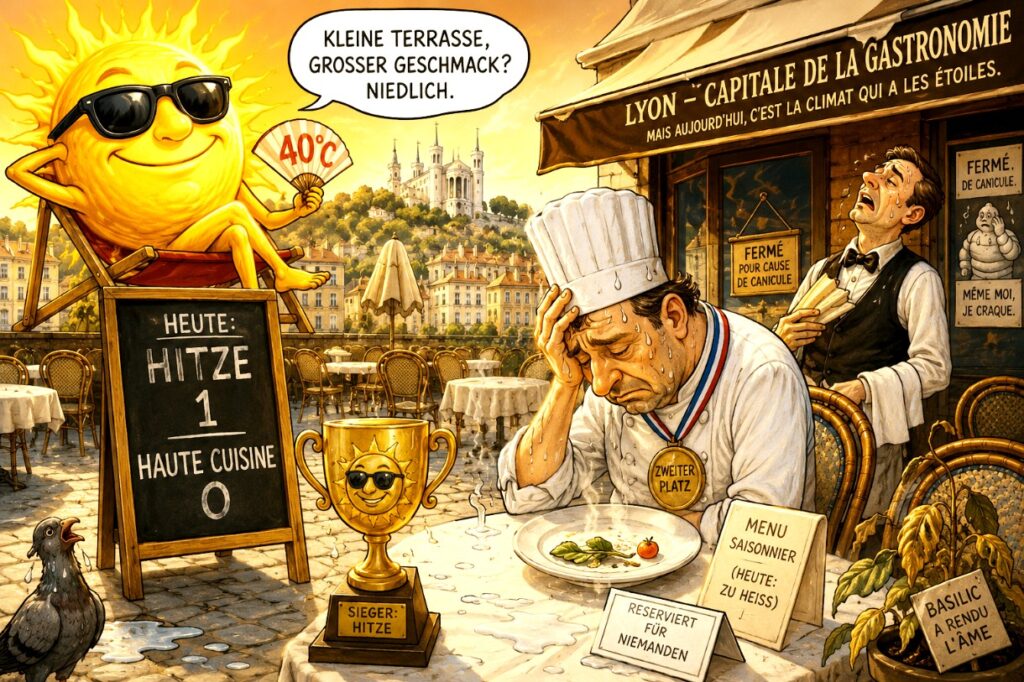
The answer is alarmingly easy: the heat. And by a landslide.
Lyon, the proud capital of French gastronomy, is currently witnessing a spectacle that seems almost absurd. Where people would normally fight over an available table, empty chairs now stand in neat rows. The waiters are waiting. The chefs are sweating. And the guests? They have apparently decided that heatstroke is not an acceptable side dish with lunch.
Who could possibly have guessed that hardly anyone would voluntarily sit on a terrace in nearly 40-degree heat to enjoy a steaming specialty? Apparently, this realization came as a surprise to some, like snow in midsummer. Sun umbrellas, once seen as symbols of Mediterranean comfort, suddenly turn into decoration. Against temperatures that make even asphalt soft, they are about as useful as a paper fan in a sauna.
Of course, one can philosophize endlessly about it. Some speak of a poor summer season, others of a temporary weather spell. Yet an uncomfortable truth has long been pressing itself forward: the climate crisis cares very little about opening hours, reservation books, or Michelin stars. It simply drops by – and clears the place out.
It is especially bitter for the small cafes and family businesses that give Lyon its unmistakable charm. They have neither huge reserves nor air-conditioned shopping palaces. They live on people dropping in spontaneously, having a coffee, or treating themselves to a good meal. But spontaneous strolls now feel more like an expedition through a pizza oven.
One could almost laugh if the situation were not so serious. For years, cities have debated greenery, shaded spaces, and cooler streets. There has been plenty of discussion. Considerably less planting. Now people are astonished that residents would rather hide in air-conditioned shopping centers than stroll across blazing paving stones. What a sensational discovery!
Yet Lyon is losing far more than revenue. A city lives through encounters, through the hubbub of voices in its squares and the clatter of dishes on its terraces. When these sounds fall silent, a piece of its soul disappears. That cannot be brought back with special offers or extended opening hours.
Perhaps that is the real lesson of this summer. It is not the heat that must adapt to our cities, but the cities to the heat. Everything else is like a desperate attempt to put out a forest fire with an ice cube.
And if anyone is still wondering who won the contest between heat and haute cuisine: the answer stands on the deserted terraces every afternoon. Silent. Relentless. And, unfortunately, rather convincing.
Andreas M. Brucker