
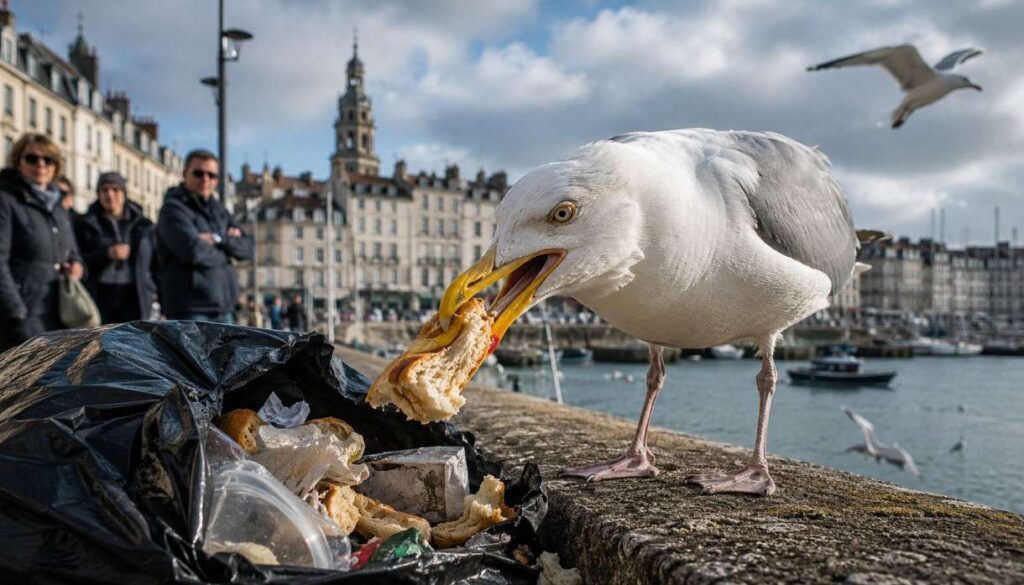
Along France’s coasts, a strange cultural clash has been unfolding for several years — between people holding fish sandwiches and birds that have learned to strike in the blink of an eye.
In Marseille, they screech over the rooftops, in Brighton they tear open garbage bags, in La Rochelle they besiege restaurant terraces. Even in traditional port cities like Boulogne-sur-Mer, the mood is turning sour. The seagull, long the romantic backdrop for vacation postcards and harbor idylls, is suddenly seen as a troublemaker.
And a rather persistent one at that.
Complaints are similar almost everywhere: noise lasting through the night, filthy facades, aggressive raids for fries, ice cream, or sandwiches. Some tourists experience their first contact with a herring gull like a little street robbery from the air. Zap — lunch is gone.
But behind the growing excitement lies much more than merely “too many birds.” In fact, this reveals an astonishing success story of adaptation. The seagull has figured out how modern cities work — perhaps better than some urban planners.
Previously, many seagull species lived mainly on cliffs and small rocky islands along the coasts. By now, they have discovered concrete landscapes that astonishingly resemble their natural habitats. Flat roofs replace rocks. Urban canyons provide shelter from the wind. And food? It’s basically available around the clock.
The modern city is like an artificial paradise for seagulls.
Especially ports and open landfills accelerated this development. But even where landfills have long since been closed or modernized, the animals remain. They have adapted their strategies. Trash bins, snack stands, restaurant terraces, or crowded beach promenades provide enough supply.
Researchers from the UK even observed that some seagulls deliberately assess human behavior. They apparently recognize people who are likely to drop food or actively feed them. It sounds almost cheeky — but it’s biologically quite impressive.
This is exactly where many cities’ problems lie.
Because simple solutions hardly work.
Previously, municipalities sometimes resorted to radical methods. Nests were destroyed, colonies expelled, animals shot. Today, laws set strict limits. Many seagull species are protected in Europe. Mass killings would be politically and legally almost impossible to enforce.
On top of that, public opinion is divided.
While annoyed residents speak of a real plague, animal rights activists see intelligent wild animals merely reacting to human mistakes. Such debates get especially heated in popular holiday resorts. There, tourism, nature conservation, and quality of life collide head-on.
A typical case of modern urban contradictions.
Many municipalities have already tried spectacular measures — falconers, drones, acoustic deterrents, or targeted harassment. The effect usually lasts only briefly. Seagulls learn quickly. If a place becomes unpleasant, they just move a few streets over.
You could almost say: The animals play urban chess.
That’s why a different insight is gaining ground among biologists. The problem is not primarily the birds, but the food supply. As long as cities produce tons of easily accessible food scraps, the habitat remains attractive.
That is why some coastal towns now invest in special lockable trash containers. Others increase fines for illegal dumping or strictly prohibit feeding the animals. Schools distribute informational materials, tourism offices warn vacationers about open snacks on promenades.
Sounds trivial — but it works.
Modern architecture is also coming into stronger focus. Many new buildings offer ideal nesting places. Nets, special roof structures, or anti-perching systems are intended to prevent entire colonies from settling.
At the same time, experts in some cities control reproduction through methods like “oiling” eggs. This stops the embryo’s development without immediately prompting the adult birds to lay new ones. The method is considered comparatively gentle but requires patience and ongoing monitoring.
Ultimately, the seagull issue tells us something bigger about our time.
Foxes in suburbs, wild boars in parks, parrots in big cities — more and more animals are discovering urban spaces for themselves. The boundaries between nature and city blur. And suddenly people realize that “more biodiversity” can sometimes be loud, dirty, and pretty intrusive.
The seagull is emblematic of this conflict.
It annoys. It screams. It steals fries.
But it also shows how adaptable wild animals have become — in a world completely redesigned by humans.
Maybe the issue is no longer about driving seagulls out of cities. Rather, it’s about finding a balance that both sides can live with. That won’t be easy.
Because seagulls have long understood that Europe’s coastal cities are a damn good territory.
Andreas M. B.