
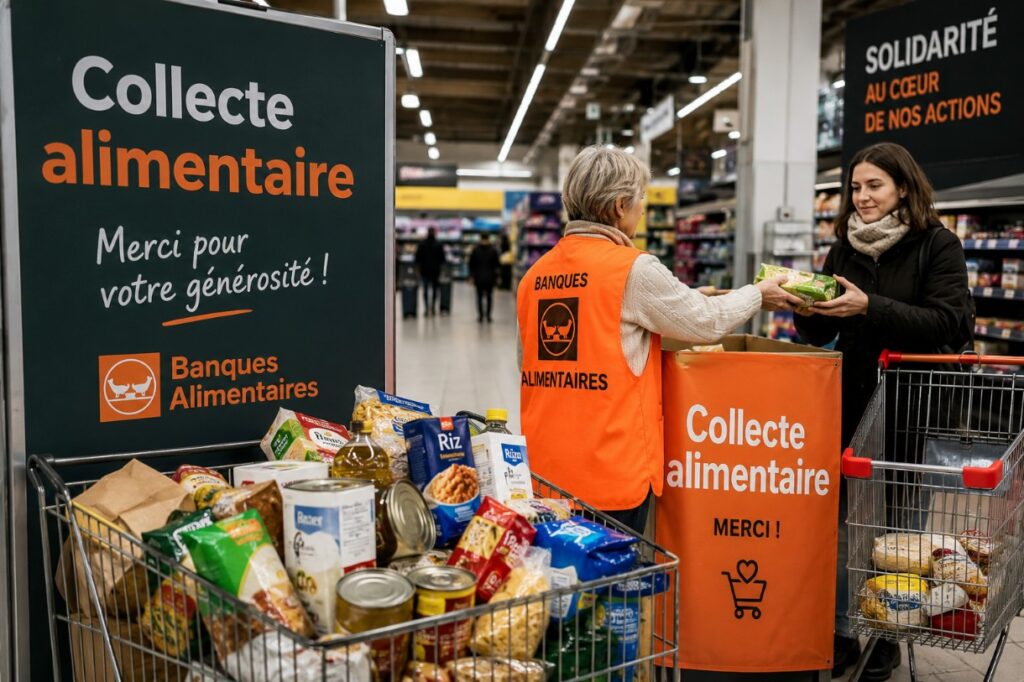
Every year, French food banks collect several thousand tons of food for those in need during their nationwide campaigns. The willingness of the population to donate remains consistently high. However, one aspect of these solidarity campaigns sparks political debates: several members of parliament are demanding that supermarket chains in the future relinquish the profit margins generated from products specially purchased for the collections.
The initiative is based on a simple observation. During the collection campaigns, customers buy groceries directly in the supermarket to then hand them over to the volunteers waiting at the checkout. This generates additional sales for the retail chains, on which they apply their usual margins. From the perspective of the proposers of the bill, this contradicts the actual purpose of the campaigns. Consumers’ generosity should exclusively benefit the aid organizations and not simultaneously generate commercial profits.
Increasing pressure on aid organizations
The request comes at a time when numerous charitable organizations are under increasing pressure. Persistent inflation, higher housing costs, and the economic uncertainty of many households have significantly increased the demand for food aid in France. At the same time, aid organizations are facing rising costs for transportation, storage, and energy.
The proposed regulation provides that retailers transfer the net margins obtained from the collection campaigns to the relevant organizations. The additional funds can, for example, be used for the purchase of urgently needed products, the expansion of logistics capacities, or the financing of ongoing aid programs.
Opposition from the Trade
In turn, the trading companies point out that they already make a significant contribution to combating poverty and food waste. For years, many supermarket chains have donated unsellable goods to non-profit organizations and have organizationally supported local aid campaigns. Representatives of the industry also warn of additional administrative burdens and a more complex handling of the collection campaigns.
The discussion thereby touches on fundamental questions around corporate responsibility. While proponents argue that solidarity must not be a source of commercial profit, critics point to the important role of traders as infrastructure partners of food banks.
Whether the initiative will receive parliamentary majorities remains uncertain. Regardless of the outcome, however, the discussion makes a social trend clear: expectations of companies nowadays go increasingly beyond their economic function. There is not only a demand for willingness to support social projects but also for transparency about who ultimately benefits from solidarity.
Author: Andreas M. Brucker