
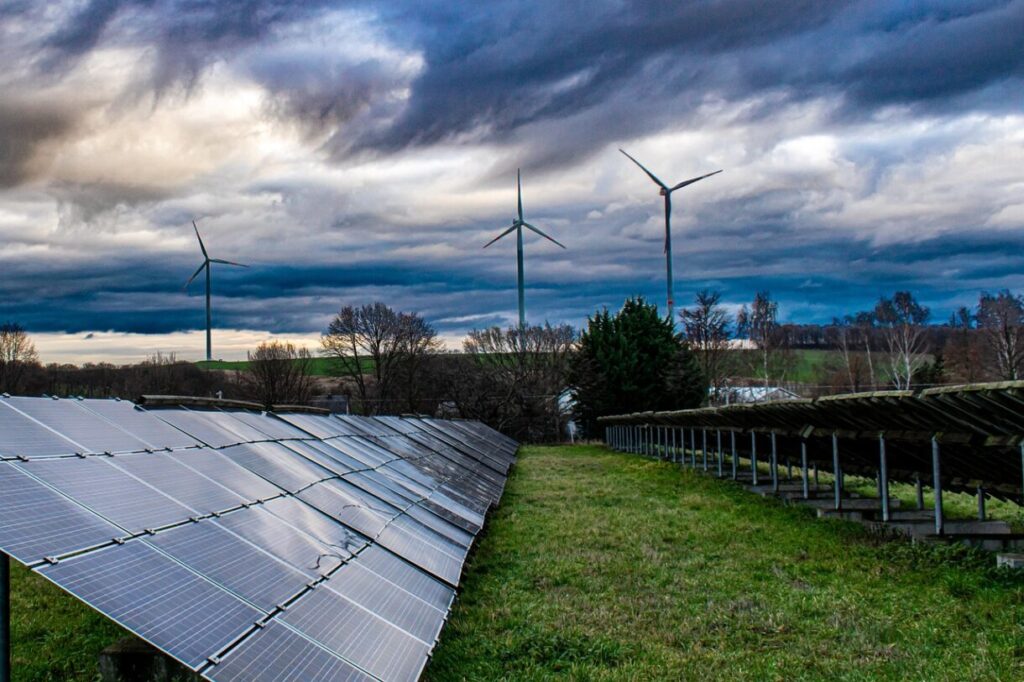
Where ammunition was once produced and stored, solar panels are now set to shine under the sun. In Salbris, France, in the Loir-et-Cher department, a solar park is being developed on a former military site that is more than just a conventional energy project. The planned photovoltaic system represents a transformation that reaches deep into the state’s strategic considerations.
The project envisions a capacity of 42 megawatts peak. The facility is intended to be operated over a period of three decades. Particularly remarkable: the electricity generated will not primarily flow into the general grid but will be directly purchased by the French Ministry of Defense. According to current plans, starting from 2030 the plant could cover around four percent of the ministry’s annual electricity demand.
At first glance, this seems like another chapter in the energy transition. In fact, however, the site tells a much longer story.
Since the 1930s, the location has played an important role for the French arms industry. For decades, ammunition and military equipment were produced there. In the 1980s, up to 840 people worked on the site. When operations ceased in the early 2000s, about 200 employees still worked there. Afterward, the area remained marked by its industrial past and is partly considered contaminated.
Sites like this have increasingly come into focus for project developers. They offer large areas that are often only limitedly usable for housing or agriculture. Solar installations appear here as a pragmatic solution. A place of military production is becoming a site of sustainable energy generation – a kind of industrial recycling in the open air.
But it’s not that simple.
The public debate surrounding the project shows how complex the energy transition remains, even where the initial conditions seem favorable. Residents and environmental groups have raised questions about possible impacts on wetlands. Risks related to forest fires as well as visual landscape interventions have also been discussed. Such debates now accompany many large energy projects in France. The desire for climate-friendly power generation regularly meets local interests and ecological protection requirements.
This is exactly where the political significance of the project lies. The Ministry of Defense describes the facility as a contribution to financial resilience. Behind this term lies a sober idea: those who can secure part of their electricity at long-term, calculable prices become less dependent on fluctuations in energy markets. The energy crises of recent years have shown how quickly rising prices can burden state budgets.
The French military increasingly regards energy as a strategic resource. In the past, tanks, aircraft, and ammunition depots were the focus of security planning. Today, power supply, land management, and long-term energy contracts have come into focus as well. Modern defense capability does not end at the gate of the barracks.
Salbris thus becomes a small symbol of a larger transformation. A former ammunition site is turning into a power source. An area that once served military production is becoming a building block for the state’s energy independence. The energy transition is thereby reaching a sector long considered a classic domain of state power – and shows that strategic sovereignty in the 21st century increasingly also relies on solar modules.
Andreas M. Brucker