
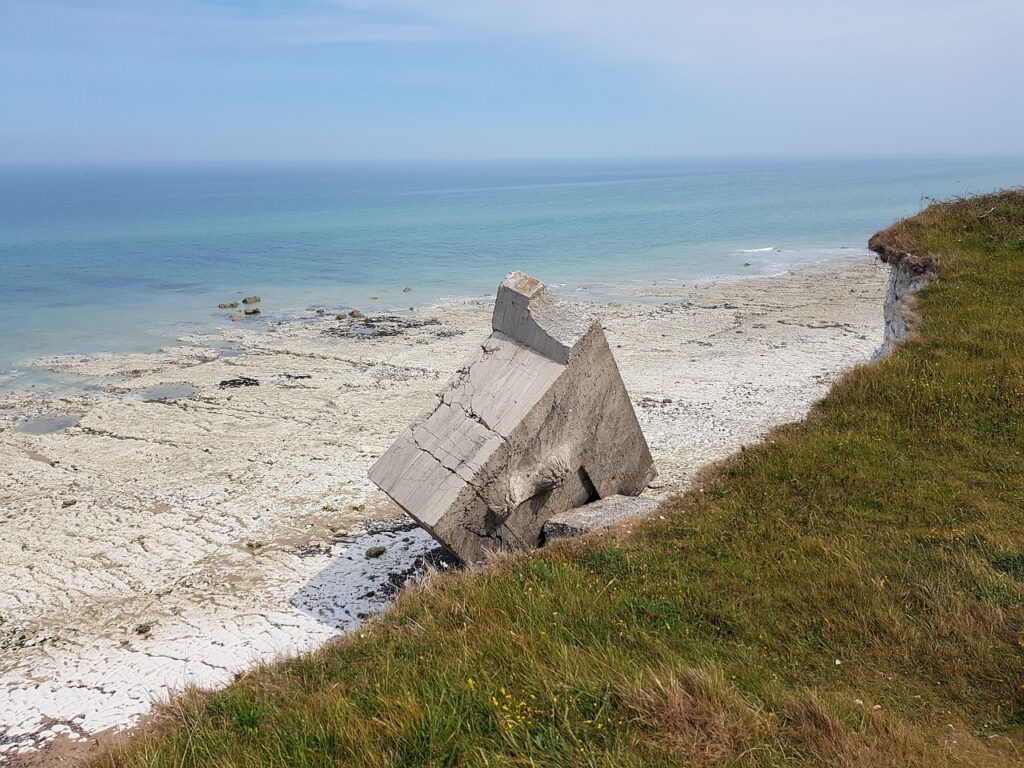
Along the coast of Loire-Atlantique, relics from World War II are slowly tipping into the sea. Old German bunkers of the Atlantic Wall, once deeply anchored in dunes and coastal fortifications, today lie tilted in the sand, breaking apart or being swallowed further by every tide. The scenes seem almost surreal: massive concrete giants, built for eternity, losing their decades-long battle against wind, water, and time.
This phenomenon is especially visible on the Pen Bron peninsula near La Turballe. There, coastal erosion has destabilized several bunkers. Some have already collapsed, others hang like tilted monuments at the edge of the dunes. In some areas, the coast loses about half a meter per year. What was once far inland is now directly at the surf.
These concrete giants tell several stories at once. First and foremost, of course, is the story of the Atlantic Wall — that gigantic defense system Nazi Germany began constructing along the European Atlantic coast from 1942 onwards, fearing an Allied invasion. Thousands of fortifications were built between Norway and the Spanish border: gun emplacements, observation posts, casemates, and underground bunkers. Loire-Atlantique was also heavily fortified, especially around Saint-Nazaire, which was strategically central for the German Navy. The submarine bunker there remains one of the largest concrete structures in Europe to this day.
The Atlantic Wall was an expression of a military logic of total control. The installations were designed to withstand bombings. Some of the walls are several meters thick. The National Socialist leadership saw these fortifications as an impregnable barrier against the Western Allies. Yet historical hindsight reveals the irony of these gigantic structures: the Atlantic Wall could not prevent the Normandy landings in 1944. Today, its remnants fail against an opponent against which no defensive ring can be built — the slow but unstoppable transformation of coastal landscapes.
Because in the meantime, the bunkers mainly tell the story of another front: the fight against climate change, sea level rise, and coastal erosion. What was once hidden beneath sand is now being exposed. Winter storms tear open dunes, currents carry away sediments, and cliffs collapse. Some installations now stand directly in the water. Others slowly tilt toward the sea until their own weight causes them to finally collapse.
The French Atlantic coast is among the regions in Europe most severely affected by erosion. This is caused by a combination of rising sea levels, more frequent storm events, and human interventions in natural coastal dynamics. Harbors, tourist infrastructure, and coastal protection measures often alter currents and sediment movements. This destabilizes some coastal sections even further.
All the more, the images of decaying bunkers fascinate many people. A blockhouse usually symbolizes toughness, permanence, war, and control. Yet along the French coasts, these structures suddenly appear vulnerable. The Atlantic transforms military architecture into a landscape of ruins. Power becomes decay.
French architectural theorist Paul Virilio was already deeply engaged with these relics in the 1970s. For him, the bunkers of the Atlantic Wall were more than mere military facilities. He understood them as archaeological objects of modernity — fossil remains of an industrial era of total warfare. His “bunker archaeology” described the concrete structures as monuments of a civilization that has disappeared.
Indeed, many of these installations now possess a peculiar aesthetic. Photographers and artists have documented the tilted concrete shapes in the sand for years. Some bunkers resemble stranded ships, others abstract sculptures. Nature deforms the once geometrically precise military architecture and transforms it into seemingly organic ruins. This very combination of a history of violence and landscape decay creates their strong symbolic impact.
However, this creates a very concrete problem for affected communities. The erosion endangers not only historical relics but also roads, hiking trails, campsites, houses, and tourist infrastructure. Along the French Atlantic coast, questions once politically taboo are now openly discussed: Should certain coastal sections be abandoned in the long term? How expensive can coastal protection measures still be? And which regions can be secured permanently?
The debate is by no means limited to France. From the Netherlands to northern Germany, European coastal regions face similar challenges. The retreat of the sea, which for centuries seemed controllable by dikes and technical measures, is increasingly uncertain. Climate scientists expect that extreme weather events will become more frequent over the coming decades. This increases the pressure on coastal cities and tourist areas.
There is another danger as well. When old blockhouses collapse or are uncovered, munitions remnants can become visible. In several regions of France, explosive ordnance disposal experts have already had to intervene after shells or explosive leftover hazards were exposed due to erosion. The past literally resurfaces — not as a historical memory, but as a concrete danger.
This reveals a paradoxical development: For decades, many of these bunkers were seen as disturbing relics of the occupation era. Some communities wanted to remove them or let them vanish in the sand. Today, they are increasingly regarded as historical witnesses — while nature destroys these witnesses faster than they can be preserved.
Loire-Atlantique thus becomes a symbol for the connection between history and climate change. The coast is not only changing landscapes. It is also changing memory culture. The Atlantic is slowly erasing traces of the 20th century — meter by meter, wave by wave.