
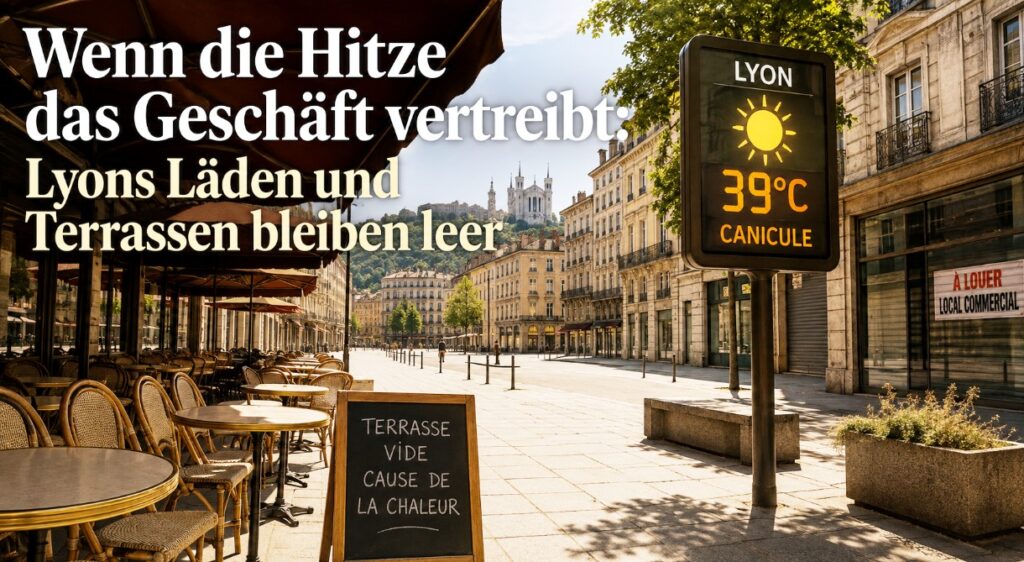
Lyon lives through its streets. Between the narrow lanes of the old town, the elegant shopping streets of the Presqu’ile and the spacious squares around Place Bellecour, the scenes that normally define the city’s character unfold: people stroll, sit in street cafes or browse in small shops. But this summer, an unfamiliar sight can be seen in many places. Recurring heatwaves are silencing public life – with noticeable consequences for retail and hospitality.
On particularly hot days, the thermometer climbs to nearly 40 degrees Celsius. The densely built-up city center stores heat like a giant oven. Asphalt, facades and paving stones release the heat well into the evening. Anyone without a compelling reason avoids going into the center, seeking shade, a swimming pool or the cooler surrounding countryside instead. The result is immediately visible on the shopping streets: where there is normally bustling activity, many shop windows go unnoticed.
Small owner-operated shops in particular are coming under pressure as a result. They depend on spontaneous visits and passing trade. When these customers are absent, revenue falls immediately. Some retailers report sales declines of up to 30 percent compared with ordinary summer days. Large shopping centers, by contrast, are coping with the heat much better. Thanks to air-conditioned sales areas, they attract many people who come not only to shop but also to find more pleasant temperatures.
The situation is no less tense in the hospitality sector. Restaurant terraces that are usually well frequented remain surprisingly empty even during the peak season. At temperatures well above 35 degrees Celsius, even shaded seats lose their appeal. Lunch in the blazing sun? For many guests, that is simply out of the question.
Numerous restaurateurs are responding with more flexible opening hours and shifting their focus to the evening. But even after sunset, the heat often remains noticeable. At the same time, many regular customers are absent, spending their holidays outside the city. Tourism is also developing more weakly than hoped, meaning additional customers fail to materialize.
For employees, the situation represents a double burden. Temperatures rise to levels in kitchens in particular that make everyday work considerably more difficult. Air conditioning is absent from many older buildings or is insufficient to provide effective cooling. At the same time, fans and refrigeration equipment drive up electricity costs – precisely at a time of falling revenue.
The trend shows just how strongly the climate crisis is now affecting economic life in city centers. Heatwaves are changing not only people’s leisure behavior, but also the foundations of retail and hospitality. More trees, shaded areas, drinking fountains and greener streets could provide cooling in the long term. But such projects take time. For many retailers and restaurant owners, however, every single summer day counts. Because if the heat permanently drives people off the streets, Lyon will lose a part of the vibrant urban culture that visitors and residents have always appreciated.
Author: C.H.