
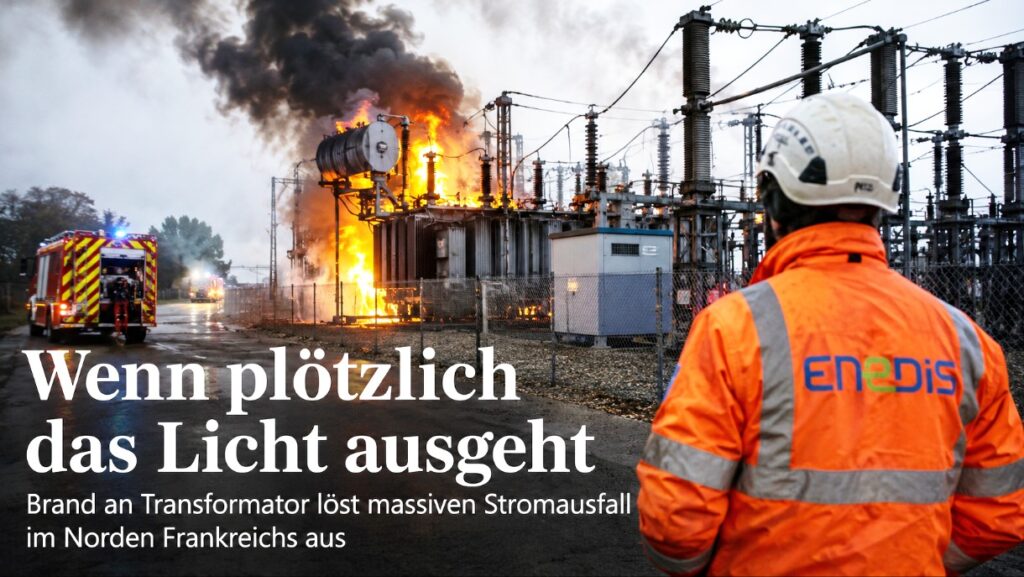
It often starts unspectacularly. A brief flicker maybe, a quiet click in the fuse box — and then that peculiar silence that modern societies hardly know anymore. No humming refrigerators, no router lights, no traffic lights directing traffic. On this Saturday morning (May 23, 2026), thousands of people in northern France experienced exactly this moment. A fire at an electrical transformer in the Département Somme brought large parts of the region to a standstill and caused disturbances as far as Normandy.
About 16,000 households in the Somme were temporarily without power, along with tens of thousands more affected in neighboring areas. For many, this initially sounded like an ordinary outage. But the longer the outages lasted, the more clearly it became apparent how thin the layer of comfort and routine has become.
Because power outages affect us differently today than they did forty years ago.
In the past, a lamp simply wouldn’t light. Today, within seconds an entire web of communication, mobility, and supply collapses. Gas stations no longer work properly, card payments fail, and mobile networks stumble. Even the simple question “Do you have coverage?” suddenly gains an existential tone. Anyone who has ever stood in front of motionless checkout counters at a supermarket knows how quickly everyday hustle can turn into a strange uncertainty.
France has one of the most powerful electrical grids in Europe, closely interconnected with neighboring regions and supported by its strong nuclear energy production. It is precisely this interconnectedness that makes the system vulnerable. When a central transformer fails, other lines come under pressure — like dominoes knocking each other over. Sometimes a single technical defect is enough to shake entire regions.
And suddenly an uncomfortable question arises: How resilient is a society whose everyday life completely depends on the constant functioning of invisible infrastructure?
The debate about this has long been ongoing in France. For months, politicians, media, and security authorities have been discussing critical infrastructure. Power grids, railways, telecommunications — all these are no longer seen merely as technical backbones but as sensitive nervous systems of a country. Every major disruption immediately causes nervousness. Not out of panic, but rather from experience.
The images from Saturday almost seemed old-fashioned. Dark intersections. Closed shops. People standing confused in front of gas stations. And technicians in orange vests trying somewhere between cable ducts and substations to bring order to an invisible chaos.
It is easy to forget how physical electricity actually is. Behind every light switch there are kilometers of cables, transformer stations, cooling systems, and people on night shifts. Only when something burns does this hidden world briefly come into consciousness.
Perhaps this is precisely the real lesson of such incidents.
Not alarmism. Not dystopian scenarios of Europe’s collapse. But the realization that modern states, despite all their digitalization, remain surprisingly vulnerable. A fire in a transformer house somewhere in the provinces — and suddenly daily life stumbles a hundred kilometers away.
It’s actually crazy.
For Saturday afternoon, authorities hope for gradual progress in restoring the supply. Most households should then gradually receive power again. What remains is this feeling of disturbance. That diffuse unease that arises when a society realizes how dependent it has become on things normally unseen.
An article by M. Legrand