
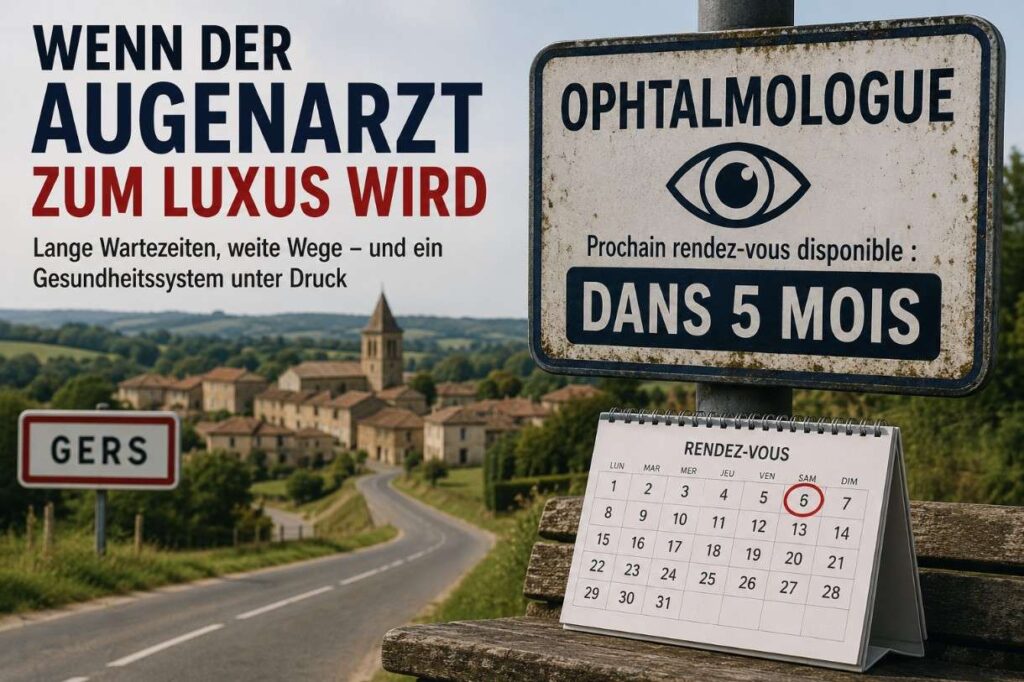
Anyone needing an appointment with an ophthalmologist in the French department of Gers primarily needs one thing: patience. Five-month waiting times – in some communities even longer – are no longer unusual there. For many, this initially sounds like a provincial problem, one of those minor mishaps of rural life. But a closer look behind the numbers tells a different story. A story about a health system that is supposed to belong to everyone but increasingly depends on where one lives.
The term “désert médical” has been used in France for years. Medical desert. That sounds drastic, almost like an exaggeration. In Gers, however, the word feels frighteningly accurate. Because what is missing is not just doctors. What is missing are accessible doctors, available time slots, and routes that older people can still manage at all.
And that is exactly where the real problem begins.
Picking up a new pair of glasses later – that’s forgivable. But eye diseases do not adhere to waiting lists. A beginning glaucoma, for example, works silently like a pickpocket in the dark. Retinal diseases or age-related macular degeneration also tolerate no delay. Waiting months for an examination can mean, in the worst case, losing something that cannot be repaired: eyesight.
Older people, in particular, come under pressure. Many live alone in the countryside, no longer drive themselves, or depend on infrequent bus connections. The journey to a specialist in Toulouse or Tarbes then quickly feels like a small expedition. Just popping in to see the doctor? Rather not.
France is thus experiencing a quiet division of its healthcare system. While specialist centers grow in metropolitan areas and modern practices compete for patients, rural regions struggle for every available consultation hour. Doctors settle where infrastructure, working conditions, and income appear more attractive. This is human – but bitter for those living in the countryside.
The authorities are trying to counteract this. Additional consultations, support programs, mobile services. All sensible, all well-intentioned. Yet many initiatives so far seem like patches on a deeper wound. Because the fundamental problem remains: young specialists rarely move to sparsely populated regions. Those who have studied for years often also look for professional networks, modern clinics, cultural life, and predictable working hours. Gers offers plenty of peace, lots of landscape – but not always the conditions that doctors expect today.
Added to this is a demographic effect. Many ophthalmologists of the older generation are retiring, successors are missing. Suddenly, the only practice within a fifty-kilometer radius disappears.
All of this shows how fragile the republican principle of equality has become. On paper, every French person has the same access to healthcare. In reality, the postal code increasingly decides how quickly help remains accessible.
The ophthalmologist as a luxury good – that sounds harsh. For many people in rural France, it simply describes everyday life now.
By C. Hatty