
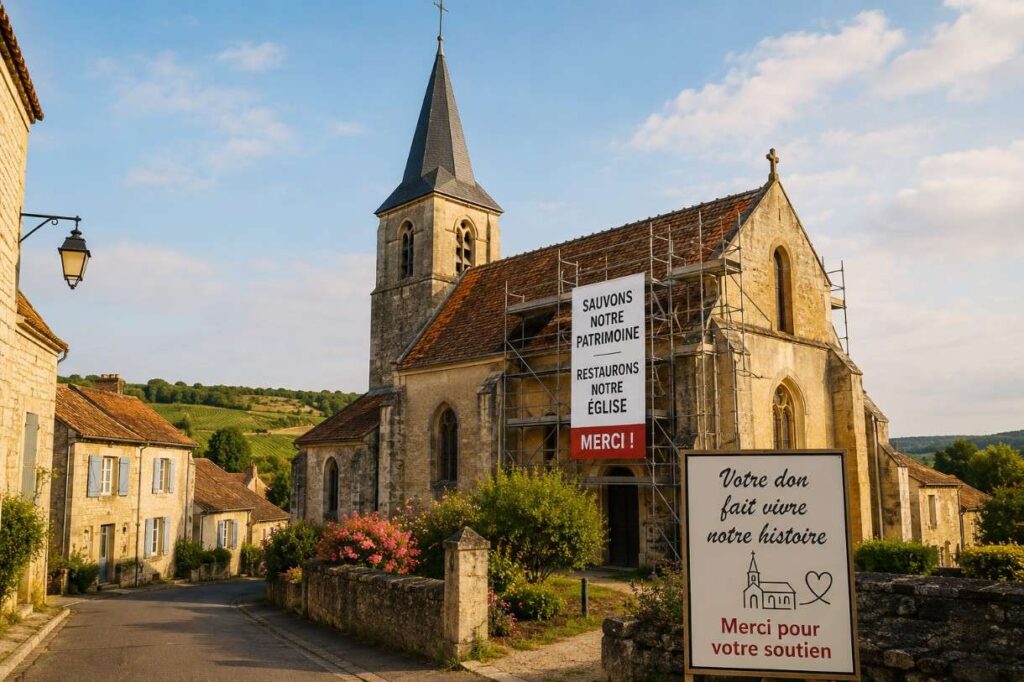
In the villages of Marne, church towers have shaped the landscape for centuries. They rise above fields and houses, serving as landmarks and telling stories from times gone by. But behind the often picturesque facades, a serious challenge often lurks. Numerous churches suffer from the effects of age, weather, and an ever-increasing need for restoration. For many small communities, financing necessary work is a task hardly manageable.
This is exactly where a trend is gaining more importance in Marne: the commitment of private donors and patrons.
In recent years, support for preserving religious cultural heritage has risen significantly. More and more citizens, companies, and associations participate in fundraising campaigns to save endangered church buildings. The Champagne Ardenne region is now counted among the areas in France where particularly high sums are collected for listed buildings. Marne is one of the pioneers of this movement.
The reason for this willingness to help often lies in a deep emotional connection. For many inhabitants, the village church is much more than a place of worship. It forms the heart of the community, preserves memories, and accompanies generations through important phases of life. Baptisms, weddings, funerals, or festive services—all these moments connect people to their church building.
Who does not remember the ringing of bells on a Sunday morning or the Christmas Mass in a festively decorated church? Such memories create a bond that is often stronger than any financial consideration.
That is why calls for donations frequently find great resonance. Citizens support the restoration of “their” church, even if they no longer regularly participate in church life. For many, it is less about religion than about home, history, and identity.
The challenges are considerable. Numerous buildings require extensive work on roofs, facades, or bell towers. Some churches struggle with penetrating moisture, others with damaged windows or unstable masonry. Added to that are safety regulations that require high investments, especially for old towers or bells.
For many communities with a few hundred inhabitants, such sums seem almost unaffordable. Municipal budgets are already under pressure. Schools, roads, social institutions, and energy costs compete for limited funds. This often leaves little room for restoration in keeping with heritage conservation.
All the more important appears the role of private sponsors.
Donation campaigns, charity events, and crowdfunding projects nowadays make numerous undertakings possible that would hardly be feasible without additional support. Frequently, not only locals become involved. Former residents, holiday guests, or lovers of historical architecture also participate in the collections.
Often, a remarkable dynamic develops. As soon as the first contributions come in, attention grows. Local clubs organize concerts, schools participate in activities, and businesses provide financial means. A restoration project often develops into a community project for the entire village.
The French state additionally supports this development through tax incentives. Those who donate for the preservation of cultural assets benefit from attractive tax deductions. This makes the decision to participate easier for many people. At the same time, more private capital flows into the protection of historic buildings.
Marne offers numerous examples of this new momentum. Some projects concern impressive Romanesque or Gothic churches whose history goes back several centuries. Others focus on smaller village churches that are architecturally less known but hold invaluable worth for their communities.
Precisely these inconspicuous buildings often tell the most exciting stories. They reflect the development of rural regions, preserve old craftsmanship, and document the societal changes over generations.
A particularly symbolic example comes from Drosnay. There, the historic half-timbered church was destroyed by fire in 2023. The loss sparked concern far beyond the municipal boundaries. Quickly, the desire arose to rebuild the building and thus preserve an important piece of regional history.
The planned reconstruction now symbolically represents the will of many people not to let cultural heritage simply disappear. Because when such a church is lost, far more than just a building vanishes. A part of collective memory dissolves.
For this reason, citizen participation in monument protection is steadily gaining importance.
In the past, responsibility lay predominantly with the state, church, and municipalities. Today it is spread over many more shoulders. Associations, foundations, companies, and private individuals together form a network that enables the preservation of historic buildings. This model not only provides additional funding opportunities but also strengthens awareness of the value of cultural heritage.
One could say: The future of many churches is now decided not only in town halls or ministries but also at the kitchen tables of committed citizens.
This makes the development in Marne particularly interesting. Here, it becomes clear how local engagement can bring about concrete changes. Every donated euro contributes to securing roofs, stabilizing walls, or restoring valuable works of art.
And honestly: What would a French village be without its church tower on the horizon?
Many people find the answer difficult. That is precisely why the willingness to take responsibility and secure the survival of these buildings is growing. The churches of Marne thereby remain not only witnesses of the past but also living parts of the present.
Their preservation tells a story of cohesion, a sense of home, and the desire to pass cultural roots on to coming generations. In a time when many things seem fast-paced, this movement sends a strong signal: Some values deserve to be preserved.
An article by M. Legrand