
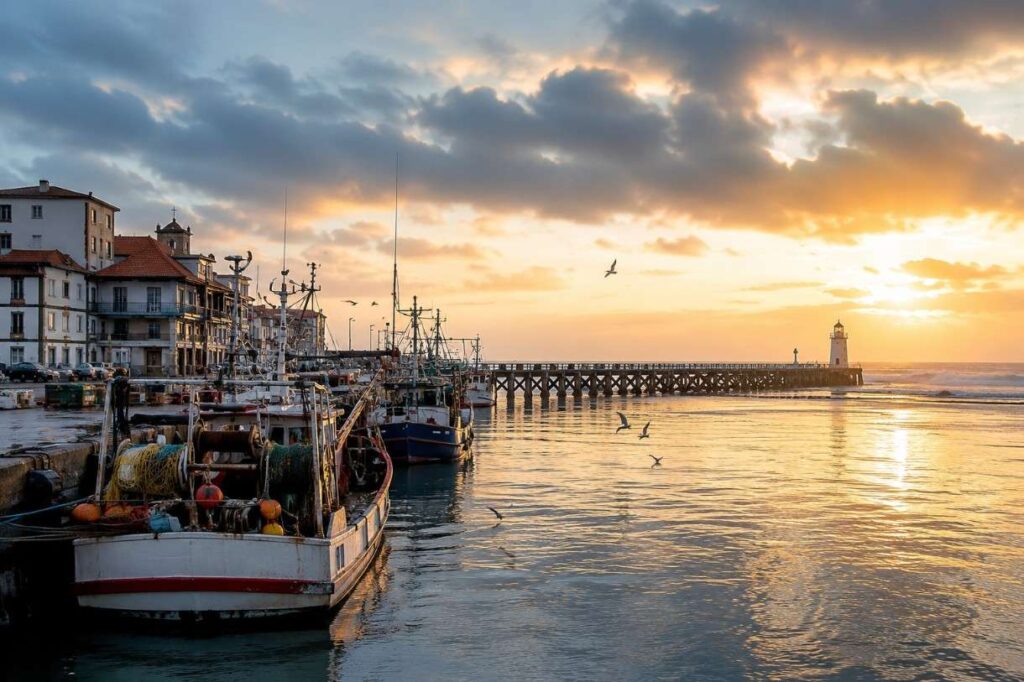
Capbreton feels like a place that never decided to be pretty. And precisely for that reason it lingers in the memory. While many seaside resorts on the French Atlantic coast present themselves polished like polished polished polished – polished down to the last beach bar – this harbor in the south of Les Landes still wears traces of salt, work and wind on its face. Nothing here seems completely smoothed out. Not the facades. Not the voices. Not even the sky.
If you walk through the harbor early in the morning, you quickly notice: Capbreton does not live for visitors alone. The town first functions for those who spend their everyday life here. Fishermen unload crates full of hake, sole or squid. Metal clatters on wet concrete. Seagulls screech like hysterical market vendors. Diesel fumes rise from the boats, mixed with seaweed and cold Atlantic air. The whole thing has little romance and precisely because of that a peculiar dignity.
The coast of Les Landes usually evokes other images. Endless beaches. Dunes. Surfboards on car roofs. Young people with bleach-blond hair and sand between their toes. But Capbreton draws the gaze away from the beach and toward the harbor basin. There the town’s real heart beats.
The last fishing port of Les Landes.
You hear that sentence often. Never loudly. Never exploited for tourism. More like a quiet reminder that another France still exists here. One that works before it poses.
In the early morning the cafés around the harbor open. Men in weatherproof jackets discuss wind directions and catch sizes. Others look silently at the water. Sometimes a glance at the swell is enough for everyone at the table to understand how the day will likely go. Outsiders hardly notice that the Atlantic here functions like a second language.
And what a language it is.
The ocean decides income, mood, and sleep patterns. It determines whether fishermen set out. Whether surfers drive to the beach euphorically. Whether restaurant owners serve fresh fish or have to improvise. Even walkers align their steps with the tides. In Capbreton no one looks at the sea by chance. The gaze has intent.
This is especially clear at the famous Estacade, that long wooden pier that has extended into the Atlantic since the time of Napoleon III. Tourists photograph sunsets in orange and pink there, while locals read the sky at the same time like others read stock market charts. Is wind coming? Is the swell turning? Will the weather change?
Sometimes older men stand there with their arms crossed and stare out at the water for minutes. Not a word. Only sightlines between sky and horizon. As if they were listening to a message the Atlantic sends only to them.
Capbreton has something stubbornly maritime about it. Even the houses seem built against the wind. Basque-Landais villas with red shutters. Modernized fishermen’s houses. Streets where sand is blown from the beach into the doorways. The Atlantic never stays outside. It pushes in everywhere – onto windowsills, into conversations, under the skin.
And of course into the town’s history.
For centuries Capbreton has owed its existence to the sea. The port was once strategically placed for trade and fishing. Today the industry is fighting for survival. Catch quotas, rising diesel prices, depleted stocks and international competition weigh heavily on the small fishing fleet. Many fishermen speak of it without pathos, almost dryly. As if uncertainty has long been part of the job title.
Still they go out.
Maybe that is precisely the soul of this place. No great heroism. No folkloric pose. But a quiet persistence. An “On y va quand même,” as you sometimes hear here – we carry on anyway.
The summer months of course change Capbreton enormously. Cars with surfboards arrive from Paris, Bordeaux or Toulouse. Holiday apartments fill up. The promenade hums like an overheated beehive. Restaurants serve oysters, sea bream and chipirons on closely set terraces. Children lick ice cream that melts faster than it is eaten.
And yet the daily life of the port town never completely disappears behind this holiday backdrop.
Perhaps that is why Capbreton seems more authentic than many other coastal towns. Tourism does not completely overwhelm the town. It merely settles over it seasonally like a thin summer blanket.
What remains interesting is the social change that has now affected almost every attractive coastal region in Europe. Property prices in Capbreton are also rising rapidly. Old houses change hands for sums that sometimes make locals bitterly laugh. New residents are arriving: remote workers with laptops and Atlantic yearnings, retirees from big cities, investors with second homes.
The classic story of displacement is slowly beginning here too.
In the bars at the harbor, nostalgia mixes with concern. Some tell of times when winters were harsher, summers quieter, and fish stocks seemed fuller. Others rant about holiday apartments that remain dark in January like vacant sets. Still others just wave it off. Change is part of life on the coast, they say.
But what does change actually mean here?
Capbreton is indeed changing. But the Atlantic quickly relativizes human plans. A single winter storm is enough for sections of beach to disappear or dunes to collapse. Then the sea shows who really holds the upper hand here.
Coastal erosion now affects almost everyone on the French Atlantic coast. In Capbreton people don’t discuss it abstractly. The changes can be observed directly. Paths disappear. Protective structures appear. The horizon remains the same and yet the sea seems to draw nearer.
Perhaps this is precisely where the place’s particular mentality comes from. A mixture of calmness and constant vigilance. People know: the Atlantic gives a lot. Fish. Beauty. Tourism. Freedom. But it also demands respect.
And sometimes tribute.
Particularly fascinating in this context is the so-called “Gouf de Capbreton.” Off the coast a gigantic submarine canyon opens, dropping abruptly into the depths of the Atlantic. Scientists have been studying this geological phenomenon for decades. For many fishermen, however, the Gouf has less academic and more almost mythical significance.
Some speak of it as an invisible presence beneath the water. A kind of deep breath of the ocean.
That may sound a bit esoteric. But anyone who sits in the harbor in the evening, wind in their hair, salt on their lips and dark water beneath the boats, suddenly understands why such ideas arise. The Atlantic off Capbreton rarely seems harmless. Beautiful, yes. But never tamed.
That is precisely what sets the place apart from many Mediterranean resorts built on comfort and control. In Capbreton a residue of wildness always remains. Windowpanes bear traces of salt. Wind whistles through street corners. After storms, seaweed remnants lie on sidewalks. Nature does not apologize for its presence.
And honestly: hasn’t that become the real longing of many people?
In an era of perfectly curated travel destinations, a harbor like Capbreton appears almost surprisingly genuine. Nothing here seems entirely primped for social networks. Even the beauty has edges. The light can be harsh. The wind is annoying. The Atlantic roars against the breakwater at night. And yet from that very thing this magnetic atmosphere arises.
Perhaps people need places that do not completely adapt to them.
Capbreton is a reminder that coasts were once working spaces and not mere backdrops for sunsets. That the sea is not a wellness product but an element with its own character. A character, by the way, that can be pretty capricious.
The fishermen have long known that anyway.
And the surfers as well. They often sit early in the morning on their boards out beyond the breakers waiting for the right wave. Patience is part of everyday life here. No one argues with the ocean. Either the conditions are right or they are not. This attitude seems to have eventually rubbed off on the whole town.
Capbreton therefore has something pleasantly unexcitable. Despite the summer bustle. Despite the real estate boom. Despite Instagram-worthy sunsets.
The town remains a harbor at its core.
Perhaps that is its greatest strength. While elsewhere maritime identity often serves only as decoration, here it continues to live in the rhythm of the tides. In the conversations. In the smell of the quays. In people’s gaze toward the sky.
Anyone who spends a few days in Capbreton takes away fewer souvenirs than a feeling. The feeling that the Atlantic does not merely form a landscape, but a way of life.
And that places like this are becoming rare.
An article by M. Legrand